Apex Trader Funding Rules for Automated Trading (What's Allowed)

Heads up: some links below are affiliate links. If you sign up through them we may earn a commission at no extra cost to you — it never changes what we recommend.
No — Apex Trader Funding prohibits AI, auto-bots, algorithms, full automation, and high-frequency trading on funded accounts. The rule is written around human traders: you can run a rules-based strategy, but you have to be the one placing every order. Violating it isn't a warning — Apex states the consequence is account closure and forfeiture.
The LPFT Copilot pairs a tested, rules-based method with alerts you can trade by hand where automation isn't allowed, or let it run automatically on Tradovate where it is. Start a 7-day free trial.
Start your 7-day free trialThe short answer: no bots on a funded Apex account
Apex Trader Funding's policy on automation is one of the most direct in the prop-firm industry. On funded accounts, the firm prohibits AI, auto-bots, algorithms, full automation, and high-frequency trading. The rule is built around the idea of a human trader at the controls — not around any particular piece of software.
That means the question isn't “is my bot good enough” or “is my strategy compliant with risk rules.” It's simpler and less forgiving than that: did a person place this order, or did a program place it for them? Apex only wants the first answer.
What Apex actually prohibits
- AI-driven systems that generate or place trades on your behalf.
- Auto-bots of any kind connected to a funded account.
- Algorithms that execute orders without manual input.
- Full automation — a strategy that runs start to finish without a human clicking.
- High-frequency trading (HFT), regardless of how it's implemented.
Apex states that violating this policy results in account closure and forfeiture — on a funded account, that means the payout you were trading toward. Assume it's enforced the first time a violation is found, not after repeated warnings.
What this actually means day-to-day
In practice, “human traders only” draws a line at order placement, not at whether you use a system to decide what to trade. You can build or follow a fully rules-based method — a defined entry, a defined exit, a daily loss limit — as long as you are the one clicking buy or sell every time.
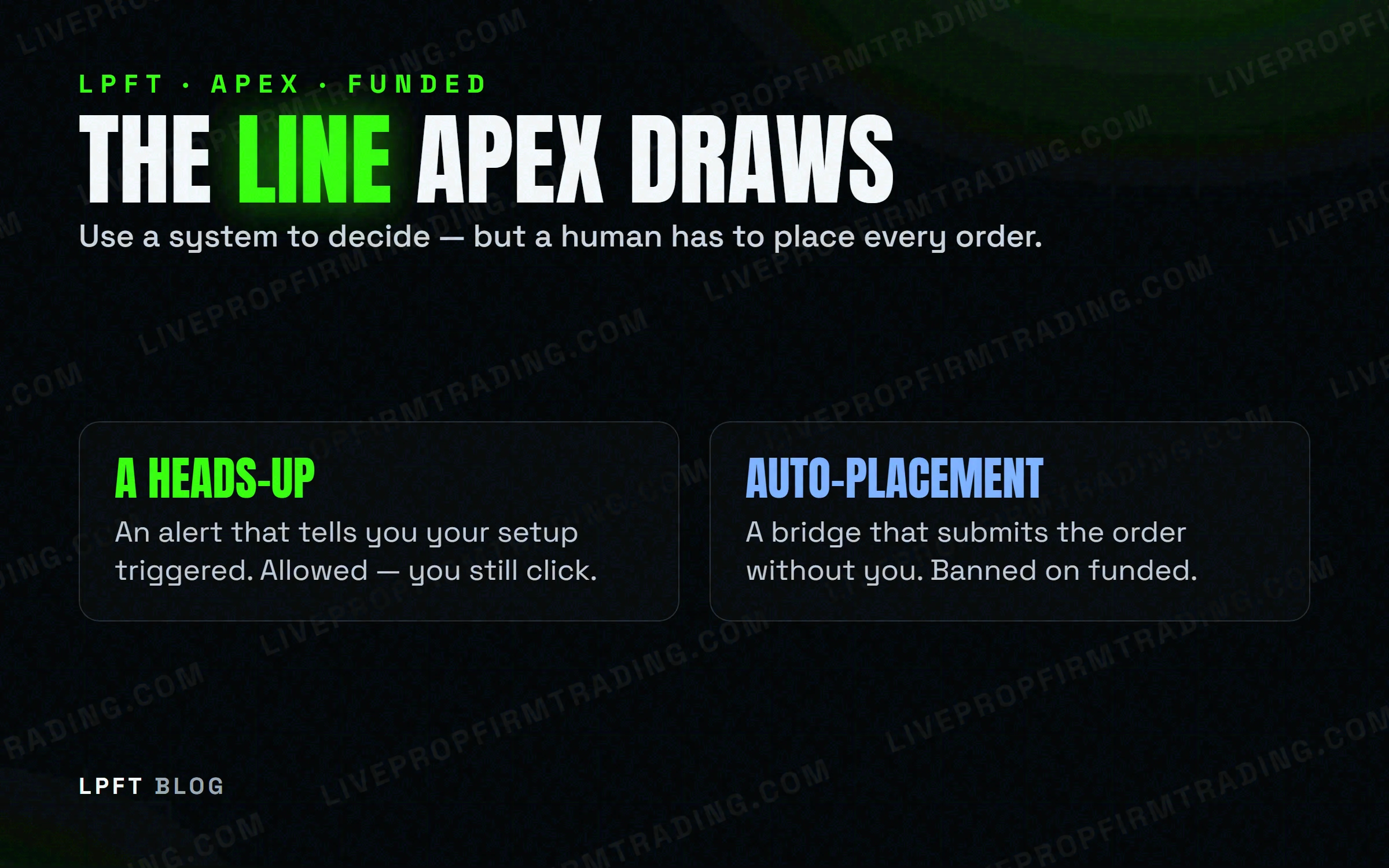
Apex's rule targets automated order placement, not a notification. A TradingView alert that pings you when your setup triggers doesn't place a trade by itself — it just tells you to look. The line Apex draws is between that alert and a bridge that submits the order without you: the first is a heads-up, the second is exactly what's banned.
The policy is stated for funded accounts specifically. If you're still in an evaluation and want to know whether the same restriction applies there, that's worth confirming directly with Apex — it isn't separately spelled out in what we could verify here.
Tradovate is fine. Automating orders on it isn't.
It's worth separating two things that get confused constantly: Apex supports Tradovate as an execution platform, and Apex bans automation on funded accounts. Both are true at once. The broker being available never means the firm's automation policy changed — those are two different questions, and only one of them is about Apex's rules.
LPFT only supports prop-firm connections that run through Tradovate. You can point our tools at a firm's own API key at your own discretion, but not every prop firm supports the Tradovate API — and a guarantee claim requires your full broker statement where applicable. Always check your firm's current rules first.
What a compliant, rules-based discipline looks like instead
None of this means you're stuck trading on gut feel. A rules-based approach still works on a funded Apex account — it just has to end with your own hand on the trigger. That typically looks like:
- A written plan: the exact setup you're watching for, defined before the session starts.
- A defined session window and a daily loss limit you won't override mid-session.
- Alerts that tell you when to look, never orders that fire without you.
- A single, consistent process you run manually every day — the discipline of automation, without the automated order.
The LPFT Copilot runs the whole stack for you on Tradovate — start a 7-day free trial and watch it work.
Start your 7-day free trialIf your firm doesn't allow automation on funded accounts, that's exactly the gap a rules-based manual routine is built to close. For the fuller landscape of which firms take a different stance, see which prop firms actually allow automated trading & bots, and how Topstep's version of “permitted but unsupported” compares in Topstep automated trading: rules, limits & what to know.
Frequently asked questions
No. Apex explicitly prohibits AI, auto-bots, algorithms, full automation, and high-frequency trading on funded accounts — the rule requires a human trader placing every order.
Apex states the violation results in account closure and forfeiture — treat it as an immediate consequence, not a warning you'll get a chance to fix.
Apex's rule targets automated order placement, not notifications. As long as you place every order yourself, an alert that tells you when your setup triggers doesn't cross the line — a bridge that submits the order for you does.
No. Tradovate is a supported execution platform on Apex — the restriction is on automating orders, not on the broker you trade through.
Apex's stated rule names funded accounts specifically. If you want certainty for the evaluation phase, confirm directly with Apex — it isn't something we could separately verify here.
Eli Y.
Eli builds and runs rules-based automated futures systems on TradingView and Tradovate, and helps traders take emotion out of the screen. He writes about futures automation, prop-firm evaluations, and the tools that connect them — plainly, and without hype.
Risk disclosure: Trading futures involves substantial risk of loss and is not suitable for everyone. This article is educational content only and is not financial advice or a recommendation to trade. Past performance is not indicative of future results. Some links are affiliate links.