
Automated Trading & Prop Firm Drawdown Rules: How Not to Blow the Account

Heads up: some links below are affiliate links. If you sign up through them we may earn a commission at no extra cost to you - it never changes what we recommend.
There are two main drawdown mechanics: trailing (max) drawdown, which follows your account's highest-ever balance and never moves back down, and end-of-day (EOD) drawdown, which only recalculates once a day off your closing balance. Mixing them up - or letting a bot ignore either - is how funded accounts get closed without warning. Set a hard daily loss limit in your broker's risk settings, use fixed size, and always confirm your own firm's exact type and number before you connect anything.
The LPFT Copilot trades your own Tradovate account with sizing and session rules already configured. Start a 7-day free trial and watch it work inside your own cushion.
Start your 7-day free trialTrailing drawdown vs. end-of-day drawdown, in plain terms
Every funded futures account has a rule for how much you're allowed to lose before the account is done. Almost every firm builds that rule around one of two mechanics: trailing (max) drawdown or end-of-day (EOD) drawdown. They sound similar. They are not the same rule, and mixing them up is one of the quietest ways a funded account gets closed.
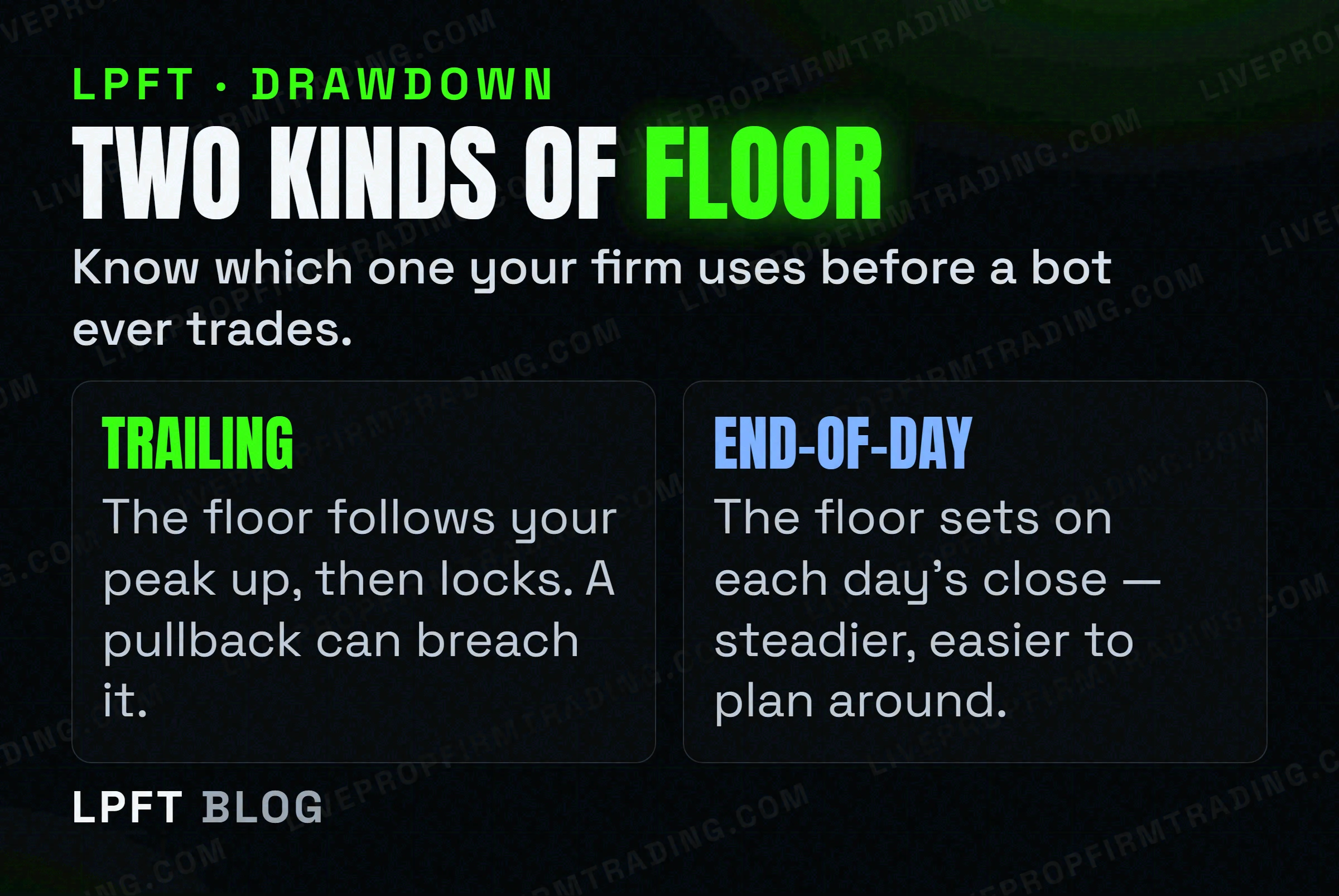
Trailing drawdown follows your account's highest-ever balance, not your starting balance. Every time you set a new peak, the floor moves up with it - and then it stays there. Give some of that profit back and the floor doesn't fall with you; it's already locked in at the old peak.
End-of-day (EOD) drawdown works differently: the floor only moves once a day, based on your balance at the close. Whatever you do intraday - up, down, back up again - doesn't touch the floor until the session ends and a new one is set from wherever you closed.
Trailing tracks your peak, tick by tick. EOD tracks your close, once a day. Same goal - stop you losing too much - completely different math.
A simple worked example: watch the line move
Numbers make this click faster than definitions. Say a funded account starts at $50,000 with a $2,000 drawdown allowance - pick whichever type; here's how each one behaves from the exact same morning.
Trailing: you have a good morning and your balance climbs to $51,000. Your new peak is $51,000, so the trailing floor moves up to $49,000 ($51,000 minus $2,000). Afternoon goes badly and you give back $1,500, landing at $49,500. You're still above the floor - but the floor is $49,000, not the $48,000 you might expect if you assumed it was still tied to your $50,000 starting balance. Touch $49,000 at any point and the account is done, even if your day-end balance sits well above it.
End-of-day: that same good morning to $51,000 changes nothing intraday - the floor was set at yesterday's close and stays put all day, however far you swing. Only when today's session ends does a new floor get calculated from wherever you actually closed. One bad hour in the middle of the day can't touch a floor that isn't moving until the close.
With trailing, the danger is a floor that quietly rose while you were winning. With EOD, the danger is assuming intraday swings are free - they're not free forever, just free until the close.
Why traders breach a rule they never saw moving
Almost nobody blows a funded account on purpose. Most breaches happen because the trader's mental model of the drawdown line is one version behind reality.
- Assuming the floor is fixed to the starting balance. On a trailing rule, the floor moves with every new peak - a profitable week can quietly raise it much closer to your current balance than you think.
- Forgetting open (unrealized) losses count too. Many firms measure drawdown against your live equity, including a trade that's still open and underwater - not just what you've already closed and booked.
- Treating EOD like trailing, or vice versa. Assume the wrong type and you'll either take intraday risk you don't actually have room for, or hold onto caution you didn't need.
The fix isn't cleverness - it's checking. Your firm states its drawdown type and dollar figure somewhere in your account rules or dashboard. Read it once, know exactly which line you're trading against, and revisit it every time your account size changes.
Configuring automation so a bot can't cross the line
A bot doesn't get nervous near a drawdown floor - it just keeps following its rules, which is exactly why the guardrails have to live outside the strategy itself, not inside it.
- Set a hard daily loss limit in your broker's risk settings. Tradovate lets you configure a daily loss limit at the account level - set it tighter than your firm's actual drawdown number, so trading halts with room to spare instead of right at the edge.
- Use fixed position sizing. A bot that increases size after a loss, trying to win it back, can turn one bad stretch into a floor-breaching one. Fixed size keeps every trade's worst case the same, predictable number.
- Add a stop-after-loss rule. Configure the bot or platform to pause itself for the rest of the session or day once a set loss is hit, instead of continuing to trade through a losing streak.
Slippage, spread, and a fill landing a tick worse than expected all eat into your buffer. Set your own limit meaningfully inside the firm's real number - not equal to it.
Tradeify supports Tradovate as a broker. Always verify a firm's current automation policy yourself before connecting anything.
Check Tradeify →Always confirm your own firm's exact rule first
Everything above is the general mechanic - the actual dollar figures, whether open positions count, and even which drawdown type applies can differ by firm and sometimes by account size. Before you connect any bot to a funded account, read your firm's own rules and confirm the type and number for your specific account.
LPFT only supports prop-firm connections that run through Tradovate. You can point our tools at a firm's own API key at your own discretion, but a guarantee claim requires your full broker statement where applicable - not every prop firm supports the Tradovate API, so always check yours first. If you're wondering whether bots are even allowed on your account in the first place, we cover that in running a bot on a prop firm account, and what happens once the account changes after a breach in what happens to your bot during a payout or reset.
Frequently asked questions
Trailing drawdown moves up with your highest-ever account balance and never resets down; EOD drawdown recalculates once a day off your closing balance, so it only steps once every 24 hours instead of following every tick.
No. Once it rises with a new peak balance it stays there. It doesn't retreat just because you gave some profit back - the floor only tracks the peak, never the pullback.
At many firms, yes - an open losing trade can push you toward the floor before you've even closed it. Check whether your firm calculates drawdown on realized results only or on live equity including open positions.
Set a hard daily loss limit in Tradovate's risk settings below your firm's actual number, use fixed position sizing, and add a stop-after-loss rule so the bot pauses itself instead of trading through a bad streak.
In your funded account's rules or dashboard - it varies by firm and even by account size, so always confirm your own before you connect any automation to it.
Eli Y.
Eli builds and runs rules-based automated futures systems on TradingView and Tradovate, and helps traders take emotion out of the screen. He writes about futures automation, prop-firm evaluations, and the tools that connect them - plainly, and without hype.
Risk disclosure: Trading futures involves substantial risk of loss and is not suitable for everyone. This article is educational content only and is not financial advice or a recommendation to trade. Past performance is not indicative of future results. Some links are affiliate links.