Are Trading Bots Legal? Yes, and Here's the Nuance

Heads up: some links below are affiliate links. If you sign up through them we may earn a commission at no extra cost to you - it never changes what we recommend.
Yes. Using a trading bot on your own futures account is legal in the United States, and automated trading is a normal, recognised part of the market. What the law prohibits is specific conduct, chiefly market manipulation and spoofing, and those are just as illegal done by hand. The thing that actually stops most traders is not a statute at all. It is the contract with their broker or prop firm, which can forbid automation even though nothing about it is unlawful.
The LPFT Copilot runs a tested, rules-based method on your own Tradovate account, with the risk limits built in. Start a 7-day free trial and see how it behaves.
Start your 7-day free trialThe question is really four questions
Almost every page that answers "are trading bots legal" gives one answer to what is actually four separate questions with four different answers. Separating them is most of the work, and once they are separated the whole topic stops being murky.
- Is automated trading itself lawful? Yes, for retail participants in US futures markets.
- What conduct is illegal no matter who or what does it? Manipulation and disruptive practices, with spoofing named explicitly in statute.
- What does your broker allow? A commercial question, answered in their terms, not in law.
- What does your prop firm allow? The same, and in practice the one that catches people out.
Numbers one and two are law. Numbers three and four are contract. Confusing the two is why so much writing on this is vague, and why traders end up believing either that bots are some grey-area risk or that anything goes because it is "just software".
Automated trading is recognised, not merely tolerated
Regulators do not treat algorithmic trading as an exotic edge case. They define it. In its rulemaking on automated trading, the CFTC framed algorithmic trading as trading where one or more computer algorithms or systems determines whether to initiate, modify or cancel an order. That is a definition written to regulate an accepted activity, not to outlaw one.
The same is true in Europe, where MiFID II defines algorithmic trading as a computer algorithm determining order parameters with limited or no human intervention, and treats high-frequency technique as a subset with additional authorisation requirements. Again, a framework for something permitted.
Nobody is going to prosecute you for letting software click the button. The law is interested in what the orders do to the market, not in whose finger sent them.
What is genuinely illegal, and it has nothing to do with automation
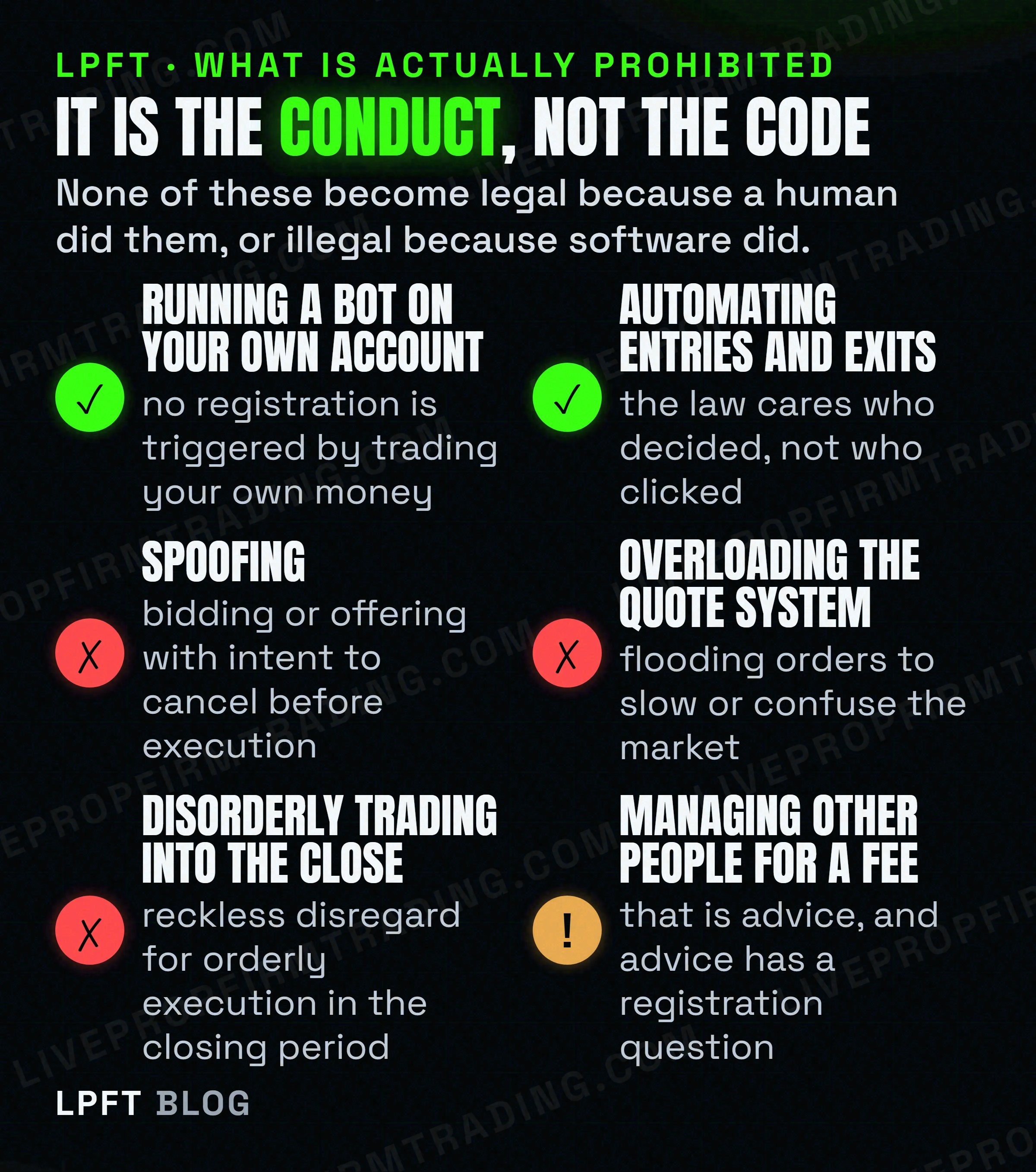
The Dodd-Frank Act added a disruptive practices provision to the Commodity Exchange Act, and it is short enough to be worth knowing. It makes it unlawful to engage in trading, practice or conduct on a registered entity that violates bids or offers, that demonstrates intentional or reckless disregard for the orderly execution of transactions during the closing period, or that is commonly known as spoofing.
Spoofing is defined right there in the statute as bidding or offering with the intent to cancel the bid or offer before execution. The CFTC has described the kinds of behaviour that fall under it, including submitting or cancelling orders to overload a quotation system, to delay someone else getting filled, or to create a false appearance of interest in the book.
Two things follow. First, intent matters. The Commission has said a spoofing violation requires some degree of intent beyond recklessness, so an order genuinely meant to be filled that happens to get cancelled is not spoofing. Second, and this is the point most articles miss, none of these prohibitions mention software. A human placing and pulling orders to paint a false picture is doing exactly the same prohibited thing.
Automation does not change what is prohibited. It changes how fast you can do it thousands of times. A logic error that cancels aggressively can produce a pattern that looks like manipulation, which is a good reason to know what your order flow actually looks like.
The registration question, and why it almost never applies to you
This is the genuinely useful part that hardly anyone covers, because it is where a legal question does eventually appear. It has nothing to do with running a bot and everything to do with who benefits from it.
The NFA defines a commodity trading advisor as an individual or organisation that, for compensation or profit, advises others, directly or indirectly, as to the value of or the advisability of trading futures contracts, options on futures, retail off-exchange forex or swaps. Read the words "advises others" and "for compensation or profit" carefully, because they are what the whole thing hinges on.
- Trading your own account with a bot. You are advising nobody and being paid by nobody. There is no advisory relationship, so the definition does not reach you.
- Letting a friend use your rules for free. Still no compensation, though "for profit" is doing quiet work in that sentence and the arrangement matters.
- Selling signals, managing accounts, or charging for tailored advice. Now you are in the definition, and the question of registration or an exemption is live.
There are exemptions, and the CFTC sets them out in its regulations. They include advising fifteen or fewer people in the past twelve months while not holding yourself out to the public as a trading advisor, advice that is solely incidental to another registered business, and advice that is not based on or tailored to a particular customer account.
We are traders and builders, not lawyers, and the summary above is here so you know which questions exist. If you are about to take money to trade for someone or sell a system, that is the moment to ask a securities or futures lawyer in your own jurisdiction, not a blog.
Legal and permitted are not the same word
Here is the distinction that actually decides what happens to you. A bot can be entirely lawful and still breach the agreement you signed. The consequence of breaking a law is a regulator. The consequence of breaking a contract is that your account is closed and your balance is gone, and the second one is vastly more common.
Futures prop firms vary widely here and the rules move. Some permit self-built automated strategies through their supported platforms while banning purchased or shared bots. Some cap how many trades a day an automated strategy may take. Some require that a human is monitoring rather than leaving it entirely hands off. And some prohibit automation on funded accounts outright while allowing it during an evaluation, or the reverse.
None of that is a legal question. It is a term of service, it is theirs to set, and the only way to know it is to read the current version on their own site. We keep a sourced summary in which prop firms allow automated trading, and go deeper on the funded-account case in can you run a trading bot on a prop firm account.
The LPFT Copilot runs the whole stack for you on Tradovate - start a 7-day free trial and watch it work.
Start your 7-day free trialA short checklist before you switch anything on
- Read your prop firm rules today, not the version you remember. These pages change without announcement, and the one that matters is the one live right now.
- Check whether the restriction is on the evaluation or the funded account. Firms frequently treat the two phases differently, and assuming they match is a common way to lose a funded account.
- Find out if "your own strategy" is a condition. Several firms permit automation only if the system is yours and not purchased or shared.
- Look for trade-count and holding-time limits. A cap on trades per day, or a minimum hold time, can rule out a strategy that is otherwise entirely allowed.
- Know what your order flow looks like. If your system cancels far more than it fills, understand why before someone else asks you to explain it.
Do those five and you have covered both halves of the question. The legal half was never the risky one.
Frequently asked questions
Yes. Running an automated strategy on your own futures account is legal in the United States, and regulators define algorithmic trading as a recognised activity rather than a prohibited one. What is illegal is specific conduct such as spoofing and market manipulation, which is equally illegal when done by hand.
The statute defines spoofing as bidding or offering with the intent to cancel before execution, and the CFTC has said a violation requires intent beyond recklessness. An order genuinely meant to fill that gets cancelled is not spoofing. That said, you should understand why your system cancels orders, because a pattern is easier to explain if you already know what causes it.
Not to trade your own money. A commodity trading advisor is defined as someone who, for compensation or profit, advises others about trading futures. Trading your own account involves advising nobody. The question becomes live if you start charging for signals, selling a system or managing other people's accounts.
Yes, and this is the distinction that matters most. Legality is set by law and permission is set by the contract you signed. A firm can prohibit automation entirely, and breaching that costs you the account and the balance rather than bringing any legal consequence.
Automated trading is broadly lawful in major markets. In the European Union, MiFID II defines algorithmic trading as an algorithm determining order parameters with limited or no human intervention and treats high-frequency technique as a subset with extra requirements. Rules differ by country, so check your own jurisdiction rather than assuming.
Selling software is not the same as advising, but the line can blur quickly once you tailor advice, take a share of profits or manage accounts. That is the point at which the trading advisor definition and its exemptions become relevant, and it is a question for a lawyer in your jurisdiction rather than an article.
Eli Y.
Eli builds and runs rules-based automated futures systems on TradingView and Tradovate, and helps traders take emotion out of the screen. He writes about futures automation, prop-firm evaluations, and the tools that connect them - plainly, and without hype.
Risk disclosure: Trading futures involves substantial risk of loss and is not suitable for everyone. This article is educational content only and is not financial advice or a recommendation to trade. Past performance is not indicative of future results. Some links are affiliate links.