What Is a Futures Trading Bot (and What It Isn't)

Heads up: some links below are affiliate links. If you sign up through them we may earn a commission at no extra cost to you - it never changes what we recommend.
A futures trading bot is software that watches market data, applies a fixed set of rules to decide when to buy or sell a futures contract, and sends that order to a broker account without a person clicking buy or sell. It is not an indicator, not a signal service and not a chart alert. The distinguishing feature is that it places the order itself. If a human still has to press the button, it is not a bot.
The LPFT Copilot is the execution and risk layer on a tested rule set, running on your own Tradovate account. Start a 7-day free trial and watch each stage do its job.
Start your 7-day free trialThe definition, and the one word that carries it
Strip away the marketing and a futures trading bot is a program that does three things in a loop: it reads market data, it checks that data against rules it was given, and when the rules are met it places an order. The whole definition turns on that last verb. Software that analyses, suggests, alerts or highlights is doing something genuinely useful, but it is not a bot. Placing the order is the line.
This matters because the word gets stretched to cover almost anything with a chart on it. Search for "futures trading bot" and most of what comes back is about crypto exchanges, where perpetual contracts are casually called futures and a "bot" usually means a grid that buys and sells at fixed intervals on that exchange. That is a real product, and it has almost nothing to do with automating a strategy on a CME contract through a futures broker.
If you still have to click something for a position to open, you have a tool. If the position can open while you are asleep, you have a bot.
The four layers every automated system has
Almost every explanation of trading bots jumps from "the algorithm decides" straight to "the trade executes", which skips the part where most of the interesting engineering and all of the risk control actually lives. Pull any automated system apart and you find four distinct layers. You have all four whether you automated them or not. The only question is which ones a human is still doing by hand.
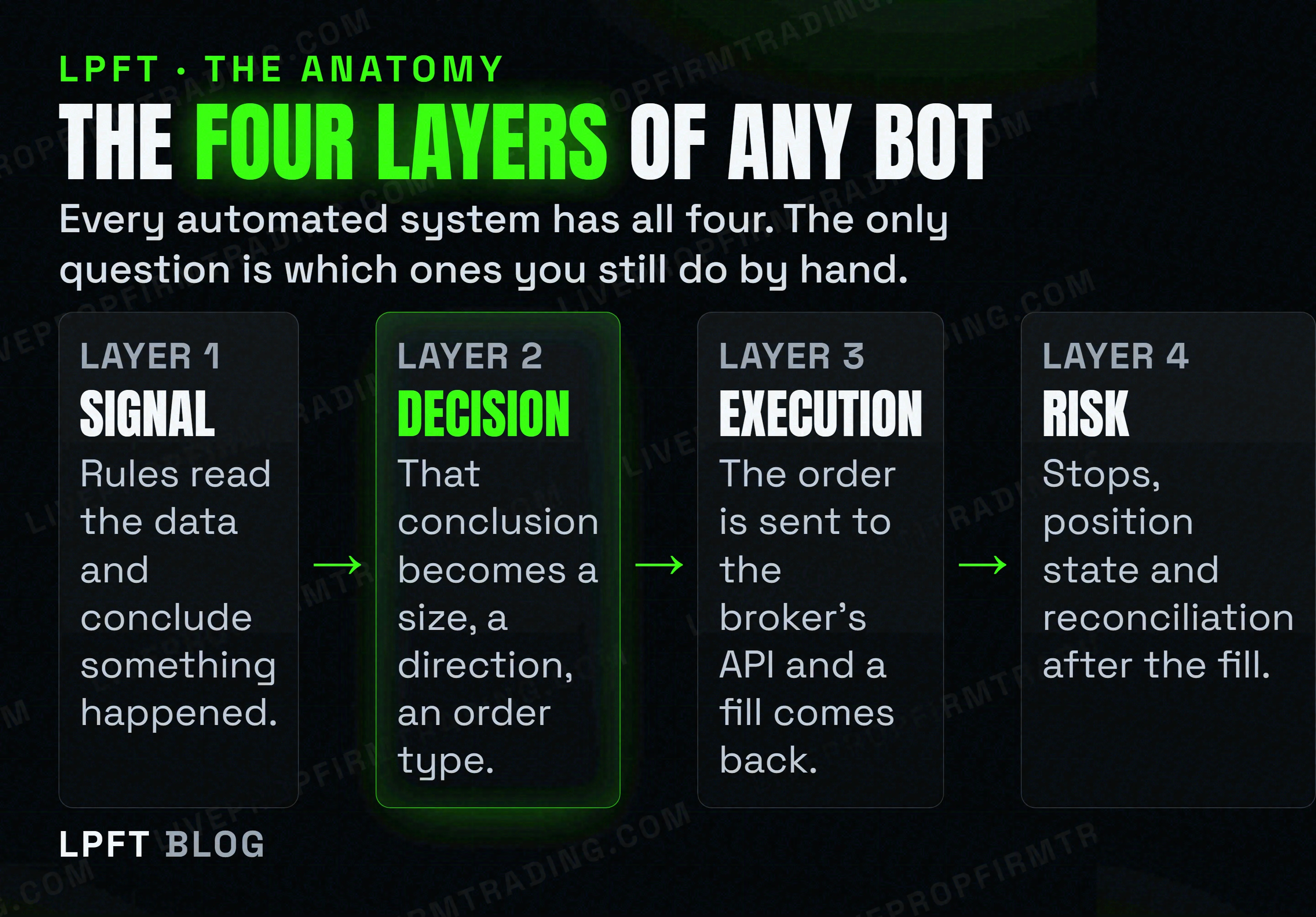
- The signal layer looks at price and concludes that something worth acting on just happened. A Pine Script condition, a moving average cross, a pattern rule. This layer only observes. TradingView says so in its own documentation: scripts containing alert triggers do not create alerts on their own, and alerts notify rather than execute.
- The decision layer turns "something happened" into an actual order specification. Which instrument, which direction, how many contracts, what order type, how long it stays live. This is where position sizing and exposure limits are genuinely enforced, and it is the layer nearly every article erases.
- The execution layer is the part that talks to the broker. It authenticates, calls the order endpoint, and handles what comes back, which might be a fill, a partial fill or a rejection. This layer has to be running somewhere continuously, and that requirement is the entire reason hosted execution exists as a product category.
- The risk layer owns everything after the fill. Where the stop sits, what the position actually is, and whether the account agrees with what the strategy thinks it holds. When an automated system fails badly, it is usually this layer that was missing rather than the signal being wrong.
Read that list again with your own setup in mind. A trader watching a chart and entering by hand is doing layers two, three and four personally. Someone running alerts into a broker has automated one and three but often has no real layer four at all, which is exactly how a small losing day becomes a large one.
How the order actually reaches the market
The chain is less mysterious than it sounds, and seeing it named removes most of the magic. Using a broker API as the concrete example, placing an automated order means authenticating to get a token, looking up which account to trade, and then posting the order itself with the instrument, direction, quantity, order type and time in force. The exchange matching engine answers with a fill or a rejection, and the risk layer updates from there.
Two details are worth holding on to. The first is that your account password is used once, at the authentication step, to obtain a token, and is not attached to each order. The second is that a rejection is a normal outcome, not an exception. A system that assumes every order fills is a system that will one day think it has a position it does not have.
For a retail futures trader the issue is uptime, not microseconds. If the machine holding your risk layer sleeps, loses power or drops its connection mid-trade, nothing is managing that stop. That, and not raw speed, is why hosted execution exists for this audience.
What it is not: the taxonomy nobody publishes
Most of the confusion in this category is one question wearing six costumes: who decides, and who executes? Answer those two and every product sorts itself out.
| What it is | Who decides | Who places the order |
|---|---|---|
| Indicator | You, reading the chart | You, by hand |
| Signal service | Their analyst or algorithm | You, by hand |
| Chart alert | Your rule, on their platform | Nobody. It only notifies. |
| Copy trading | Another trader, live | The platform, mirroring them |
| EA on MetaTrader | Code you or a vendor wrote | The EA, while your terminal is open |
| Trading bot | Rules you configured | The bot, through a broker API |
| Hosted execution service | A pre-built tested rule set | The service, on your own account |
A few of these deserve a sentence each, because the differences are practical rather than academic. An indicator never places an order, ever, no matter how good it looks. A signal service moves the decision to somebody else but leaves you as the execution layer, which means your results depend on how fast you read your phone. Copy trading hands both decision and execution to another trader, so you inherit their judgment including the bad days.
An Expert Advisor on MetaTrader is genuinely a bot, with one structural catch: it only acts while the terminal it lives in is running and connected. Close the laptop and the automation stops, mid-position if that is where you were. A hosted service removes that dependency by running the execution layer somewhere that does not sleep, calling the broker on your own account rather than needing your machine to be awake.
And a chart alert on its own is the one that catches people out most often, because it feels like automation. It is not. We went through exactly what an alert can and cannot do in can you automate trading on TradingView.
The LPFT Copilot runs the whole stack for you on Tradovate - start a 7-day free trial and watch it work.
Start your 7-day free trialBot, algo, automated system: do the words mean different things?
In everyday use, no. "Trading bot", "algo" and "automated trading system" all point at the same thing for a retail futures trader, and anyone insisting on a hard distinction is usually selling one of them. The words do separate in a regulatory context though, and that is worth knowing.
The CFTC, in its rulemaking on automated trading, framed algorithmic trading as trading where one or more computer algorithms or systems determines whether to initiate, modify or cancel an order. Notice that this definition is about who or what decides, which is the same line this article drew in the first paragraph. Exchanges care about the distinction too, and orders reaching the market are flagged according to whether they were entered by a person or generated automatically.
The practical upshot for you is that "is this a bot" is not a marketing question. It is a question with consequences, because the answer determines which of your broker and prop firm rules apply to what you are doing.
Does a bot need to be complicated?
No, and the assumption that it does is why a lot of people never start. A bot that enters on one condition, exits at a fixed target or stop, stops trading after a set loss, and does nothing else, is a complete automated system. It has all four layers. It is also far easier to debug than something with nine parameters, and far easier to tell whether it is working.
Complexity is not the same as sophistication. Most retail systems that fail do not fail from being too simple. They fail because the risk layer was an afterthought, or because the rules were tuned until they fit the past. If you are choosing between adding a condition and adding a hard daily loss limit, the loss limit wins every time.
For the mechanical walk-through of how the pieces connect end to end, read how do trading bots work.
Frequently asked questions
Software that watches market data, applies a fixed set of rules to decide when to buy or sell a futures contract, and sends that order to a broker account without a person clicking buy or sell. The defining feature is that it places the order itself rather than telling you to.
No. An alert notifies, it does not execute. TradingView documents alerts as a notification mechanism, and a webhook alert sends an HTTP request to a URL you provide. Something on the other end still has to turn that message into an order before any trade happens.
A signal service decides and then tells you, leaving you as the execution layer with a phone in your hand. A bot decides and then places the order itself. That difference decides whether your results depend on how quickly you can react.
Structurally yes, with one catch. An EA runs inside a MetaTrader terminal, so it only acts while that terminal is open and connected. Close the platform and the automation stops, potentially with a position still open. A hosted service runs the execution layer somewhere that does not depend on your machine being awake.
They have to run somewhere continuously, and that can be your own machine, a hosted server or a service that runs it for you. For a retail futures trader the concern is uptime rather than speed. If the machine managing your stop goes to sleep mid-trade, nothing is managing your risk.
No, despite ranking for the same searches. Crypto "futures" usually means perpetual contracts on an exchange, and those bots typically run a grid inside that exchange. Automating a strategy on a CME contract means placing orders through a regulated futures broker, which is a different stack entirely.
Eli Y.
Eli builds and runs rules-based automated futures systems on TradingView and Tradovate, and helps traders take emotion out of the screen. He writes about futures automation, prop-firm evaluations, and the tools that connect them - plainly, and without hype.
Risk disclosure: Trading futures involves substantial risk of loss and is not suitable for everyone. This article is educational content only and is not financial advice or a recommendation to trade. Past performance is not indicative of future results. Some links are affiliate links.