Automated Futures Trading for Beginners: How to Start Safely

Heads up: some links below are affiliate links. If you sign up through them we may earn a commission at no extra cost to you - it never changes what we recommend.
Automated futures trading means running a written rule set on a futures account so the orders are placed by software instead of by hand. A beginner starts safely by picking one route in, trading a single micro contract, and setting a daily loss limit before the first trade. The two routes are your own funded broker account or a prop firm evaluation, and which one fits depends on how much risk capital you have rather than on which sounds better.
The LPFT Copilot runs a tested, rules-based method on your own Tradovate account, with the daily loss limit already in it. Start a 7-day free trial and watch it work.
Start your 7-day free trialFirst decide which of two routes you are on
Almost every beginner guide skips this and starts at "choose a strategy". That is the wrong first move, because the route you take changes the broker, the cost, the rules you trade under and how much of your own money is at risk. There are only two routes and the answer is usually obvious once the question is asked properly.
- Your own funded broker account. You open a futures account, fund it, and trade your own money. Nobody can close you for breaking a consistency rule, you keep everything you make, and every dollar lost is yours. This is the simpler path and the more expensive mistake.
- A prop firm evaluation. You pay a fee to trade a simulated account against a target and a drawdown limit. Pass, and you trade the firm capital under their rules for a share of the profit. Your downside is the fee rather than the account, and in exchange you accept rules that can end you for reasons that have nothing to do with losing money.
If losing your starting capital would genuinely hurt, take the evaluation route, because the fee caps your downside. If you can fund an account and treat the balance as tuition, your own account teaches faster and has fewer rules to trip over.
One warning on the second route before you spend anything. Prop firms differ sharply on whether automation is allowed at all, and the rules change. Read which prop firms allow automated trading before you buy an evaluation, not after.
What you actually need, and what you are being sold
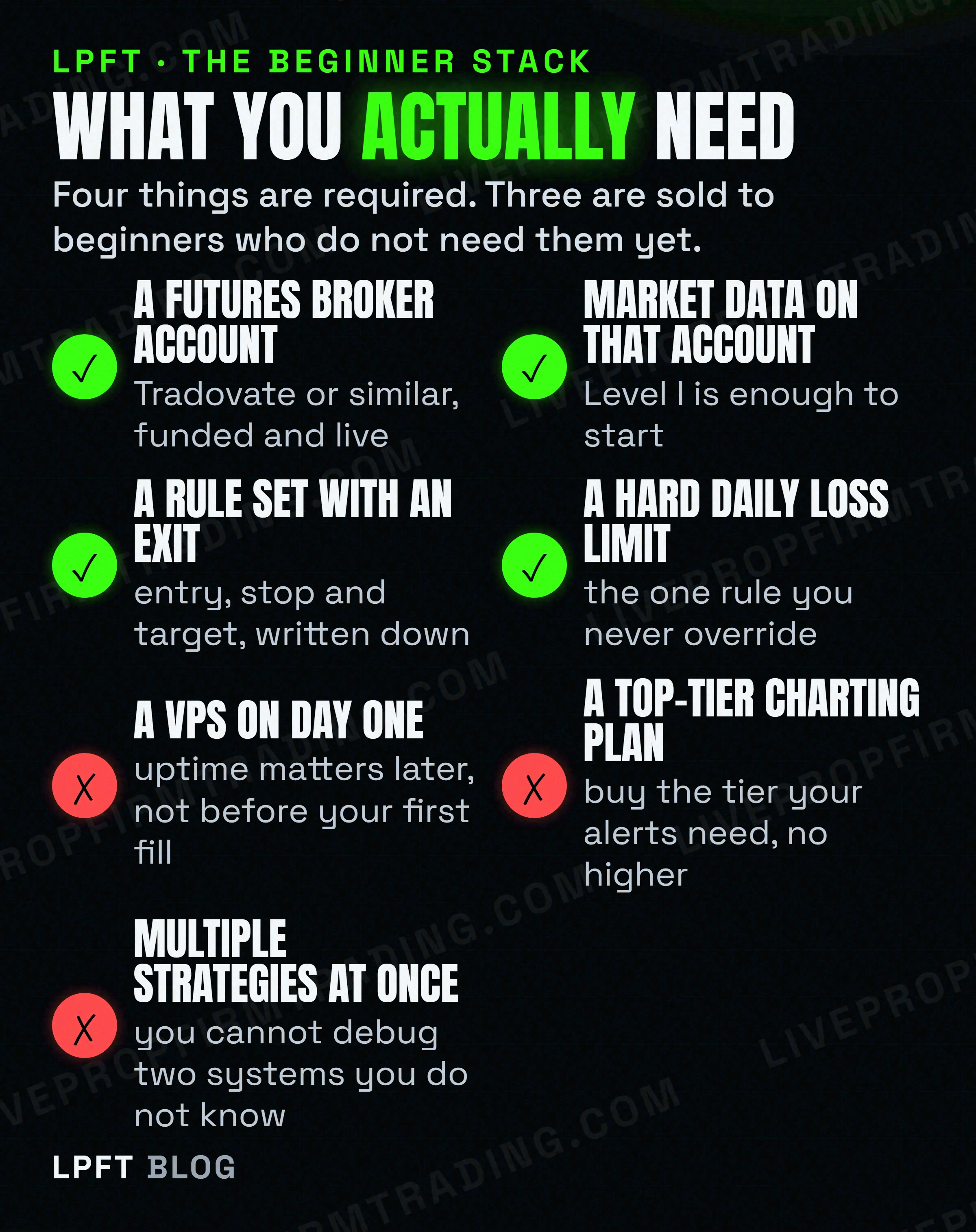
The required list is short. A live futures account with market data on it, a rule set that includes an exit, and a daily loss limit you decide in advance and never move. That is the whole minimum. Everything else is optimisation, and optimising something that does not work yet is just a way to spend money.
The three items on the "not yet" list are worth naming because all three get sold hard to beginners. A hosted server matters when you have something worth keeping alive, not before your first live fill. A premium charting plan is worth exactly what your alert count requires and no more. And running two strategies at once means that when something goes wrong you cannot tell which one did it.
What it costs in month one, added up
No beginner guide adds this up, so here it is with the sources. Commission figures come from Tradovate's pricing page, read in September 2026. Exchange, clearing and NFA fees are charged on top and are not itemised there, so pull them from your own statement rather than from anyone quoting a number at you.
| Month one | Own account | Evaluation route |
|---|---|---|
| Broker plan | $0 on the free tier | $0, the firm provides it |
| Commission, per micro round turn | $0.78 free tier, $0.58 on $99/mo | set by the firm |
| Market data | Level I included once funded | included |
| Charting and alerts | only if your setup needs webhooks | same |
| Evaluation fee | none | the main cost, plus any reset |
| The real number | your risk capital | the fee you can lose |
Beginners budget carefully for the stack and then size positions with no budget at all. The subscriptions are tens of dollars. The account is the number that actually decides whether you are still trading in six months.
One specific trap on the charting side. A TradingView alert can notify you, but it cannot place an order by itself, and the webhook feature that lets it reach a broker is not on the free plan and requires two-factor authentication to be switched on. If your plan depends on webhooks, that is a paid tier, and it is better to know that now than halfway through a setup. We covered the mechanism in TradingView webhooks explained.
Start with one micro contract, and here is the arithmetic why
Micro contracts exist so the smallest position you can take is genuinely small. On the Micro E-mini S&P 500, CME Group prices the contract at $5 times the index with a 0.25 point minimum move, so one tick is $1.25. On the Micro E-mini Nasdaq-100 it is $2 times the index, and one tick is $0.50.
Put that to work. A stop placed 20 ticks away on one MES contract risks $25. The same stop on four contracts risks $100, and on the full-size E-mini it is far more. Nothing about the strategy changed. Only the number that shows up on a bad day changed, and the bad day is the one that decides whether you keep going.
So the rule for month one is one contract, full stop. Not because one contract is profitable, but because one contract is survivable while you are still finding out what your system actually does when the market is not cooperating.
Paper trading lies to you about exactly one thing
Demo accounts are genuinely useful and you should use one. They will tell you honestly whether your automation is wired correctly, whether the orders come out the right size and direction, and whether your exit logic fires. Those are real questions and a simulator answers them well.
What a simulator cannot tell you is what price you would actually have got. It fills you at a price on a chart. A live order fills against a real order book that may have moved, and the gap between those two is slippage. It is small on a quiet morning and unpleasant on a news spike, and it is the single most common reason a strategy that looked fine in testing turns out not to be.
Use the simulator to prove the plumbing works, then move to one live micro contract as soon as it does. A week of real fills teaches you more about your system than a month of perfect imaginary ones.
If you want the fuller version of why tested results and live results diverge, we went through the mechanisms in are futures trading bots profitable.
The order to do it in
- Pick the route. Own account or evaluation, decided by the capital you can genuinely afford to lose rather than by which sounds more professional.
- Open the account and get data flowing. Before any strategy work. If you cannot see a live chart and place a manual order, automation has nothing to stand on.
- Write the rules down, including the exit. A rule set without an exit is not a strategy. If you cannot state the stop in one sentence, it does not exist yet.
- Set the daily loss limit first. Decide the number before you have an opinion about the market, because after the first losing trade you will have one.
- Wire it in the simulator and prove the plumbing. Correct size, correct direction, exits firing, no duplicate orders.
- Go live on one micro contract. Compare the fills you get to the fills you expected. That comparison is the real test.
- Change one thing at a time. Size, or rules, or instrument. Never two, or you will never know which one moved the result.
That order is deliberate. Every step is cheap to undo except the one where you go live at size, and putting the loss limit before the first trade is what keeps a bad week from becoming the end of it.
The LPFT Copilot runs the whole stack for you on Tradovate - start a 7-day free trial and watch it work.
Start your 7-day free trialThe mistakes that actually end beginner accounts
- Moving the stop. Automation exists to stop you doing this. Overriding it by hand is undoing the only thing you bought.
- Scaling up after a good week. A good week is not evidence. A few hundred trades is evidence, and even then it is weak evidence.
- Running it unattended before it has earned that. Watch it for the first stretch. You are not looking at profit, you are looking for behaviour you did not expect.
- Ignoring the account rules. On an evaluation you can be profitable and still fail on a drawdown or consistency rule. See drawdown rules and consistency rules.
None of these are exotic. They are all the same mistake wearing different clothes: acting on a small sample. The whole reason to automate is that a machine does not get impatient, and the whole reason beginners still fail is that the person watching it does.
Frequently asked questions
Pick your route first, either your own funded futures account or a prop firm evaluation, then open the account and get live data before doing any strategy work. Write down rules that include an exit, set a daily loss limit, prove the wiring in a simulator, and go live on a single micro contract.
The platform costs are small. On a free broker tier a micro round turn is well under a dollar in commission, with exchange and NFA fees on top. The number that matters is risk capital, because that is what a losing stretch actually consumes. On the evaluation route your capped downside is the evaluation fee instead.
A micro. The Micro E-mini S&P 500 is $5 times the index with a 0.25 point tick, so one tick is $1.25 and a 20 tick stop risks $25 on one contract. The Micro E-mini Nasdaq-100 is $2 times the index at $0.50 a tick. Sizing this small keeps a bad day survivable while you learn.
Not on day one. A hosted server matters when you have a working system you need to keep alive through a laptop sleeping or an internet drop. Before your first live fill it solves a problem you do not have yet, and spending on it early is a common beginner upsell.
Not by itself. A TradingView alert notifies, it does not execute. Reaching a broker requires a webhook alert, which is not available on the free plan and requires two-factor authentication to be enabled, plus something on the other end that turns the message into an order.
It is enough to prove your automation is wired correctly, and that is worth doing. It cannot tell you what price you would really have been filled at, because a simulator does not model a live order book. Move to one micro contract as soon as the plumbing is proven.
Eli Y.
Eli builds and runs rules-based automated futures systems on TradingView and Tradovate, and helps traders take emotion out of the screen. He writes about futures automation, prop-firm evaluations, and the tools that connect them - plainly, and without hype.
Risk disclosure: Trading futures involves substantial risk of loss and is not suitable for everyone. This article is educational content only and is not financial advice or a recommendation to trade. Past performance is not indicative of future results. Some links are affiliate links.