
Are Futures Trading Bots Profitable? What the Data Really Says

Heads up: some links below are affiliate links. If you sign up through them we may earn a commission at no extra cost to you - it never changes what we recommend.
Futures trading bots are not profitable or unprofitable in themselves. A bot only executes the rules it is given, so it earns money only when those rules produce an edge bigger than the cost of trading them. On a Micro E-mini S&P 500 contract, that cost is roughly one and a half ticks per round turn once commissions, exchange fees and a realistic slippage allowance are counted. Any strategy that cannot clear that bar every trade is losing money no matter how good the backtest looked.
The LPFT Copilot runs a tested, rules-based method on your own Tradovate account, with the daily loss limit built in. Start a 7-day free trial and watch it trade.
Start your 7-day free trialWhy "is it profitable" is the wrong first question
Ask whether futures trading bots are profitable and you will get two kinds of answer. Vendors say yes and show you an equity curve. Sceptics say no and point at the wreckage. Both are answering a question that cannot be answered, because a bot is not a strategy. It is a machine for executing one.
The useful question is narrower and much easier to check: what does this particular set of rules have to earn per trade before it earns anything at all? That number is knowable. You can work it out in about five minutes with a pricing page and a calculator, and almost nobody writing about trading bots ever does it. So let us do it.
Automation does not create an edge. It executes one, cheaply and without flinching. If the rules have no edge, automation just finds the losses faster.
What actually happens to people who trade this way
Before the arithmetic, some context on the base rate. This is not bot-specific data, because nobody publishes audited bot-specific data. It is something better: regulator and academic research on what happens to active retail traders as a population.
- Brazilian futures day traders. A study of everyone who began day trading index futures on the Brazilian exchange between 2013 and 2015 and persisted for at least 300 days found that 97% lost money. Only 0.4% earned more than a bank teller. Chague, De-Losso and Giovannetti, "Day Trading for a Living?"
- Taiwan, across 360,000 day traders. More than 80% lost money in a typical six-month window, and the group that reliably earned positive returns after costs was a low single-digit percentage. Barber, Lee, Liu and Odean
- India, from the regulator directly. SEBI found 93% of individual traders in equity derivatives lost money across FY22 to FY24. SEBI press release, September 2024
A very different pair of percentages gets quoted all over the internet and credited to that same Taiwan research, describing how many day traders supposedly survive six months and five years. Those figures are not in the paper. They are a mutation that spread from one content site to the next until they looked like a fact. We raise it because a page that sources its numbers from other blogs rather than from the study is not a page to take money decisions from, and that test applies to this one too. Every link above goes to the primary source so you can check us.
None of this says automation is doomed. It says the population you are joining loses, so the burden of proof on any strategy, automated or not, is high. Cost is where that proof usually dies.
The ledger: what every trade pays before it earns anything
Take the contract most automated retail futures strategies actually trade: the Micro E-mini S&P 500, MES. CME Group prices it at $5 times the index, with a minimum move of 0.25 index points, which makes one tick worth $1.25. That $1.25 is the unit everything below is measured in, because thinking in dollars hides how small the margin for error is.
Now the costs of one round turn, meaning one entry and one exit. Commission figures are from Tradovate's own pricing page, read in September 2026.
| Cost, per round turn | Free plan | $99/mo plan |
|---|---|---|
| Commission (two sides) | $0.78 | $0.58 |
| Exchange, clearing and NFA fees | extra, not itemised | extra, not itemised |
| Slippage allowance, 1 tick total | $1.25 | $1.25 |
| Cost before fixed fees | $2.03 (1.6 ticks) | $1.83 (1.5 ticks) |
So on the cheaper commission tier, a strategy has to be right by about one and a half ticks per round turn, on average, across every trade it ever takes, before it has made a single dollar. Not on the winners. On the average of winners and losers together.
Exchange, clearing and NFA fees are real and Tradovate says so plainly, but it does not itemise them on the pricing page, so we have not invented a figure. Pull them off your own statement. One tick of total slippage is an assumption, not a measurement. Measure your own fills and replace it.
The fee trap nobody calculates
Here is the part that is genuinely counter-intuitive, and the reason a "cheap" setup is often the expensive one. Fixed monthly costs do not care how much you trade, so their cost per trade falls as frequency rises, while commission and slippage per trade stay flat.
Run the two Tradovate tiers against each other. The free plan charges $0.78 per round turn and nothing monthly. The $99 plan charges $0.58 and $99 monthly. The monthly plan saves $0.20 a round turn, so it only starts paying for itself after 99 divided by 0.20, which is 495 round turns a month. Below that you are paying a subscription to lose money more slowly.
Now flip it and look at what the subscription costs a low-frequency strategy. Two round turns a day over roughly 21 trading days is 42 trades a month. Spread $99 across 42 trades and the plan alone is costing $2.36 per trade, which is almost two extra ticks on every single trade. At ten round turns a day the same $99 costs about $0.47 a trade, under half a tick.
A strategy that trades rarely needs a much larger edge per trade than a strategy that trades often, purely because of fixed costs. Two systems with identical win rates can land on opposite sides of break-even for no reason other than how the fees were spread. Work out your own number before you buy the plan.
Why the backtest said yes and the account said no
Every article about trading bots contains the sentence "backtests can be misleading". Almost none of them say why in a way you can check. There are three specific mechanisms, and they are all measurable.
- The fills are imaginary. A backtest fills you at a price that existed on a chart. A live order fills where the book actually was, which on a fast move is worse, and in thin overnight hours can be much worse. If the backtest modelled zero slippage, you already know it overstates the result by at least the slippage line above.
- The winner was picked from a crowd. If you test forty variations of a rule and keep the best one, the best one looks good partly because it got lucky. This is not a hunch, it is formalised in the Deflated Sharpe Ratio, which adjusts a backtest result downward for the number of trials that produced it. The CFTC has flagged the same overfitting risk for automated strategies in its own technology advisory work.
- The sample was too small to mean anything. A strategy with 40 trades and a good year has told you almost nothing. Ask for the trade count, not the date range. A year is not a sample size.
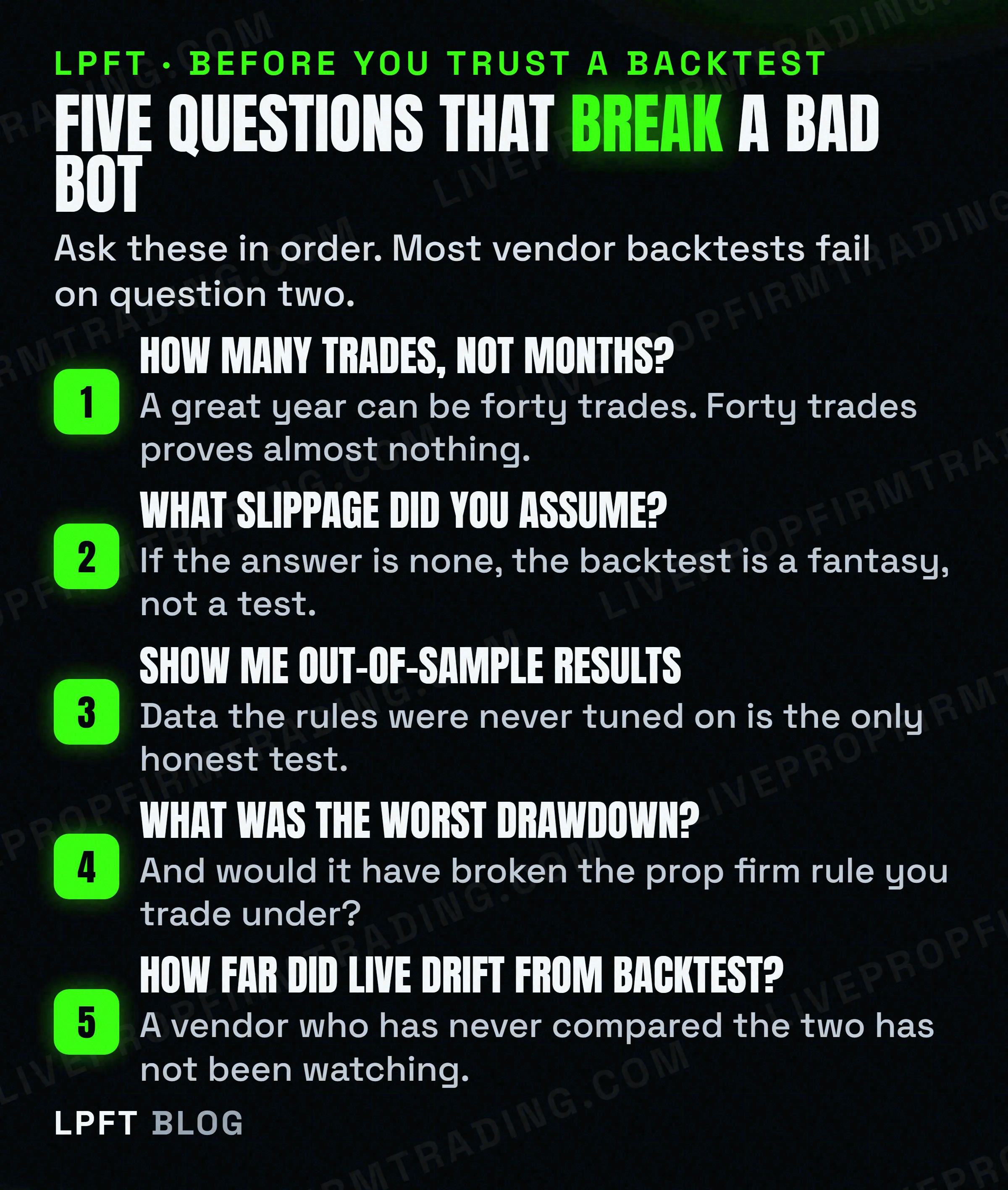
If you want the deeper version of this, we pulled it apart separately in why your TradingView backtest lies to you.
On a prop account, "profitable" is not the bar
This is the part the rest of the internet misses entirely, and it matters more than everything above if you trade a funded account. A strategy can have a genuine long-run edge and still be completely unusable at a prop firm, because the firm is not measuring profit. It is measuring the shape of the path.
- Drawdown rules kill positive-expectancy systems. A system that makes money over two hundred trades but takes a 6% dip along the way is finished at a firm with a 5% limit. The edge was real and the account is still gone. We went through this in automated trading and prop firm drawdown rules.
- Consistency rules punish the one big day. Several firms cap how much of your total profit may come from a single session, which quietly bans the lumpy return profile many automated strategies produce. See prop firm consistency rules explained.
- The firm may not allow the bot at all. Policies differ sharply and change often, and running a bot where it is prohibited costs you the account and the balance. Start with which prop firms allow automated trading.
So the real question for a funded trader is not "does this bot make money". It is "does this bot make money in a shape my contract permits". Those are different tests and the second one is harder.
The LPFT Copilot runs the whole stack for you on Tradovate - start a 7-day free trial and watch it work.
Start your 7-day free trialSo, are they profitable?
Some are. Most are not, and the ones that are not usually fail for reasons that were visible before a dollar was risked: an edge too small to cover one and a half ticks, a backtest with no slippage in it, a sample of forty trades, or a drawdown shape the account rules would never have survived.
That is genuinely good news, because every one of those is checkable in advance. The honest summary is that automation is not a way to get an edge. It is a way to execute one without talking yourself out of it, which is worth a great deal if the edge exists and nothing at all if it does not.
If you want the companion piece on what automation does and does not do mechanically, read do automated trading bots actually work.
Frequently asked questions
Only when the rules they run have an edge larger than the cost of trading them. On a Micro E-mini S&P 500 contract that cost is roughly one and a half ticks per round turn once commissions and a realistic slippage allowance are included. The automation itself neither adds nor removes profit.
Work it out from your own broker's pricing. On Tradovate's $99 plan a round turn is $0.58 in commission, exchange and NFA fees are charged on top, and a conservative slippage allowance is one tick, or $1.25 on MES. That lands near $1.83, about one and a half ticks, before any fixed monthly costs are spread across your trade count.
Usually one of four things: the edge was too small to cover trading costs, the backtest assumed fills it would never get, the result came from testing many variations and keeping the luckiest, or the sample was far too small. All four are visible before you risk money if you ask for trade counts, slippage assumptions and out-of-sample results.
It can, but profit alone is not the test. Funded accounts apply drawdown limits and often consistency rules, so a strategy with a genuine edge can still fail on the shape of its equity curve. Check the firm's current rules on automation before you run anything, because policies differ and change.
It depends entirely on how often you trade. Comparing two Tradovate tiers, the $99 monthly plan saves $0.20 per round turn against the free plan, so it only breaks even at roughly 495 round turns a month. Below that the free tier is cheaper despite the higher commission.
No. There is no audit requirement for a retail trading system, which is why the burden is on you to ask. Request the trade count, the slippage assumption, out-of-sample performance and the worst historical drawdown, and treat a refusal to answer any of the four as the answer.
Eli Y.
Eli builds and runs rules-based automated futures systems on TradingView and Tradovate, and helps traders take emotion out of the screen. He writes about futures automation, prop-firm evaluations, and the tools that connect them - plainly, and without hype.
Risk disclosure: Trading futures involves substantial risk of loss and is not suitable for everyone. This article is educational content only and is not financial advice or a recommendation to trade. Past performance is not indicative of future results. Some links are affiliate links.