
Prop Firm Consistency Rules Explained - and How Automation Helps

Heads up: some links below are affiliate links. If you sign up through them we may earn a commission at no extra cost to you - it never changes what we recommend.
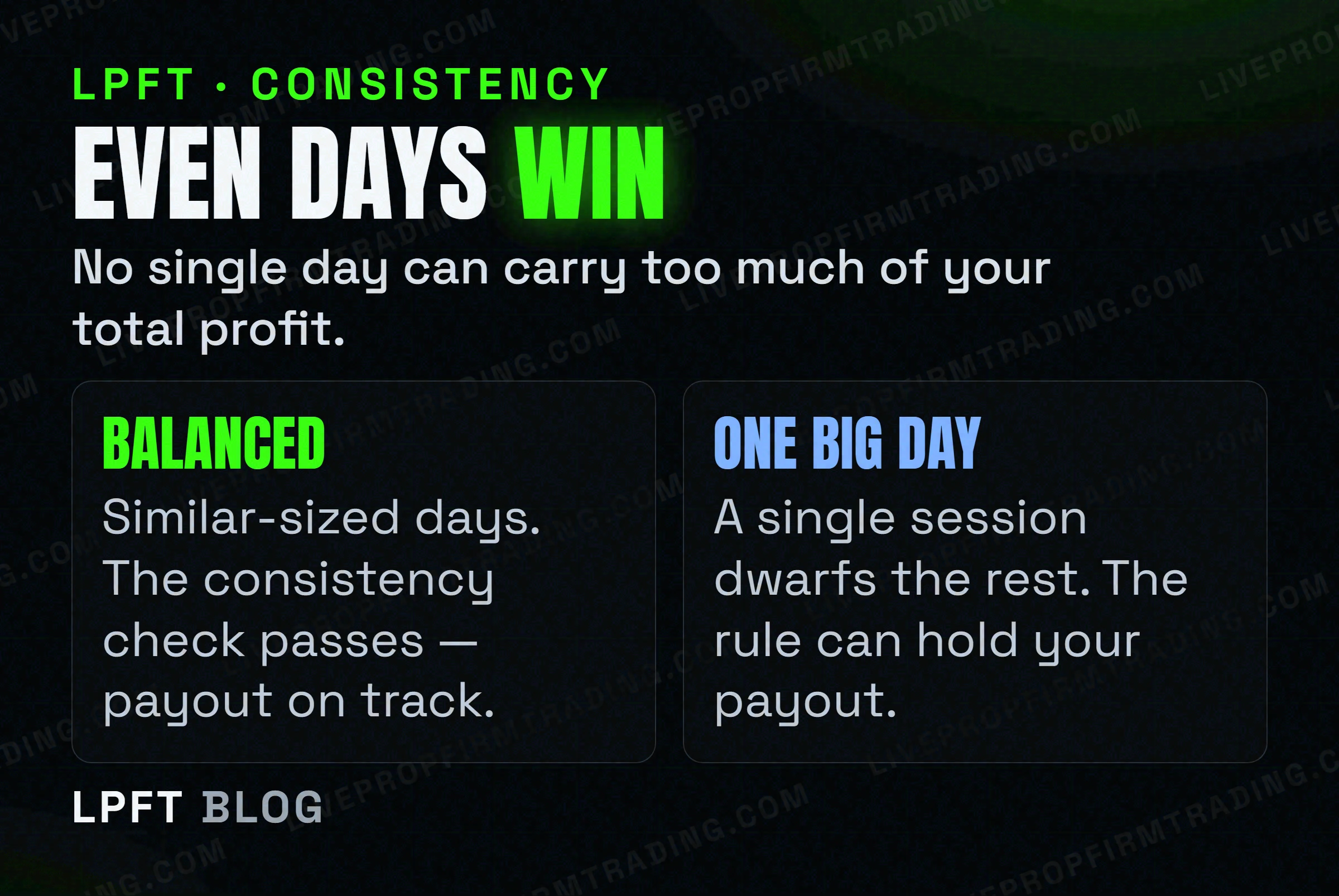
A consistency rule caps how much of your total profit a single day is allowed to represent. Firms use it to confirm you traded a repeatable process, not one lucky swing. The exact percentage is set by each firm and varies - always check yours, never assume - but the fix is the same everywhere: trade the same size and the same plan every day, and let automation enforce that instead of hoping you remember on the day it matters.
The LPFT Copilot trades the same size and the same rules every session, so your best day never ends up carrying your whole payout. Start a 7-day free trial.
Start your 7-day free trialWhat a consistency rule actually checks
Most futures prop firms don't just want to see a profit target hit - they want to see it hit the same way, day after day. That's what a consistency rule checks: how much of your total profit came from a single trading day. If one session did most of the heavy lifting, the firm reads that as luck rather than a repeatable process, and it can hold up - or flatly deny - a payout even though the account itself is green.
The exact cap is set by each firm individually, and it genuinely varies: some publish it plainly in the payout terms, some bury it, and it can differ between the evaluation stage and the funded stage of the same firm. We're not going to print a number here and let you assume it's yours. What matters is the shape of the rule, not the digit: no single day should carry more of your total profit than the rest of your trading put together.
Consistency caps differ by firm and can change without much notice. Before you trade toward a payout, open your current agreement and confirm the exact percentage - don't rely on a forum post, a Discord message, or this article.
How it quietly fails a discretionary trader
The trap almost never looks like a mistake while it's happening. It looks like your best day. A trader who's been perfectly fine on size for two weeks can trip a consistency rule in a single afternoon without doing anything that felt reckless in the moment.
- Sizing up after a win streak. Three good days in a row feel like proof the size is too small - so the fourth day trades bigger, and now it's carrying the week.
- A revenge trade that happens to go right. An oversized re-entry after a loss, out of frustration rather than plan, that this time pays off big.
- Skipping the plan on an "obvious" setup. The one trade that looked too good to size normally - so it wasn't.
- Trading heavier on a big news day. Volatility makes the same contract count swing harder, pulling a single session miles ahead of the rest.
None of those days feel like a problem while they're happening. The rule doesn't care that it was a good trade - it cares that it was disproportionate. If the deeper issue is the urge to take more or bigger trades than the plan calls for, that's overtrading, and we cover it directly in how to pass an evaluation without overtrading.
The fix isn't smaller wins - it's smaller variance
Fixed size, every session
The instinct is to think a consistency rule punishes good days. It doesn't - it punishes uneven days. The fix isn't trading worse on your best day; it's keeping size identical whether yesterday was a loss, a scratch, or your biggest win of the month. Same contracts, same stop distance, same plan, regardless of how the last session went.
A stop that doesn't move with your mood
The other half is a daily loss limit and a stop-after-target rule that don't bend once you hit them - not because the market changed, but because you did. Consistency comes from removing the moments where a good streak or a bad one talks you into deviating from what you did yesterday.
A consistency rule doesn't ban a great trading day - it bans a great day built on a different size and plan than every other day. Keep the inputs identical and the rule mostly takes care of itself.
Where automation earns its keep
This is exactly the kind of rule automation is good at, because it's a discipline problem, not a market-reading problem. A rules-based system applies the same size and the same limits on day one and day one hundred - it doesn't get confident after a streak or emotional after a loss. Consistency stops being something you have to remember and becomes a byproduct of how the system is built.
The LPFT Copilot runs the whole stack for you on Tradovate - start a 7-day free trial and watch it work.
Start your 7-day free trialAutomation doesn't remove the requirement to know your own firm's rule, and it doesn't guarantee a payout passes review - firms check consistency their own way, and futures trading carries real risk regardless of how an order gets placed. LPFT only supports prop-firm connections that run through Tradovate. You can point our tools at a firm's own API key at your own discretion, but a guarantee claim requires your full broker statement where applicable. Not every prop firm supports the Tradovate API - always check yours first. If drawdown limits are the piece you're worried about next, see automated trading and prop firm drawdown rules.
Frequently asked questions
It's a payout condition that caps how much of your total profit can come from a single trading day. It's designed to confirm your results come from a repeatable process, not one outsized session.
It varies by firm and can differ between the evaluation and funded stages of the same firm. Always check your own firm's current agreement for the exact number rather than assuming it matches another firm's.
It can, if that day represents a larger share of your total profit than your firm's consistency rule allows - even if every other day was fine. The rule looks at proportion, not just the total.
No. Automation applies the same size and limits every day, which removes the size-creep that usually causes a violation, but firms review payouts their own way and futures trading always carries risk.
No, they check different things. A drawdown rule limits how much your account can lose from its peak; a consistency rule limits how much of your profit one day can represent. See automated trading and prop firm drawdown rules for the drawdown side.
Eli Y.
Eli builds and runs rules-based automated futures systems on TradingView and Tradovate, and helps traders take emotion out of the screen. He writes about futures automation, prop-firm evaluations, and the tools that connect them - plainly, and without hype.
Risk disclosure: Trading futures involves substantial risk of loss and is not suitable for everyone. This article is educational content only and is not financial advice or a recommendation to trade. Past performance is not indicative of future results. Some links are affiliate links.