
How to Pass a Futures Prop Firm Evaluation Without Overtrading

Heads up: some links below are affiliate links. If you sign up through them we may earn a commission at no extra cost to you - it never changes what we recommend.
Most evaluations aren't lost to a bad strategy - they're lost to overtrading. Sizing up after a win, revenge-trading a loss, or just taking one ticket too many turns a normal day into a blown one. The fix is a fixed-size, fixed-limit discipline framework: same size every trade, a daily loss limit that actually stops you, a rule to stop at target, and a cap on trades per day. Automation is the most reliable way to enforce all four, because it doesn't get talked into an exception.
The LPFT Copilot trades a fixed size with a daily loss limit and a stop-after-target rule built in - no override switch for a bad moment. Start a 7-day free trial.
Start your 7-day free trialWhy evaluations actually get blown
Ask most traders why they failed an evaluation and you'll hear about a strategy that stopped working. Look at the actual trade log and it's rarely that. It's almost always overtrading: more size, more trades, or more risk than the plan called for, added in the moment because the moment felt different.
- Sizing up after a win. A good morning becomes the excuse to trade bigger in the afternoon, right when a losing trade does the most damage.
- Revenge-trading a loss. An oversized re-entry, seconds after a stop-out, meant to win the money back rather than take the next planned setup.
- Boredom trades. Taking a marginal setup late in a quiet session just to have done something that day.
- Chasing a missed move. Jumping in late and oversized because the original entry was missed and the trade "looked obvious" without it.
A firm's evaluation exists to see whether you'll trade the same way once real capital is on the line. The pass/fail number is really a proxy for whether you can hold a plan under pressure.
The discipline framework: four rules, no exceptions
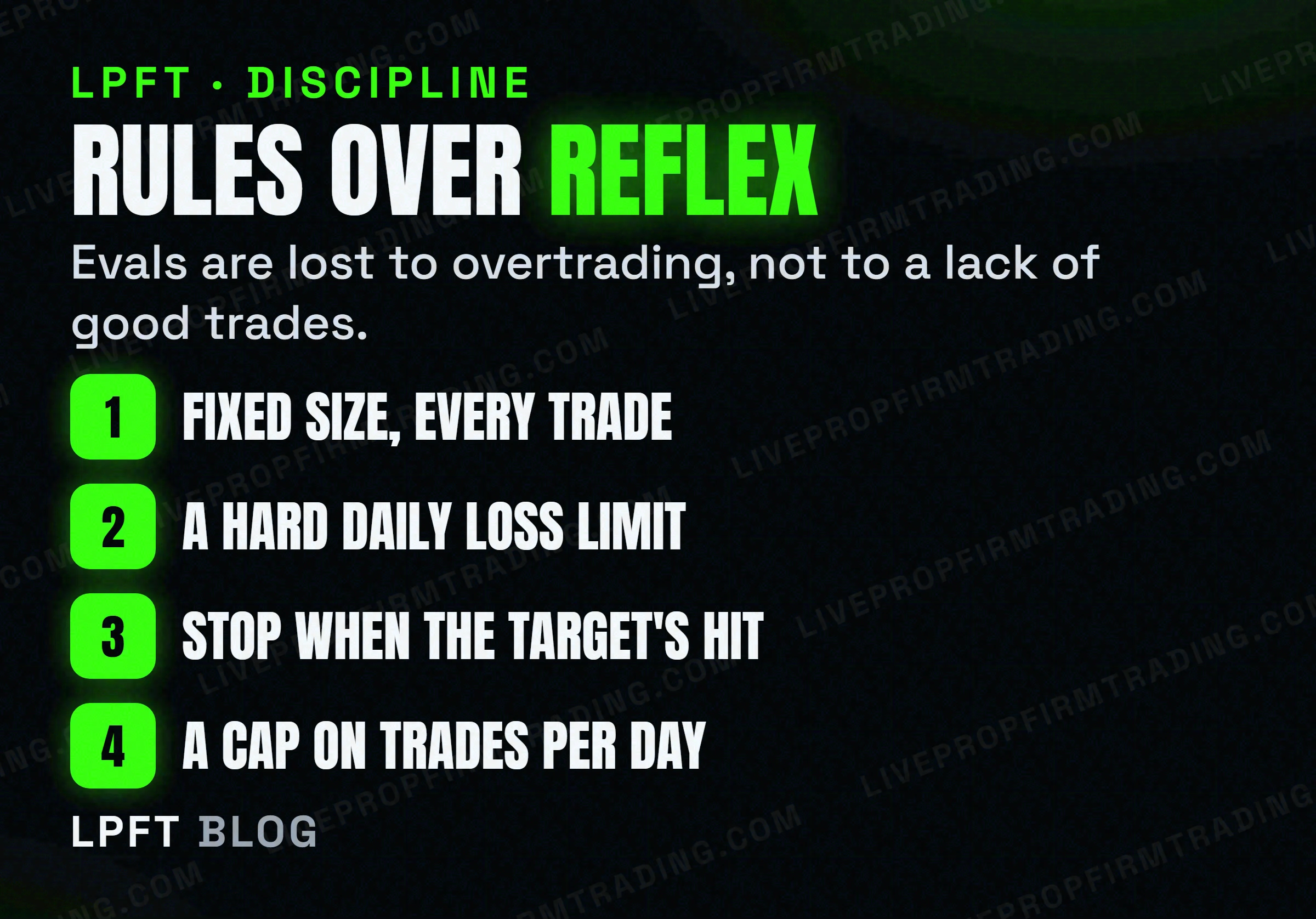
None of this requires a better strategy. It requires four limits that don't move once you set them - ideally before the evaluation starts, while you're calm and not mid-session.
| Rule | What it stops | How to enforce it |
|---|---|---|
| Fixed size | size creep after a win or a loss | pick one contract count for the whole evaluation and don't revisit it |
| Daily loss limit | one bad session becoming a blown account | set a dollar or point limit that flattens and locks you out for the day |
| Stop after target | giving back a good day chasing a better one | a banked target ends the session - no "just one more" |
| Trades-per-day cap | boredom and chasing turning into extra tickets | a hard number of entries allowed, decided in advance |
Each rule alone helps. Together, they remove almost every path that actually blows an evaluation, because each failure pattern above needs at least one of these four to break before it can do damage.
Where automation removes the emotional decision
The hard part was never knowing these four rules - most traders could recite them. The hard part is holding them at 2 p.m. after a stop-out, when the very same brain that set the rule this morning is now negotiating with it. That's the moment automation is built for: a rules-based system applies the fixed size, checks the daily loss limit, and respects the trades cap the same way on a calm Tuesday and an ugly Friday, because it isn't the one feeling the loss.
The LPFT Copilot runs the whole stack for you on Tradovate - start a 7-day free trial and watch it work.
Start your 7-day free trialThis is also the piece that overlaps with a firm's consistency rule: fixed size every day is the same habit that keeps one session from carrying too much of your total profit. Discipline and consistency aren't two separate problems - they're the same fix wearing two names.
What automation can and can't fix here
Be clear-eyed about the limits. Automation enforces the four rules perfectly, but it can't pick a sensible size for an account it doesn't know, and it can't overturn a plan that was unrealistic to begin with. You still need to set the size, the daily limit, and the target relative to your own account and your own firm's specific rules before anything else matters.
Wondering whether an automated tool is even allowed on your evaluation in the first place? Several firms restrict or prohibit it outright - see can you use EAs or bots to pass a prop firm challenge before you connect anything. LPFT only supports prop-firm connections that run through Tradovate, and not every prop firm supports the Tradovate API - always check yours first.
Frequently asked questions
Overtrading - sizing up after a win, revenge-trading a loss, or taking extra trades out of boredom or frustration. It's far more common than the strategy itself simply not working.
Four fixed rules set before you start: the same position size every trade, a daily loss limit that actually stops you, a rule to stop trading once you hit a target, and a hard cap on trades per day.
It can enforce fixed size, a daily loss limit, and a trades cap consistently, which removes the in-the-moment decision that usually causes overtrading. It can't pick sensible limits for you or guarantee a pass.
No - sizing up after a streak is one of the most common ways an evaluation gets blown, and it also risks tripping a firm's consistency rule on the payout side.
Only if your specific firm allows it - several prohibit automated systems, including during the evaluation. Check the firm's current rules before connecting anything; see our breakdown of using bots on a prop firm challenge.
Eli Y.
Eli builds and runs rules-based automated futures systems on TradingView and Tradovate, and helps traders take emotion out of the screen. He writes about futures automation, prop-firm evaluations, and the tools that connect them - plainly, and without hype.
Risk disclosure: Trading futures involves substantial risk of loss and is not suitable for everyone. This article is educational content only and is not financial advice or a recommendation to trade. Past performance is not indicative of future results. Some links are affiliate links.