
Can You Use EAs or Bots to Pass a Prop Firm Challenge?

Heads up: some links below are affiliate links. If you sign up through them we may earn a commission at no extra cost to you - it never changes what we recommend.
Sometimes - but often no, and the restriction can start on day one of the challenge, not just once you're funded. An EA can execute a fixed plan without hesitation, but it's still subject to whatever your firm's rules say about automation, and several firms prohibit it outright. Apex and TakeProfit ban automated systems, Topstep allows bots through its own API but requires every order to originate from your personal device, and a handful of others haven't published a clear policy at all. Check your firm's current rules before you connect anything - not the other way around.
The LPFT Copilot runs a tested, rules-based method on your own Tradovate account - you decide where it's allowed to connect. Start a 7-day free trial.
Start your 7-day free trialWhat an EA or bot actually does - and doesn't do
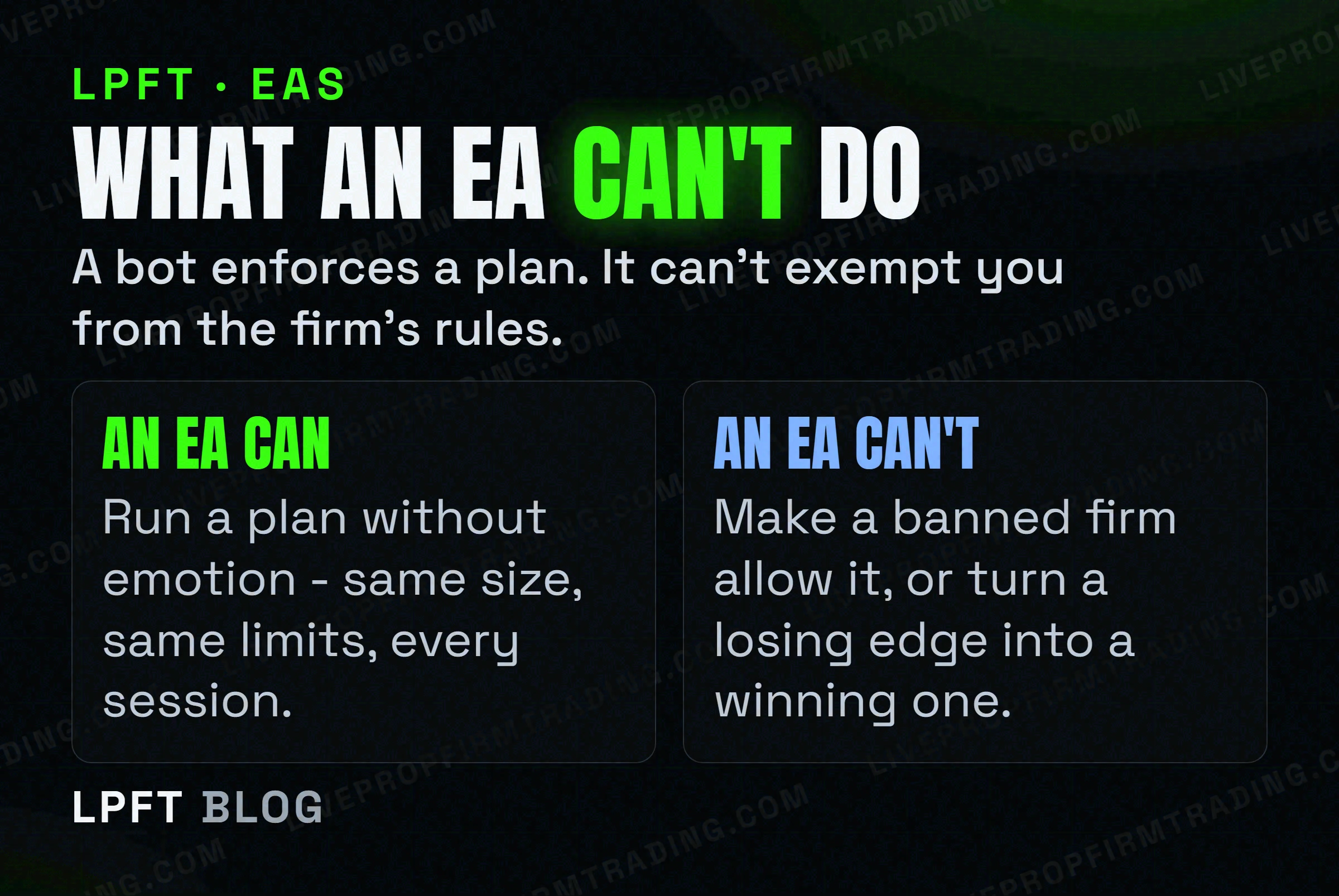
An EA (expert advisor) or trading bot executes a fixed set of rules without hesitation: it enters, sizes, and exits exactly as programmed, every time the condition is met. On a challenge, that can look appealing - no sizing up after a win, no revenge trade after a loss, none of the in-the-moment decisions that blow most evaluations.
What it doesn't do is get you an exemption from the firm's rules, and it doesn't guarantee the challenge passes. The account is still yours, the firm's daily loss limit and drawdown rule still apply exactly as if you clicked the buttons yourself, and automation removes emotion from execution - it doesn't remove the risk of the trade itself. Futures carry substantial risk of loss regardless of how the order gets placed.
Why many firms restrict or ban it outright
This is the part that trips people up: automation restrictions aren't rare exceptions, they're the norm among the firms with a published policy. Apex Trader Funding prohibits AI, auto-bots, algorithms, and full-automation - its stated rule is human traders only, with account closure and forfeiture as the consequence. TakeProfit Trader goes further and requires every trade to be manually executed, full stop. Topstep takes the opposite approach: custom bots are allowed through its own TopstepX and ProjectX API, but every order has to originate from your personal device, so a VPS, a VPN or a remote server is barred.
A couple of firms sit in a greyer zone. Trade Day forbids third-party bots but does permit custom strategies built on its supported platforms (NinjaTrader, Tradovate, TradingView) - a meaningfully different thing from an outside EA. Tradeify supports Tradovate as a broker, but its automation policy specifics aren't verified publicly, so don't assume either way.
Several published policies are written around the funded account. That doesn't mean the evaluation is automatically open season - many firms apply the same restriction from the challenge onward, because they're evaluating how you trade, not just the number at the end. Read the evaluation agreement itself, not just the funded-account FAQ.
How to actually check before you connect anything
- Open the current evaluation agreement - not a summary page - and search for "automat", "bot", "EA", and "API" specifically.
- Check whether the restriction is scoped to the funded stage only, or stated from the start of the challenge.
- Look for a separate VPS/VPN clause - some firms ban the infrastructure a bot needs even where the strategy itself isn't named.
- If it isn't clearly stated either way, ask the firm directly and get the answer in writing before you connect anything.
That last step matters more than it sounds. "Unverified" and "not addressed" are not the same as "allowed" - treat silence as a reason to ask, not a green light.
Where a rules-based approach helps - and where it can hurt
Where a firm genuinely permits automation, a fixed-rules approach is a real advantage on a challenge: the same size and the same stop every trade is exactly the discipline that keeps an evaluation from being blown by overtrading. Where a firm prohibits it, using one anyway isn't a grey area - it's the fastest way to lose the challenge outright, since the stated penalty is typically closure and forfeiture, not just a warning.
The LPFT Copilot runs the whole stack for you on Tradovate - start a 7-day free trial and watch it work.
Start your 7-day free trialLPFT only supports prop-firm connections that run through Tradovate. You can point our tools at a firm's own API key at your own discretion, but a guarantee claim requires your full broker statement where applicable. Not every prop firm supports the Tradovate API - always check yours first. Already funded and wondering how the rules differ once the challenge is over? See can you run a trading bot on a prop firm account.
Frequently asked questions
It depends entirely on the firm. Apex and TakeProfit prohibit automated systems outright, Topstep allows bots through its own API but bars VPS, VPN and remote servers, and others have not published a clear policy. Always check your firm's current agreement first.
No. An EA executes a fixed plan without hesitation, but it's still subject to the firm's loss limits and drawdown rules, and futures trading carries real risk regardless of how the order is placed.
Sometimes. Some published policies are written around the funded account specifically, but many firms apply the same restriction from the start of the challenge. Read the evaluation agreement itself rather than assuming.
The stated consequence at firms like Apex is account closure and forfeiture - not a warning. Check the rule before you connect anything, not after.
Trade Day permits custom strategies built on its supported platforms, though it forbids outside third-party bots. Policies change, so confirm directly with the firm before you rely on this.
Eli Y.
Eli builds and runs rules-based automated futures systems on TradingView and Tradovate, and helps traders take emotion out of the screen. He writes about futures automation, prop-firm evaluations, and the tools that connect them - plainly, and without hype.
Risk disclosure: Trading futures involves substantial risk of loss and is not suitable for everyone. This article is educational content only and is not financial advice or a recommendation to trade. Past performance is not indicative of future results. Some links are affiliate links.