
Do Automated Trading Bots Actually Work? An Honest Answer

Heads up: some links below are affiliate links. If you sign up through them we may earn a commission at no extra cost to you - it never changes what we recommend.
Yes, automated trading bots work - but “work” means they execute a set of rules exactly, not that they guarantee profit. A bot removes emotion and never misses a signal, which is a real edge over a distracted human. What it can’t do is predict the market or rescue a strategy that has no edge. Whether a bot makes or loses money comes down to the quality of the rules it runs and the risk limits around it - not the automation itself.
The LPFT Copilot runs a tested, rules-based method on your own Tradovate account, with the risk limits built in. Start a 7-day free trial and watch it run.
Start your 7-day free trialWhat “work” actually means for a trading bot
The word “work” hides two very different questions. The first is mechanical: does the bot reliably do what I told it to? The answer there is a clear yes - a well-built bot watches the market tick by tick and places, manages and closes orders the instant its conditions are met, without ever getting tired, scared, or greedy.
The second question is the one the ads quietly swap in: will the bot make me money? That depends entirely on the rules it’s running and the risk controls around them. Automation is an amplifier. Point it at a genuine edge with sane risk and it compounds that edge with machine discipline. Point it at a coin-flip strategy and it will execute the coin flip flawlessly, all the way down.
A bot doesn’t create an edge - it executes one. The automation is only as good as the plan you hand it.
Where a bot genuinely beats a human
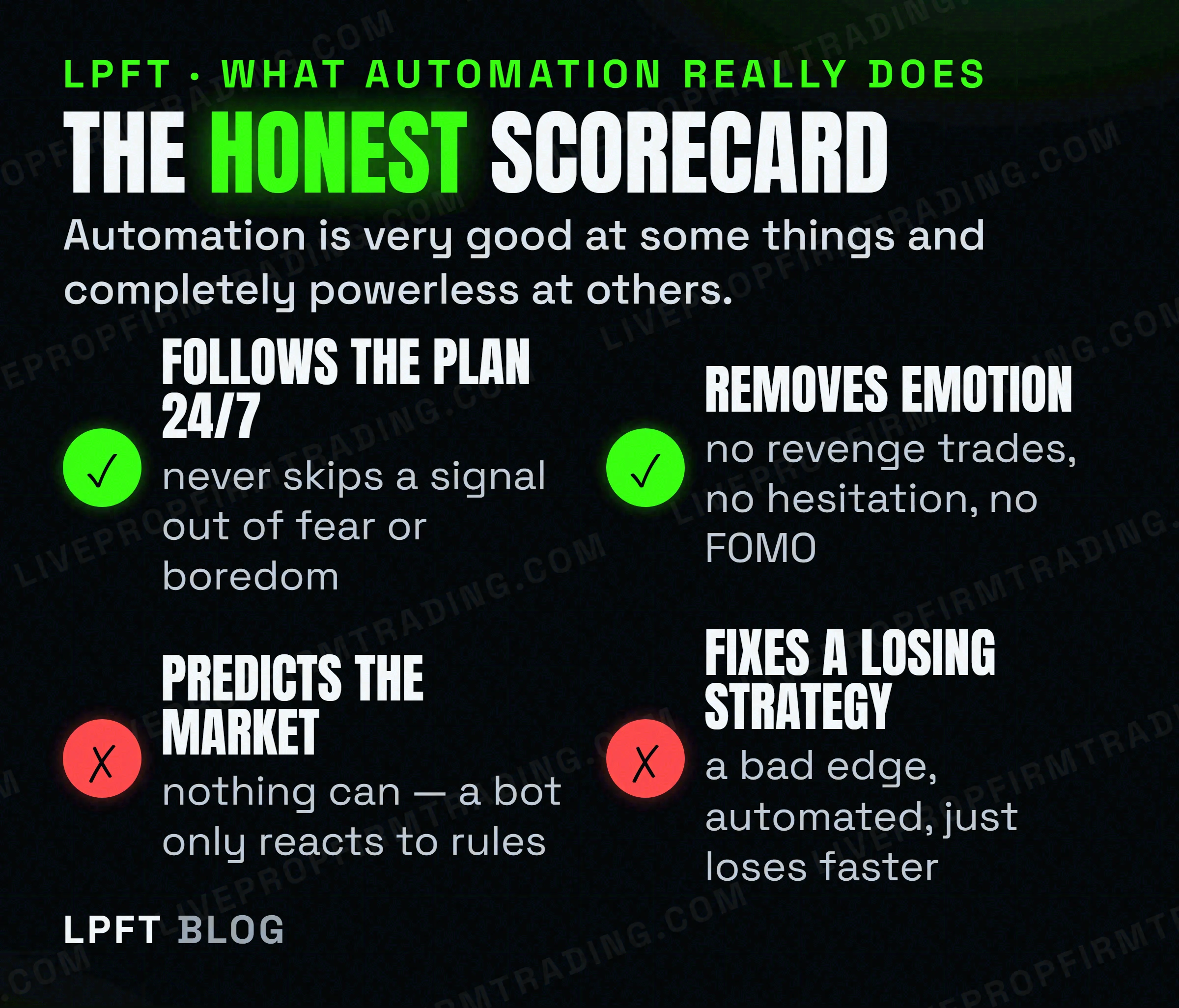
Most trading accounts don’t die because the strategy was hopeless. They die because the person running it moved the stop “just this once,” doubled down to get even, or froze and skipped the one trade that would have paid for the week. Those are emotional failures, not strategic ones - and they are exactly what a machine does not do.
- Consistency. The bot takes every valid signal the same way, whether it’s up big or down on the day. No cherry-picking, no hesitation.
- Speed. It reacts in milliseconds - entering, moving to a target, or cutting a loss faster than you can reach the mouse.
- Availability. It watches sessions you can’t sit through, so you don’t have to choose between a job, sleep, and the market.
Where bots quietly fail - and why most retail bots lose
Be honest about the graveyard: plenty of automated systems lose money. When they do, it’s almost always one of a few predictable reasons - and none of them are the automation’s fault.
- The strategy had no real edge. A backtest that looks perfect is often curve-fit or repainting - it describes the past, not the future.
- No risk limit. A system that can’t stop itself will happily trade a bad day into a blown account. A hard daily loss cap is non-negotiable.
- Wrong conditions. A bot tuned for a trending session bleeds out in a chop it was never designed for. Context still matters.
- It was never tested live-small first. Paper results and one live micro contract tell you very different things.
A bot will follow a flawed rule straight off a cliff without blinking. That’s why the rules and the risk limits - not the fact that it’s “automated” - are what decide the outcome.
So should you run one?
A bot is worth running when three things are true at once: the strategy has a tested, believable edge; there are hard risk limits it can’t override; and you’ve watched it trade small with real money before scaling. Miss any one of those and you don’t have automation - you have a faster way to be wrong.
That’s also the honest case for a done-for-you system over building your own from scratch. Instead of hoping your first hand-built strategy is the rare one with an edge, you run a method that has already been tested and comes with the session windows and risk rules baked in.
The LPFT Copilot runs the whole stack for you on Tradovate - start a 7-day free trial and watch it work.
Start your 7-day free trialFrequently asked questions
They can - but the automation itself doesn’t create profit. A bot executes a set of rules exactly; whether that makes money depends on whether the rules have a genuine edge and whether risk is controlled. A bot running a weak strategy will lose money very efficiently.
Usually the strategy had no real edge (an over-fit backtest), there was no hard risk limit, or it was run in market conditions it wasn’t built for. The failure is almost always in the plan and the risk controls, not in the automation.
For discipline, speed and consistency, yes - a bot never gets emotional or tired. For judgment in a genuinely new situation, a human still has the edge. The best setups pair a tested rule set with strict, automated risk limits.
No. Nothing can. Trading futures carries a substantial risk of loss, and automation does not remove that risk - it only removes the emotion. Always use a hard daily loss limit and test in a demo before going live.
Test it in a demo, then run a single micro contract live for a while and compare the results to what you expected. Real fills, slippage and your own follow-through only show up once real money is on the line.
Eli Y.
Eli builds and runs rules-based automated futures systems on TradingView and Tradovate, and helps traders take emotion out of the screen. He writes about futures automation, prop-firm evaluations, and the tools that connect them - plainly, and without hype.
Risk disclosure: Trading futures involves substantial risk of loss and is not suitable for everyone. This article is educational content only and is not financial advice or a recommendation to trade. Past performance is not indicative of future results. Some links are affiliate links.