Is Automated Trading Worth It? The Honest Cost and Benefit

Heads up: some links below are affiliate links. If you sign up through them we may earn a commission at no extra cost to you - it never changes what we recommend.
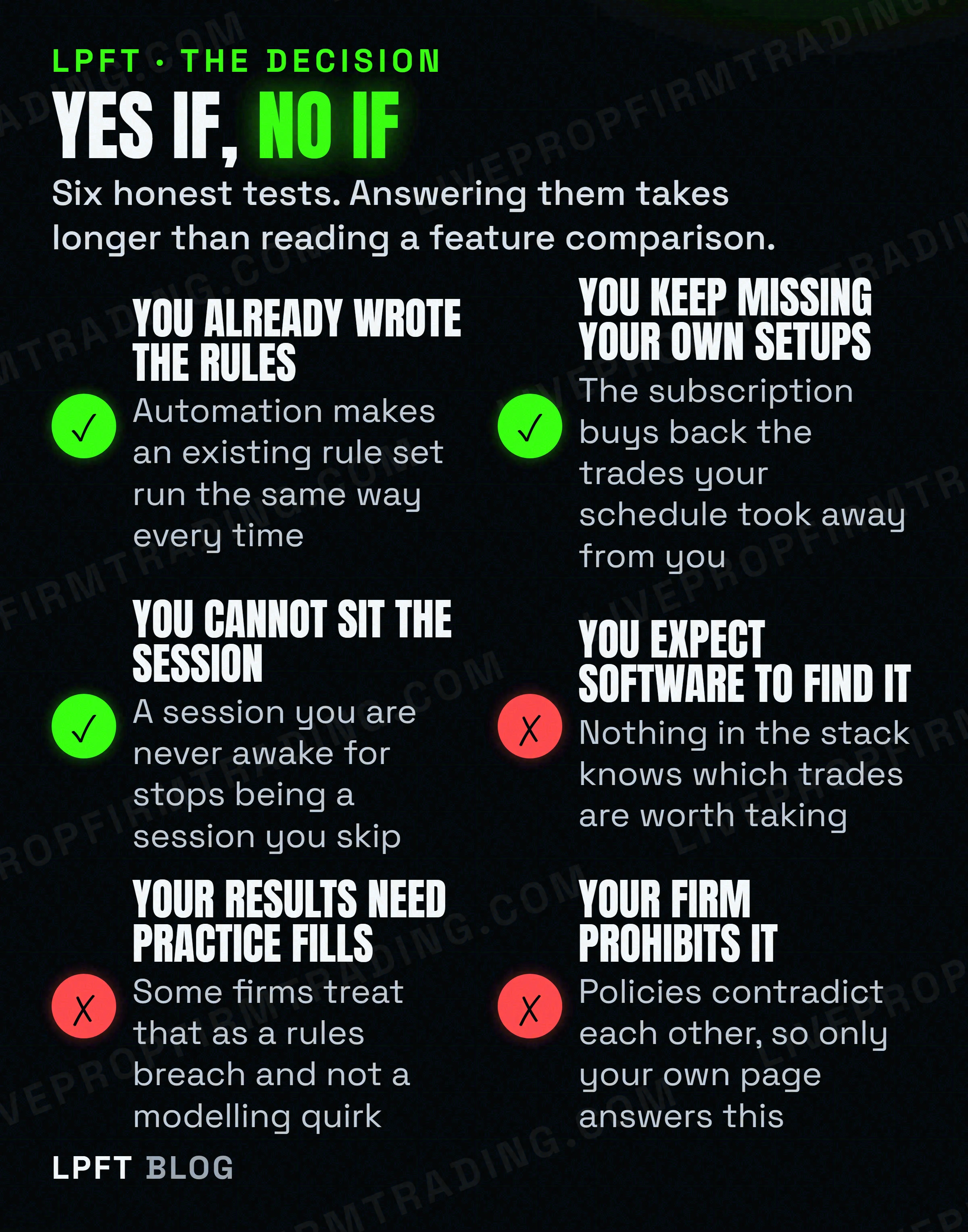
Automated trading is worth it if you already have written rules you execute badly. It is not worth it if you are hoping the software supplies the edge. Automation is an execution technology. It changes how faithfully your rules run, never whether those rules work.
The LPFT Copilot runs a tested, rules-based method on your own Tradovate account, so the build cost and the wiring are not yours to carry. Start a 7-day free trial.
Start your 7-day free trialThe question behind the question
Almost every version of this question is really two questions wearing one coat. Is automation worth the monthly cost, and will automating make me money. The first has a clean answer that depends on your situation. The second has a clean answer that does not depend on anything, and it is no.
Automation is a way of executing a decision, not a way of making one. Nothing in the stack, from the charting platform to the bridge to the broker API, has an opinion about which trades are worth taking. Point it at rules that lose money and it will now lose money on time, at the right size, in both sessions, without ever getting bored.
So the honest framing is narrower and more useful. You are buying execution consistency, coverage of hours you cannot sit, and the removal of your own hesitation. The question is whether those three things are worth what they cost you, and that depends almost entirely on whether you already have rules worth executing.
What it actually costs, in numbers you can check
The cost stack for a retail futures trader has four layers, and only two of them are advertised anywhere.
- The charting plan. Webhook notifications, the mechanism that lets a chart alert reach anything outside TradingView, start at the Essential plan and are not included on the free Basic plan. If you also want an alert that does not stop at its two month expiry, the open-ended option sits on Premium and Ultimate. Check the current price on their pricing page, because it is shown in your local currency.
- The bridge. TradersPost publishes its pricing openly. Billed yearly, the plans run from Starter at $41.65 a month, through Basic at $84.15 and Pro at $169.15, to Premium at $254.15, with extra live accounts at $10 a month each and extra paper accounts at $5. There is a free 7-day trial, and their note that yearly billing saves fifteen per cent is on the same page.
- The broker, the exchange and the data. Commissions, exchange fees, clearing and data subscriptions vary by broker and by the data you take, so this is the layer to price at your own broker rather than from an article. It is also the layer that scales with how often your system trades, which makes a high trade count expensive twice.
- The build. The unadvertised one. Writing the rules, coding them, wiring the path, and then testing all of it long enough to trust it. Paid in weeks rather than dollars, and paid before the first live trade.
Then there is the cost of finding out, which is the only one that buys information. The smallest real unit of risk in equity index futures is a Micro E-mini S&P 500 tick. MES is $5 times the index with a minimum tick of 0.25 index points, which is $1.25 a tick and $5 a point, one tenth of the full-size ES contract. A month of testing on one micro contract is the cheapest tuition available in this business. How much money you need to start works through the account side of that honestly.
TradersPost receives TradingView alerts in the cloud and routes them to a broker, with Tradovate explicitly supported, and it runs independently of your computer. The free 7-day trial is enough to price the whole path before you commit to a year of anything.
Try TradersPostWhat you are actually buying, according to the CFTC
There is a measurement of this that almost nobody quotes, and it reframes the question. CFTC economists Richard Haynes and John Roberts published a working paper in March 2015 called Automated Trading in Futures Markets, built on the complete CME electronic trade record from November 2012 to October 2014. That is 1.5 billion trades, 805 futures products and close to 362,000 accounts.
They could measure it precisely because CME requires every order sent to GLOBEX to carry a flag saying whether a human entered it. Orders count as automated, in the paper's words, if they are "generated and/or routed without human intervention". The flag lives in FIX Tag 1028 and was written into each exchange's rulebook in October 2012.
The share of volume that was automated, by product group, over that window: FX at 79.9 per cent, equities at 66.6, interest rates at 62.3, energy at 46.9, metals at 46.5 and agriculture at 38.1. The authors summarise it as "a large presence of automated trading across a wide set of futures products, often well over half of all trading".
It says automation is normal in these markets rather than exotic, so automating is not an advantage over the room. It says nothing whatsoever about whether automated traders make more money, because the paper does not measure that. Treat it as a description of 2012 to 2014, not of today.
The same paper carries the counterweight, and it is the part the marketing never quotes. "We also find that manual trading can be quite fast, and act as a large portion of liquidity provision in key contracts", the authors write, concluding that futures markets "appear to provide an environment conducive to both manual and automated participants". They also note that manual participation rises during roll periods.
So the answer to "will automating put me on the winning side" is that there is no such side. Manual versus automated trading goes through where each one genuinely wins.
The three situations where the answer is no
You have no tested rules yet. This is by far the most common one. Automation applied to an idea you have not tested converts a vague plan into a precise loss. The sequence that works is rules first, then evidence, then automation. How to backtest before you automate covers the evidence step, including why the fills in your backtest were assumed rather than observed.
Your results depend on flattering fills. A practice account has no queue and no counterparty. Tradovate says so on its own simulated trading page, where the disclaimer reads that simulated trading "does not represent actual trading and is based on hypothetical conditions" and that real results "may differ significantly due to factors such as market conditions, liquidity, execution, and the emotional and psychological impact of risking real money". On a funded account this becomes a rules matter as well. MyFundedFutures permits automated strategies so long as they "do not aim to exploit the favorable fills offered in the Simulated Environment". Paper trading versus live testing separates what each one proves.
Your firm does not allow it. Policies genuinely contradict each other between firms, so no article can answer this for you. Alpha Futures states that "The use of AI, bots, and other automated trading mechanisms is strictly prohibited across all account types". Topstep allows custom automated strategies via its TopstepX and ProjectX API while prohibiting VPS, VPNs and remote servers. TradeDay prohibits bots purchased from a third party and strategies producing more than 200 trades in a day. All three were read on their own domains on 22 September 2026. Which prop firms allow automated trading collects the ones we have verified.
LPFT only supports prop-firm connections that run through Tradovate. You can point our tools at a firm's own API key at your own discretion, but a guarantee claim requires your full broker statement where applicable. Not every prop firm supports the Tradovate API, so always check yours first.
How to find out for the price of a few ticks
The good news about this question is that it is cheap to answer properly, and almost nobody does, because the cheap answer takes a month and the expensive one takes an afternoon.
- Write the rules down first, in words. If you cannot state the entry, the exit, the size and the stop in four sentences, there is nothing to automate yet and no subscription changes that.
- Price the stack at your own broker. Charting plan, bridge, commissions, exchange and data fees, for the trade frequency your rules actually produce. A system that trades often pays this layer twice.
- Run the free trials together. The bridge and the practice account both have them. Use the window to prove the whole path end to end rather than any single piece of it, because the path is what breaks. Why automated traders fail lists where.
- Go live on one micro contract. At $1.25 a tick this is the only rung that can tell you what your fills really are, and it cannot be simulated. Compare its results with the practice ones. If they broadly agree, you have a system you understand.
- Then decide. You will be comparing a known monthly cost against a measured change in how your rules execute, which is an actual decision rather than a guess.
A fair summary of the whole thing: automation is worth paying for when the gap between your plan and your behaviour is costing you more than the stack does. That gap is measurable, and for a lot of traders it is the largest single line item in their year. For traders without a plan, the same stack is an expensive way to be wrong on schedule.
The obligatory and entirely genuine caveat. Futures trading involves a substantial risk of loss and is not suitable for everyone. Automation changes how a rule set is executed, not what the market does with it, and a well-built automated system can still have a bad month. Nothing above is a forecast, and none of it is advice about what to trade.
The LPFT Copilot runs the whole stack for you on Tradovate - start a 7-day free trial and watch it work.
Start your 7-day free trialFrequently asked questions
It is worth it when you already have written rules that you execute inconsistently, when you keep missing your own setups because of your schedule, or when your market runs in hours you cannot sit. It is not worth it when you are hoping the software will supply the edge, because no part of an automation stack decides which trades are worth taking.
There are four layers. A charting plan that supports webhook notifications, which start at TradingView's Essential tier. A bridge, where TradersPost publishes plans billed yearly from $41.65 a month for Starter up to $254.15 for Premium, plus $10 a month for each extra live account. Broker commissions, exchange and data fees, which vary and scale with trade frequency. And the unpriced one, the time spent building and testing.
There is no reliable public evidence that it does, and the largest regulatory dataset does not claim it. The CFTC working paper on automated futures trading measured how much volume is automated, not how profitable it is, and found that manual trading can be quite fast and provides a large portion of liquidity in key contracts. Automation changes execution, not the quality of the underlying rules.
CFTC economists measured the complete CME electronic trade record from November 2012 to October 2014, covering 1.5 billion trades. Automated orders accounted for 79.9 per cent of FX futures volume, 66.6 per cent of equities, 62.3 per cent of interest rates, 46.9 per cent of energy, 46.5 per cent of metals and 38.1 per cent of agriculture. Those figures describe that window, not today.
Run the free trials together. Prove the whole path on a practice account first, then trade one Micro E-mini contract live, where a tick is $1.25 on MES. That single micro is the only way to measure your real fills, because a simulator has no order queue. Compare the two sets of results before you pay for a year of anything.
Only if your firm allows it, and firms genuinely disagree. Alpha Futures prohibits AI, bots and other automated trading mechanisms across all account types. Topstep allows custom bots via its TopstepX and ProjectX API but prohibits VPS, VPNs and remote servers. TradeDay prohibits bots bought from a third party and strategies producing more than 200 trades in a day. Read your own firm's automation clause before connecting anything.
Eli Y.
Eli builds and runs rules-based automated futures systems on TradingView and Tradovate, and helps traders take emotion out of the screen. He writes about futures automation, prop-firm evaluations, and the tools that connect them - plainly, and without hype.
Risk disclosure: Trading futures involves substantial risk of loss and is not suitable for everyone. This article is educational content only and is not financial advice or a recommendation to trade. Past performance is not indicative of future results. Some links are affiliate links.