Manual vs Automated Trading: Which Is Right for You?

Heads up: some links below are affiliate links. If you sign up through them we may earn a commission at no extra cost to you - it never changes what we recommend.
Neither one wins on merit. Automate when your edge is a set of rules you can write down and the market moves while you cannot watch it. Trade manually when the setup needs a judgement call. In futures there is a third factor most comparisons skip entirely: your prop firm may already permit one of the two and ban the other.
The LPFT Copilot runs a tested, rules-based method on your own Tradovate account with the session windows and loss limits built in. Start a 7-day free trial and watch it run.
Start your 7-day free trialThe comparison everyone writes, and the question it dodges
Search this topic and you get the same article a dozen times. Manual trading gives you control and flexibility. Automated trading gives you speed and removes emotion. Pick the one that suits your personality. It reads well and it helps nobody, because personality is close to the least useful input you have.
A more honest framing: automation is not a style, it is a decision about where the decision gets made. Manual means you decide in the moment, with everything you know and everything you feel. Automated means you decided in advance, wrote it down, and gave up the right to change your mind at 10:14 in the morning. Both are defensible. Only one of them works when you are in a meeting.
Not "do I like control?" but "can I write my rules down, and am I allowed to run them?" Those two answers settle it for most futures traders.
Where each one genuinely wins
Strip out the marketing on both sides and the honest scorecard is narrower than either camp admits. A machine is better at exactly the things humans are worst at, and useless at the thing humans are for.
| Manual | Automated | |
|---|---|---|
| Reacting to something new | Strong. You can read a headline and stand aside | Weak. It only knows the rules it was given |
| Doing the same thing 300 times | Weak. Attention and discipline both drift | Strong. Trade 300 looks exactly like trade one |
| Sessions you cannot sit | Impossible unless you are at the screen | Strong. This is the whole argument |
| Respecting a daily loss limit | Hard. The limit is the first thing an angry trader moves | Strong, if the limit is coded and not optional |
| Getting started | Fast. Open a chart and trade | Slower. Rules, testing and a working order path first |
Notice what is not in that table: profit. Automation does not add an edge, it executes one. We covered that in detail in do automated trading bots actually work, and it is worth reading before you decide a bot is the answer to a strategy that is not working by hand.
The factor comparison posts leave out: your funding firm decides too
If you trade your own cash, this section does not apply and you can skip it. If you trade a funded account, it may be the only section that matters, because several firms have already made this choice on your behalf. Their rules differ far more than people assume, and "bots are banned in prop trading" is simply not true as a blanket statement.
Here is what four firms publish on their own sites, read on 20 September 2026. Policies change often, so treat this as a prompt to go and read yours rather than as a lasting fact.
- Alpha Futures states that "the use of AI, bots, and other automated trading mechanisms is strictly prohibited across all account types." Semi-automated trading is permitted, meaning an indicator can give you a signal so long as you place, monitor and manage the trade yourself.
- Topstep states that "custom automated strategies and bots are allowed via the TopstepX / ProjectX API, subject to standard platform rules and our prohibition on high-frequency trading." They also require that "all trading activity must originate from your personal device," and bar VPS, VPNs and remote servers. More in our Topstep automation rules post.
- TradeDay forbids bots and automated systems purchased from a third party or shared between users, does "not allow strategies that produce more than 200 trades in a day," and requires that an automated system run through one of their supported platforms.
- Tradeify states that "personal bots are allowed as long as they are not high-frequency trading bots," that you must be able to prove sole ownership of the bot, and that half or more of account profit must come from trades held longer than ten seconds.
The pattern across firms is not "automation bad." It is four narrower bars: the bot must be yours and not resold, it must not run unmonitored, it must stay under a daily trade ceiling, and it must not scalp in seconds. A strategy that clears those four is allowed at more firms than most traders think.
One more practical note. LPFT only supports prop-firm connections that run through Tradovate. You can point our tools at a firm's own API key at your own discretion, but a guarantee claim requires your full broker statement where applicable. Not every prop firm supports the Tradovate API, so always check yours first. Our running a bot on a prop firm account guide goes deeper on the mechanics.
Tradeify publishes its automation terms in its Funded Trader Agreement, including the personal-bot clause and the ten-second holding rule. Read the terms yourself before you commit to any firm.
See TradeifyWhat most futures traders actually end up running
The tidy manual-or-automated split falls apart in practice. Almost nobody who automates walks away from the screen forever, and almost nobody trading by hand refuses every tool. What tends to survive contact with reality is a division of labour.
- The machine owns execution and risk. Entries, exits, position size, the daily loss limit and the session window. These are the decisions that get worse when a human is involved, because they are the ones fear and boredom reach first.
- You own the on and off switch. Whether the system trades at all today, whether a news day is worth sitting out, whether something has changed enough to stop and review.
- You own the review. Reading what the system actually did against what you expected, weekly. Automation does not remove this job, it just gives you clean data to do it with.
That split is also the honest answer to the "set and forget" pitch. Handing the execution to a machine is not the same as handing over responsibility. If you are weighing this as an income plan rather than a tooling choice, read can you make a living with automated trading first, because the numbers there are sobering and they should be.
How to decide this week
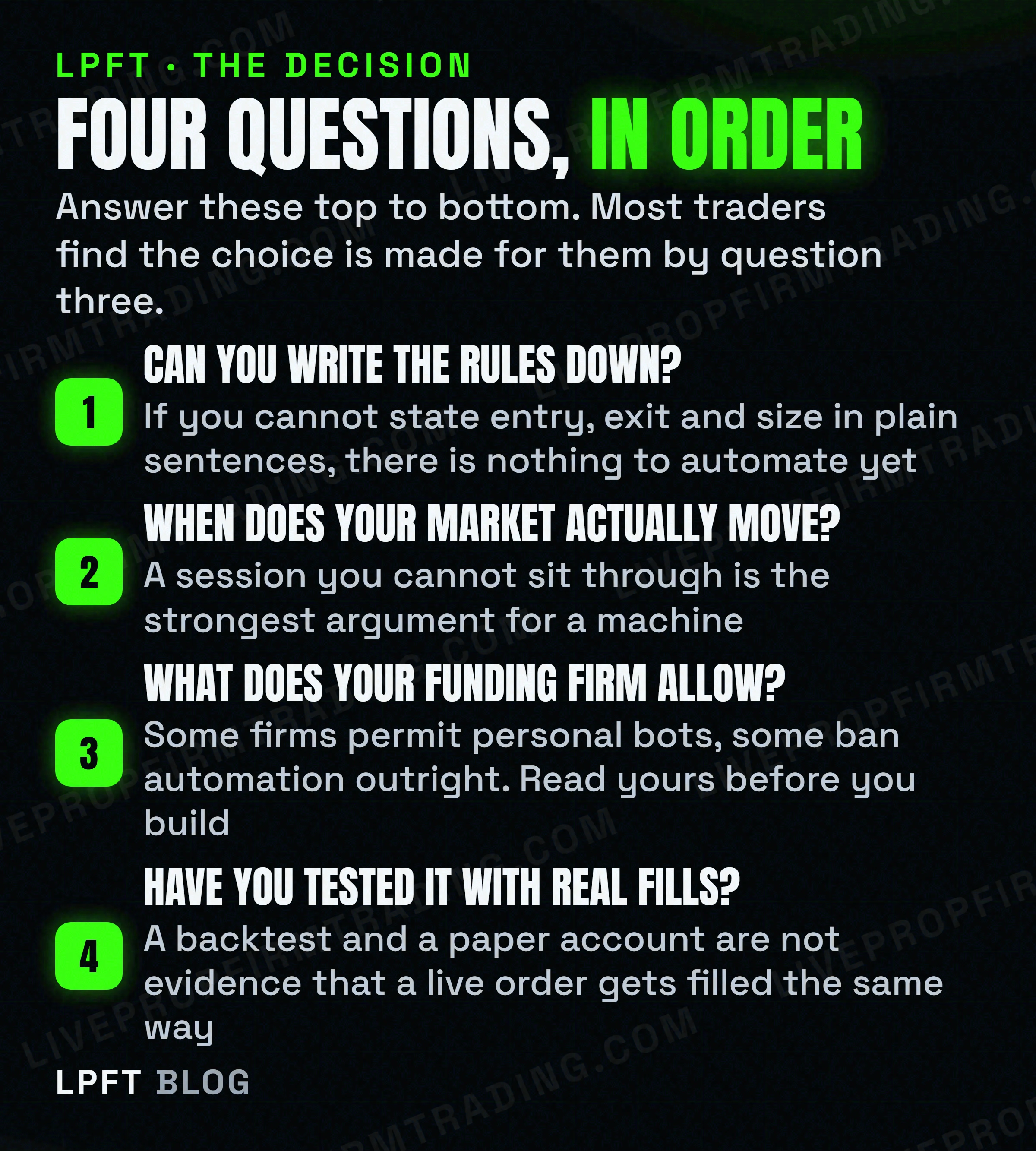
You do not need a month of soul searching. You need four answers and about two hours.
- Write your rules as sentences. Entry, exit, stop, size, and when you do not trade. If you cannot finish those five sentences without the word "usually," you are not ready to automate anything and that is genuinely useful to learn on a Tuesday afternoon.
- Log when your setups happen. Two weeks of timestamps. If most of them land while you are unavailable, the decision is already made.
- Open your firm's rules page and actually read it. Not a forum thread about it.
- Test before you trust. Start with how to backtest a strategy before you automate it, then prove it with real fills rather than assumed ones.
And if the honest conclusion is that your rules are sound but building the infrastructure is not how you want to spend your evenings, that is a legitimate answer too. You are not choosing between manual and automated so much as choosing between building it and running something already built. Worth knowing that a hosted path needs no machine of your own left running, which is why the VPS question matters less than the vendors selling them suggest.
The LPFT Copilot runs the whole stack for you on Tradovate - start a 7-day free trial and watch it work.
Start your 7-day free trialFrequently asked questions
Neither is better in general. Automation is stronger at repetition, speed and holding a risk limit, while a human is stronger at judging a genuinely new situation. The right choice depends on whether your edge can be written as rules, when your market moves relative to your availability, and what your funding firm permits.
It depends entirely on the firm, and the differences are large. Reading their own published pages on 20 September 2026, Alpha Futures prohibits AI and bots across all account types, while Topstep allows custom bots through its TopstepX and ProjectX API but bans high-frequency trading and any VPS or remote server. Always read your own firm's current rules before building anything.
There is no reliable evidence that automation by itself improves results, and it is not a claim worth trusting from anyone. A bot executes the rules it is given, so a weak strategy automated simply loses more consistently. Futures trading carries a substantial risk of loss either way.
Semi-automated means software generates the signal and a human places and manages the trade. Some funding firms that prohibit full automation explicitly permit this. Alpha Futures, for example, permits a custom indicator that gives buy or sell signals on the condition that the trader manually places, monitors and manages the trade.
Start by learning to state your rules precisely, which is a manual exercise regardless of where you end up. Once the rules are written and tested, automation is the natural way to stop yourself from breaking them. Trying to automate a strategy you cannot yet describe in sentences is the common and expensive mistake.
Yes, and most people do it gradually rather than all at once. The usual path is to automate the parts that hurt when a human touches them, which is normally the stop loss, the position size and the daily loss limit, while keeping the decision to trade at all for yourself.
Eli Y.
Eli builds and runs rules-based automated futures systems on TradingView and Tradovate, and helps traders take emotion out of the screen. He writes about futures automation, prop-firm evaluations, and the tools that connect them - plainly, and without hype.
Risk disclosure: Trading futures involves substantial risk of loss and is not suitable for everyone. This article is educational content only and is not financial advice or a recommendation to trade. Past performance is not indicative of future results. Some links are affiliate links.