Can You Make a Living With Automated Trading? A Realistic Look

Heads up: some links below are affiliate links. If you sign up through them we may earn a commission at no extra cost to you - it never changes what we recommend.
Almost certainly not soon, and the research is blunt about it. Among people who began day trading futures and persisted for at least 300 days, 97 percent lost money and only 0.4 percent out-earned a bank teller. Automation removes emotional mistakes. It does not remove the arithmetic underneath them, and the arithmetic is what decides this.
The LPFT Copilot runs a tested, rules-based method on your own Tradovate account, so the screen time stops being the thing that decides. Start a 7-day free trial.
Start your 7-day free trialThe question underneath the question
There are two questions hiding inside this one, and almost every article online answers only the easy one. The easy question is whether an automated system can be profitable over time. The answer to that is yes, plainly, or there would be no industry. The hard question is whether the money it produces can be withdrawn every month, in an amount you can live on, without wrecking the account that produces it.
Those are different problems. The first is about whether a method has an edge. The second is about the shape of the returns, and the shape is what turns a working system into a salary or into a slow bleed. A method can be genuinely good and still be completely unable to pay rent in March.
People quit jobs on the strength of the first answer and then discover the second one. Understanding the difference early is the cheapest lesson in this entire subject, because the alternative way to learn it costs you your savings and your income at the same time.
So can you make a living trading bots? Start with the research
Two large academic studies have actually measured this rather than guessed at it, and both looked at real accounts over long periods rather than survey responses. Neither was funded by anybody selling a course.
| Study | What it measured | What it found |
|---|---|---|
| Chague, De-Losso and Giovannetti (University of Sao Paulo) | Everyone who began day trading Brazilian equity futures between 2013 and 2015 and kept going for at least 300 days | 97 percent lost money. Only 0.4 percent earned more than a bank teller, which the paper puts at 54 US dollars a day. The single best performer averaged 310 dollars a day with a standard deviation of 2,560 dollars. |
| Barber, Lee, Liu and Odean | Day traders in Taiwan across 1992 to 2006 | Less than 1 percent of the day-trader population could predictably and reliably earn positive returns after fees. On an average day, under 3 percent of active day traders managed it. |
The Brazilian paper is the more relevant of the two, because it studied futures rather than stocks and because it set out to test this exact claim. Its conclusion is that it is virtually impossible for an individual to day trade for a living, contrary to what course providers claim. The authors also found no evidence of learning, meaning the people who stayed longest did not get measurably better.
The best individual in a group of thousands averaged 310 dollars a day with a standard deviation of 2,560 dollars. That is a person earning a decent wage while routinely swinging eight times that wage in a single session. Even the winner was not living a stable life.
Neither study tested bots specifically, and that is a fair objection to raise. What they establish is the base rate for the activity itself. Anyone claiming automation clears that base rate is making a claim about their software that these studies neither support nor refute, which is exactly why the next section matters.
What automation actually changes
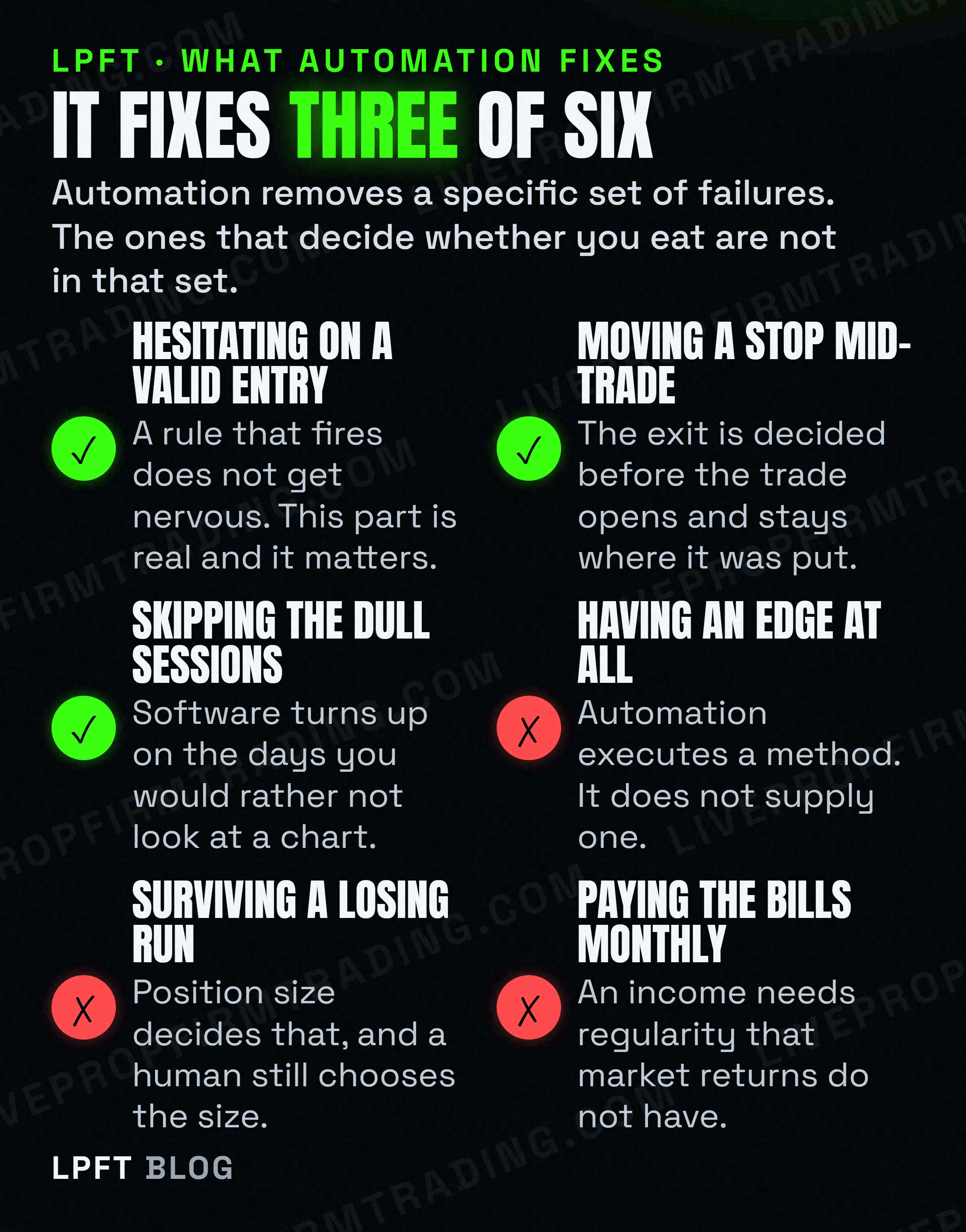
Automation is not snake oil. It removes a real and well-documented category of mistake, and anybody who has watched themselves widen a stop at the worst possible moment knows how expensive that category is. Three things genuinely improve.
- Execution stops depending on how you feel. A rule that fires at a defined condition does not hesitate, does not get bored, and does not decide this one looks different.
- The exit is fixed before the money is at risk. Most account-ending damage happens in the minutes after a trade goes wrong, and that is precisely when a human is least able to do arithmetic.
- Attendance becomes free. Turning up every session is a real edge and a real cost. Software pays that cost without complaining.
What does not change is more important. Automation executes a method, so the quality of the method is still the whole game. Position sizing still decides whether a normal losing streak is an inconvenience or the end. And the returns still arrive when the market feels like producing them rather than on the first of the month.
If you want the honest version of whether these systems make money at all, we went through it in are futures trading bots profitable, and the specific things people wrongly assume are covered in seven trading-bot myths that quietly cost beginners money.
The withdrawal problem nobody puts in the sales page
Here is the part that almost never gets written down, and it is the reason capable traders still fail to make a living. An account that is growing and an account that is feeding you are running two different experiments.
A system left alone compounds. Every winning month increases the base the next month works on, and a drawdown is recovered by the same engine that caused it. The moment you start withdrawing a salary, three things happen at once, and they compound against you rather than for you.
- The base stops growing. Taking out what you earn means next month starts from the same place as this month, so the account never reaches the size where the same percentage move pays more.
- Drawdowns get deeper in relative terms. A losing run against a shrinking or flat balance is a bigger fraction of the account than the same run against a growing one, and the withdrawals continue during the losing run because rent does.
- The bad months still have bills in them. Markets do not distribute returns evenly, so a method that averages well across a year can easily hand you two consecutive months of nothing. An income cannot absorb that unless it was never really your income.
This is why the honest version of a living from trading involves a buffer measured in months of expenses sitting outside the trading account, and a withdrawal rule set in advance rather than decided each month based on what you need. Both of those are unglamorous and neither appears in a screenshot of a good week.
Treat trading income as a bonus on top of an income for far longer than feels necessary. Not because the method cannot work, but because the transition is the dangerous part, and the transition is survivable only when you are not forced to withdraw during a drawdown.
The LPFT Copilot runs the whole stack for you on Tradovate - start a 7-day free trial and watch it work.
Start your 7-day free trialWhat a realistic path looks like
None of the above says do not do this. It says the version where you replace a salary in six months is the version that fails. Here is the sequence that does not require you to be in the lucky fraction.
- Keep the income. Every constraint above gets easier when you are not withdrawing. This single decision changes the odds more than any software choice on the table.
- Size so that a long losing run is boring. Work forward from what you can lose across a bad stretch, not backward from what the broker will let you open. We covered the real number in how much money you need to start automated futures trading.
- Measure the shape, not just the total. Track the worst month, the longest flat stretch, and the deepest drawdown. Those three numbers tell you whether an income is possible. The total return does not.
- Withdraw on a rule, not on a need. Decide the fraction and the frequency while nothing is going wrong, and leave it alone when something is.
- Only replace income you have already matched for a long time. Not once. Repeatedly, through a stretch that included a period you hated.
If you are earlier than this and still deciding whether automation suits you at all, start with automated futures trading for beginners and the plain-language version in do automated trading bots actually work.
Frequently asked questions
Very few people do, and the research is unusually direct about it. Among individuals who began day trading futures and stuck with it for more than 300 days, 97 percent lost money and only 0.4 percent earned more than a bank teller. Automation improves execution, but it does not change the base rate of the activity by itself.
It is better at the parts humans are worst at, which are hesitation, moving stops, and skipping sessions. It is no better at having an edge, sizing positions, or producing returns on a monthly schedule. For income specifically, the schedule problem is the one that bites, and automation does not touch it.
Enough that a normal losing streak does not force a change in behaviour, plus separate savings to live on so you are never withdrawing during a drawdown. The account size follows from your stop size and how many consecutive losses you can absorb, not from the broker margin minimum.
Because that is where the long-run account-level data exists. Neither study tested automated systems specifically, which is a fair limitation. What they establish is the base rate for the underlying activity, and any claim that software clears that base rate needs its own evidence.
That an account which grows and an account which pays you behave differently. Withdrawals stop the base from compounding, make drawdowns a larger share of the balance, and continue through the months the method earns nothing. A buffer outside the account and a fixed withdrawal rule are the standard answers.
When you have matched the income you are replacing repeatedly rather than once, through a stretch that included a bad period, while holding a separate buffer of living expenses. That is a slower test than most people want, and it is the one that distinguishes the people who stay.
Eli Y.
Eli builds and runs rules-based automated futures systems on TradingView and Tradovate, and helps traders take emotion out of the screen. He writes about futures automation, prop-firm evaluations, and the tools that connect them - plainly, and without hype.
Risk disclosure: Trading futures involves substantial risk of loss and is not suitable for everyone. This article is educational content only and is not financial advice or a recommendation to trade. Past performance is not indicative of future results. Some links are affiliate links.