
How Much Money Do You Need to Start Automated Futures Trading?

Heads up: some links below are affiliate links. If you sign up through them we may earn a commission at no extra cost to you - it never changes what we recommend.
The margin to hold one micro futures contract can be as little as $25, but that is not what you need to start. The realistic figure is set by your stop size multiplied by the losing streak you must survive, which usually lands between $1,000 and $3,000 for a one-contract automated strategy. The software stack itself is minor. A broker account can cost nothing monthly, and commission on a micro round turn is under a dollar. The account is the number that decides whether you are still trading in six months.
The LPFT Copilot runs a tested, rules-based method on your own Tradovate account, with the daily loss limit already set. Start a 7-day free trial before spending anything else.
Start your 7-day free trialTwo different questions are hiding in this one
When people ask what it costs to start automated futures trading they are usually asking about subscriptions. What platform, what data, what the bot costs. Those are real costs and we will add them up properly below. They are also the small half of the answer and the half that almost never determines the outcome.
The other question, the one that actually decides whether this works, is how much money has to be sitting in the account for a normal losing stretch not to end you. Nobody asks that one first, which is exactly why so many accounts close in month two.
The stack costs tens of dollars a month. The account needs thousands. Budget for the first and ignore the second and you have not started trading, you have bought a subscription.
The stack, added up, with sources
Here is the recurring cost of actually running an automated strategy, using published prices. Commissions and margin are from Tradovate's own pricing page, read in September 2026. Exchange, clearing and NFA fees are charged on top and are not itemised there, so take those from your own statement rather than from anybody quoting a round number.
| Item | Cheapest path | If you need more |
|---|---|---|
| Broker account | $0/mo on the free tier | $99/mo for lower commissions |
| Commission, micro round turn | $0.78 | $0.58 on the paid tier |
| Market data | Level I included once funded | depth data costs extra |
| Charting and alerts | $0 if you do not need webhooks | a paid tier if you do |
| Hosting | $0, run it on your machine | a server once uptime matters |
| Monthly total | near zero plus commissions | tens of dollars |
That is the whole software bill. For a low-frequency strategy on the free tier it rounds to commissions and nothing else. It is worth knowing that the $99 plan only pays for itself at high volume: it saves $0.20 a round turn, so it takes roughly 495 round turns a month before the subscription is cheaper than the free tier. We worked that through in are futures trading bots profitable.
If your setup sends TradingView alerts to a broker, webhooks are not available on the free charting plan and require two-factor authentication to be switched on. That is a paid tier, and it is better to find out now than halfway through wiring it.
Margin is not the number, and here is why
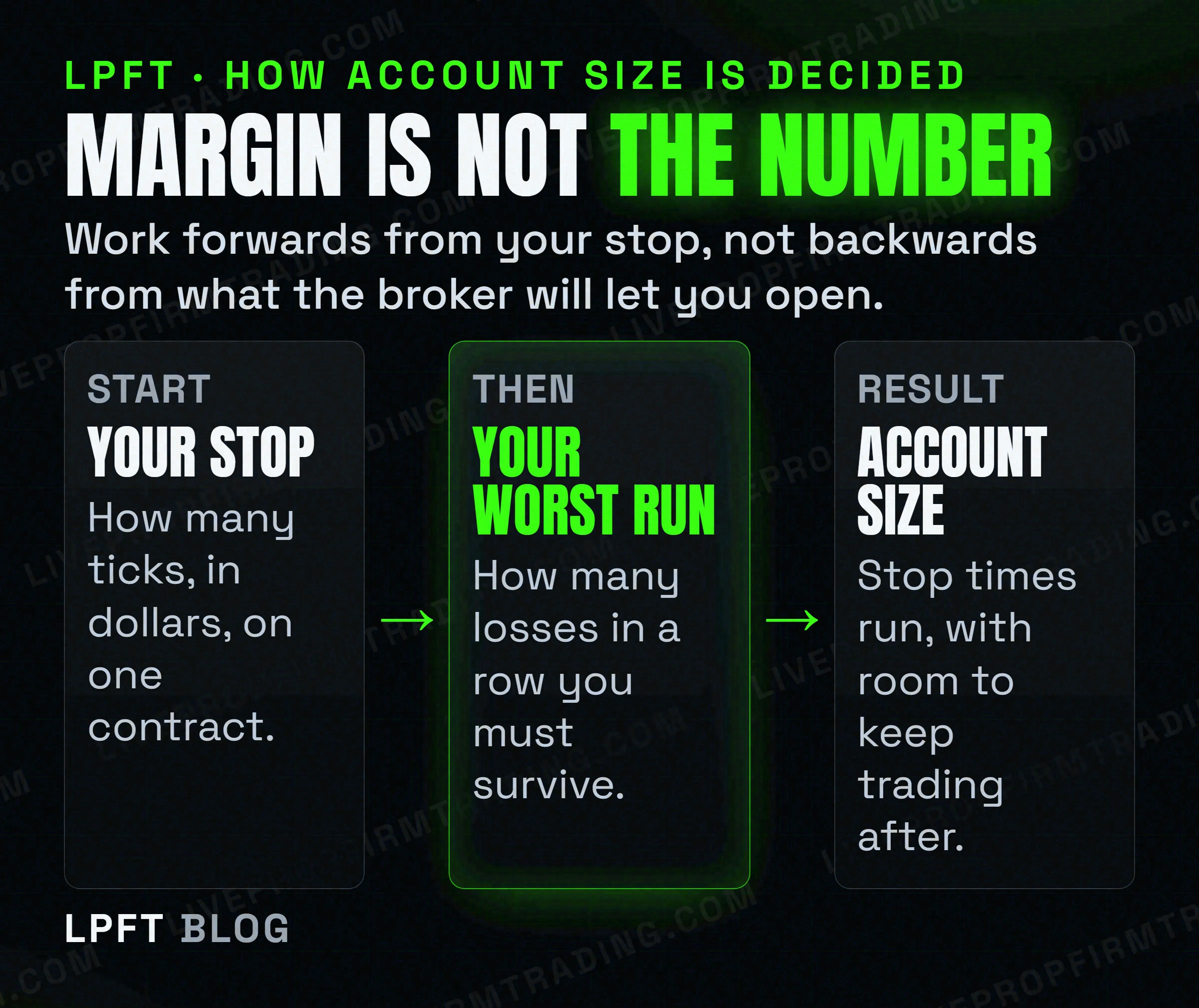
Tradovate lists a day-trading margin of $25 for a micro contract. That number tells you the broker will let you open the position. It tells you nothing whatsoever about whether you can afford to be wrong, which is the only question that matters.
Do it properly instead. On the Micro E-mini S&P 500, CME Group prices the contract at $5 times the index with a 0.25 point minimum move, so one tick is $1.25. A 20 tick stop on one contract therefore risks $25. That $25 is your unit of being wrong.
Now the part nobody does. A strategy winning half its trades will, sooner or later, lose six or seven in a row. That is not bad luck, it is arithmetic, and over a few hundred trades it is close to certain. Eight consecutive losses at $25 is $200 gone through completely normal operation of a working system.
If $200 is a meaningful share of your account, that ordinary streak forces you to stop, or worse, to start interfering. So the account has to be large enough that a normal bad run is an irritation rather than an event. Twenty to thirty times your per-trade risk is a defensible floor, which on a $25 stop puts you somewhere between $500 and $750 of pure risk buffer, and realistically $1,000 to $3,000 in the account once you allow for margin, a second contract later, and not trading at the very edge.
Account size = (ticks in your stop x tick value) x the losing streak you must survive, plus margin, plus room to not be at the edge. Do that sum before you choose a platform.
The other route: paying a fee instead of funding an account
There is a second way in, and for a lot of people it is the more sensible one. Instead of funding your own account, you pay a prop firm an evaluation fee to trade a simulated account against a profit target and a drawdown limit. Pass, and you trade their capital for a share of the profit.
The trade is easy to state. Your downside becomes the fee rather than the account balance, which caps what a bad month can cost you. In exchange you accept rules that can end you for reasons unrelated to losing money, including daily loss limits, trailing drawdown, and in some cases restrictions on automation itself.
We are not going to print evaluation prices here, because they change constantly and are heavily discounted in ways that make any quoted figure misleading within weeks. Read the current pricing on the firm's own page. What we will say is the part that does not change: budget for more than one attempt, because the pass rate on first attempts is low across the industry, and a plan that only works if you pass first time is not a plan.
- Check automation is allowed before you pay. Rules differ sharply by firm and by phase. Start with which prop firms allow automated trading and what each firm says about bots and HFT.
- Price the reset, not just the evaluation. The realistic cost is the fee times the number of attempts you are prepared to make.
- Know the drawdown type. A trailing drawdown behaves very differently from a static one, and it is the single most common reason an otherwise fine strategy fails. See drawdown rules and automation.
The LPFT Copilot runs the whole stack for you on Tradovate - start a 7-day free trial and watch it work.
Start your 7-day free trialSo what is the number?
For a one-contract automated strategy on your own account, somewhere between $1,000 and $3,000 in the account, plus commissions of well under a dollar a round turn, plus whatever charting tier your setup genuinely requires. You can technically open a position with far less. You should not.
For the evaluation route, the cost is the fee multiplied by the number of attempts you plan for, and the honest version of that plan includes more than one.
Both numbers assume one contract. The most expensive mistake in this whole article is not a subscription, it is starting on four contracts because the margin allowed it. Size is the variable that turns a survivable learning period into a short one, and it is entirely under your control.
If you are still working out the order to do things in, the beginner path is here.
Frequently asked questions
Realistically $1,000 to $3,000 for a one-contract strategy on your own account. The margin to open a micro contract can be as little as $25, but margin only says what the broker permits. The number that matters is your stop size multiplied by the losing streak you have to survive.
Tradovate lists a day-trading margin of $25 for a micro contract. That is the mechanical minimum to open the position, not a sensible account size. A 20 tick stop on the Micro E-mini S&P 500 risks $25 per trade, and a normal run of losses will take multiples of that.
Less than most people expect. A broker account can be $0 monthly with commissions under a dollar per micro round turn, and Level I market data is included once the account is funded. A paid charting tier is only needed if your setup uses webhook alerts. Exchange, clearing and NFA fees are charged on top.
It caps your downside at the fee rather than the balance, which is genuinely useful if losing capital would hurt. In return you accept rules that can end you without you losing money, such as trailing drawdown and consistency requirements. Budget for more than one attempt, because first-time pass rates are low across the industry.
Multiply the ticks in your stop by the tick value to get risk per trade, then multiply that by the consecutive losses you must be able to absorb, then add margin and some room so you are not trading at the edge. Twenty to thirty times per-trade risk is a defensible floor.
You can, and one contract is the right place to start regardless of account size. What you should not do is start at a size the margin permits but your account cannot absorb. Scaling after a good week is acting on a sample too small to mean anything.
Eli Y.
Eli builds and runs rules-based automated futures systems on TradingView and Tradovate, and helps traders take emotion out of the screen. He writes about futures automation, prop-firm evaluations, and the tools that connect them - plainly, and without hype.
Risk disclosure: Trading futures involves substantial risk of loss and is not suitable for everyone. This article is educational content only and is not financial advice or a recommendation to trade. Past performance is not indicative of future results. Some links are affiliate links.