
HFT Prop Firms: Which Ones Actually Allow High-Frequency Bots?

Heads up: some links below are affiliate links. If you sign up through them we may earn a commission at no extra cost to you - it never changes what we recommend.
Nearly every major futures prop firm bans high-frequency trading by name, including Topstep, TradeDay, Alpha Futures, MyFundedFutures and Tradeify. Most of those same firms still allow automated strategies you built yourself. The refusal is almost never about automation. It is about four specific things: whether the bot is genuinely yours, whether a human is monitoring it, how many trades a day it takes, and how briefly it holds a position.
The LPFT Copilot runs a tested, rules-based method on your own Tradovate account, at a pace built for funded-account rules rather than against them. Start a 7-day free trial.
Start your 7-day free trialYou are probably not asking about HFT
When someone searches for HFT prop firms, they almost never mean what the term actually describes. Genuine high-frequency trading means colocated servers sitting physically beside the exchange, direct market access, purpose-built hardware and a budget measured in millions to build and hundreds of thousands a month to run. Industry estimates put the cost of a serious operation well into seven figures before a single trade.
What people actually mean is closer to: I have a bot, or a fast scalping strategy, and I want to know whether a funded account will let me run it or quietly ban me on payout day. That is a completely reasonable question and it deserves a real answer, so the rest of this page answers that one.
Firms use "HFT" as a catch-all for behaviour they consider abusive of a simulated fill engine. Describing your strategy as HFT to a prop firm is therefore a bad idea even when your strategy is ordinary automation, because the word itself is the thing on their prohibited list.
What the firms actually say, from their own rules pages
Everything below was read on the firm's own help centre or trader agreement in September 2026. We have deliberately left out firms whose pages we could not reach directly, because a policy quote copied from an affiliate listicle is worth nothing to you if it is out of date.
| Firm | On HFT | On your own automation |
|---|---|---|
| Topstep | Prohibited by name | Custom automated strategies and bots allowed via their API, subject to platform rules |
| TradeDay | Bans ultra-high-speed and mass data entry | Self-built strategies on supported platforms allowed. Third-party purchased bots prohibited. No more than 200 trades a day |
| Alpha Futures | Restricted, particularly over 100 trades a day | AI, bots and automated mechanisms prohibited on all account types. Semi-automated allowed, where a human executes the signal |
| MyFundedFutures | Not allowed on their plans | Automated strategies allowed provided they do not target favourable simulated fills |
| Tradeify | Personal bots allowed as long as they are not HFT bots | Must be solely yours and exclusive to them. At least half of account profit must come from trades held longer than ten seconds |
| Earn2Trade | Does not use the term | Bans software, AI or ultra-fast data entry that could manipulate the environment or give an unfair advantage |
Apex Trader Funding, Take Profit Trader and Bulenox all have rules pages we could not load directly, and in Bulenox's case the third-party claims openly contradict each other. Their policies may well be strict. We are simply not going to tell you what a company's contract says based on somebody else's summary. Read their pages yourself before you trade there.
Notice how little of that table is actually about speed. Read it again and the real pattern shows up: the word HFT is refused almost everywhere, while ordinary automation is permitted almost everywhere, subject to conditions that have nothing to do with latency.
The four bars that actually decide it
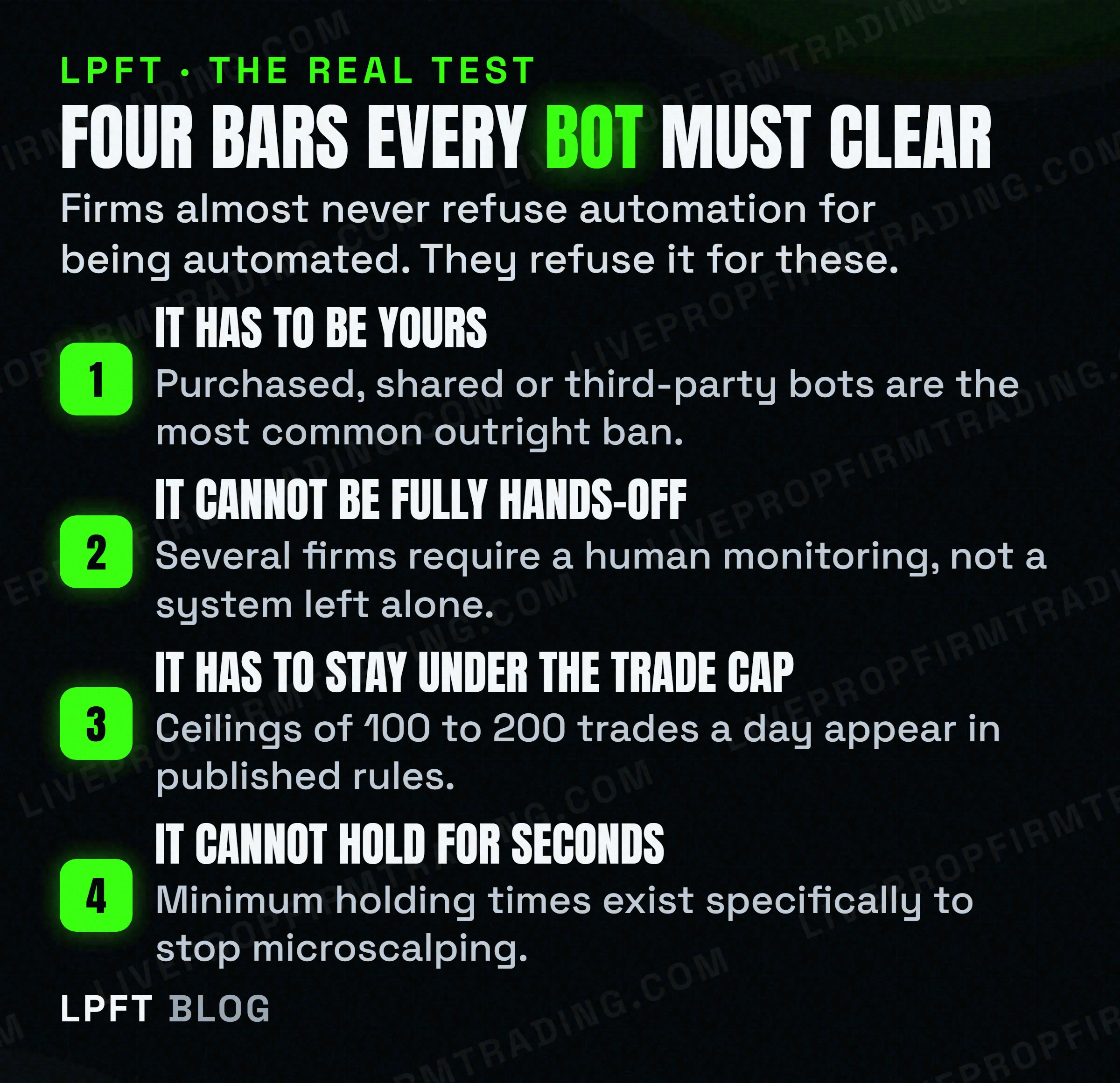
Put the published rules side by side and automation gets refused for one of four reasons. Not for being automated.
- The bot is not yours. This is the most common hard ban. Purchased, shared or third-party systems are prohibited outright at several firms, and at least one requires you to be able to show sole ownership and exclusivity.
- Nobody is watching it. Some firms distinguish an automated strategy that a trader monitors from one running entirely hands-off, and permit only the first. At one firm, a signal a human then executes is explicitly fine while the fully automatic version is not.
- It trades too often. Published ceilings exist. TradeDay states no more than 200 trades in a day. Alpha Futures flags strategies producing over 100 trades a day.
- It holds for seconds. Tradeify requires that at least half of an account's profit comes from trades held longer than ten seconds, which is a microscalping rule wearing a different hat.
If your system clears all four, the fact that it is automated is rarely the obstacle. If it fails any one of them, calling it something other than HFT will not help.
Why firms ban it, which is not the reason you think
It is tempting to read these rules as firms being hostile to sophisticated traders. The more accurate reading is narrower and less flattering to everyone involved: most evaluation accounts are simulated, and a simulated fill engine can be gamed in ways a real order book cannot.
MyFundedFutures says this almost in so many words, permitting automated strategies as long as they do not aim to exploit the favourable fills offered in the simulated environment. That is the actual concern. A strategy that harvests tiny, frequent edges out of a simulator is printing money the firm will have to pay against fills that would never have happened live.
Which explains the shape of the rules. Trade-count caps, minimum hold times and the refusal of anything described as high frequency are all proxies for the same worry. Understanding that makes the rules much easier to predict, and makes it obvious why a slower, rules-based system with normal holding periods rarely runs into trouble.
The LPFT Copilot runs the whole stack for you on Tradovate - start a 7-day free trial and watch it work.
Start your 7-day free trialWhat real HFT requires, so you can rule yourself out
Worth a short reality check, because a lot of people worry they might accidentally be doing this. Genuine high-frequency trading is defined by regulators around a cluster of traits: extremely high-speed order generation, colocation and direct feeds to cut latency, very short holding periods, large numbers of orders cancelled shortly after submission, and ending the day close to flat.
The infrastructure that implies is not something you have by accident. Industry estimates for a competitive setup run to millions upfront and tens to hundreds of thousands a month, with colocation alone in the six figures annually. If you are running a strategy from a laptop or a hosted server on a retail broker account, you are not doing HFT, whatever your strategy is called.
You almost certainly do not need an HFT-friendly prop firm. You need a firm whose automation rules your particular system already satisfies, which is a much easier thing to find.
How to check before you pay for an evaluation
- Search their help centre for the word "automated" and the word "bot" separately. They are frequently governed by different sentences on different pages.
- Check whether the rule applies to the evaluation, the funded account, or both. Firms often treat the phases differently, and the funded side is usually stricter.
- Look for a trade-count ceiling and a minimum holding time. These are the two limits that silently disqualify otherwise-permitted strategies.
- Confirm whether a purchased system is allowed. If you did not write it, assume it is a problem until their page says otherwise.
- Screenshot the page on the day you sign up. These terms change, and having the version you agreed to is worth more than remembering it.
For the wider picture on which firms permit automation at all, start with which prop firms allow automated trading. If your concern is specifically about running a bot on a funded account, this one covers it, and the rules that end accounts even when a strategy is profitable are in prop firm consistency rules explained.
Frequently asked questions
Effectively none of the major futures firms allow high-frequency trading by name. Topstep, TradeDay, Alpha Futures, MyFundedFutures and Tradeify all restrict or prohibit it in their published rules. Most of them do allow automated strategies you built yourself, which is usually what people are actually asking about.
No, and conflating them causes real problems. High-frequency trading means colocated infrastructure, direct market access and holding periods measured in fractions of a second. An ordinary automated strategy running on a retail broker account is not HFT, even if it trades actively.
At several firms yes, subject to conditions. The common ones are that the system must be yours rather than purchased or shared, that a human monitors it, that it stays under a daily trade ceiling, and that it does not hold positions for only seconds. Check the current rules on the firm's own site.
Mainly because evaluation accounts are simulated, and a very fast strategy can extract profit from favourable simulated fills that would not exist in a live order book. MyFundedFutures states this directly, allowing automation provided it does not target those fills.
It depends on the firm and the numbers are published. TradeDay states no more than 200 trades in a day. Alpha Futures flags strategies producing over 100 trades a day. Treat any strategy near those numbers as needing explicit confirmation before you fund an account.
We are not going to tell you, because we could not load their rules page directly and we do not quote a company's contract from someone else's summary. The same applies to Take Profit Trader and Bulenox. Read their current pages yourself before trading there.
Eli Y.
Eli builds and runs rules-based automated futures systems on TradingView and Tradovate, and helps traders take emotion out of the screen. He writes about futures automation, prop-firm evaluations, and the tools that connect them - plainly, and without hype.
Risk disclosure: Trading futures involves substantial risk of loss and is not suitable for everyone. This article is educational content only and is not financial advice or a recommendation to trade. Past performance is not indicative of future results. Some links are affiliate links.