
Paper Trading vs Live: How to Test a Trading Bot the Right Way

Heads up: some links below are affiliate links. If you sign up through them we may earn a commission at no extra cost to you - it never changes what we recommend.
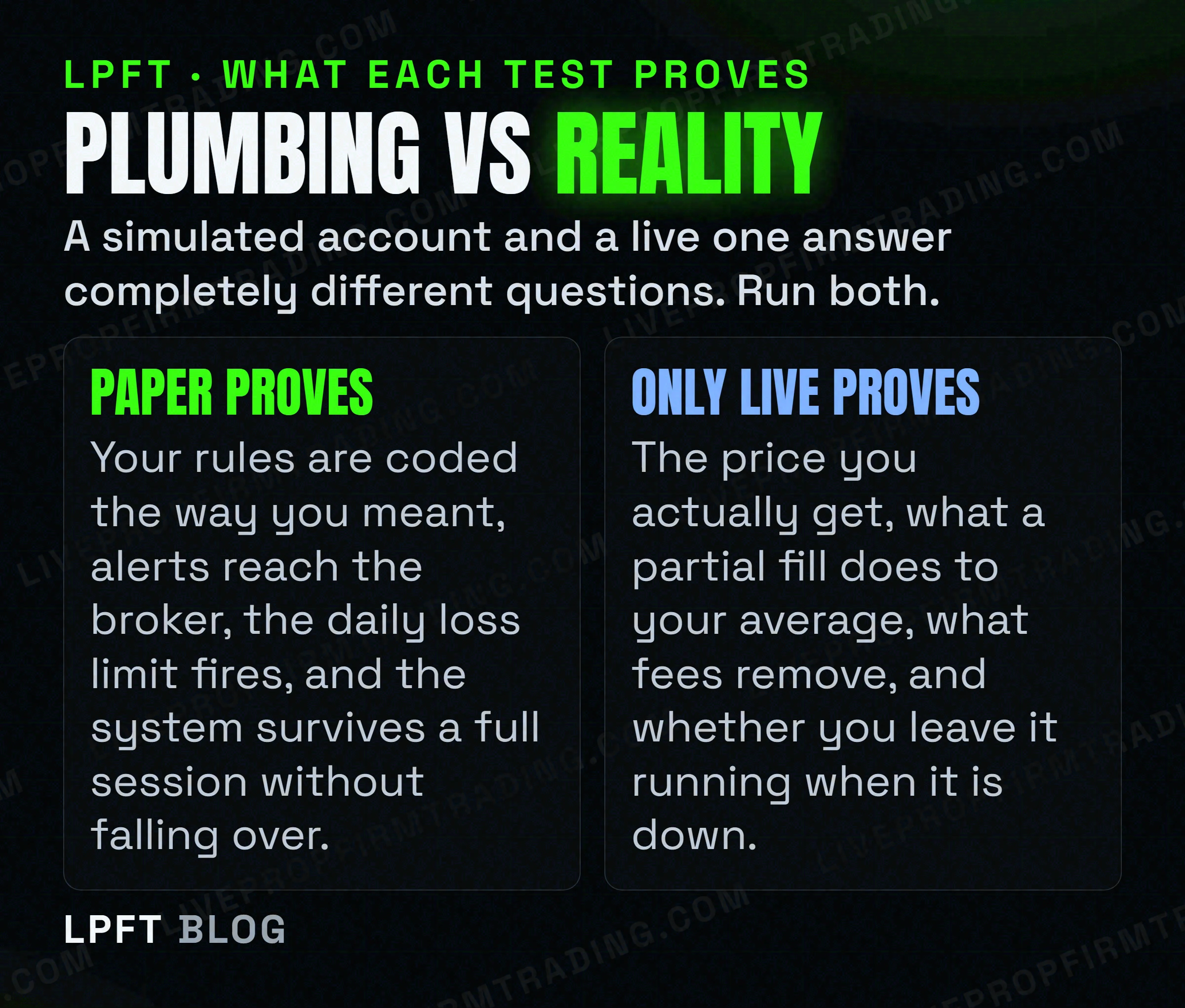
Paper trading proves your bot's logic and plumbing. It cannot prove your fills, because a simulator has no queue, no counterparty and no real slippage. Tradovate's own disclaimer states that simulated trading does not represent actual trading. Run both, in that order, then go live very small.
The LPFT Copilot runs on your own prop firm or Tradovate account, and you can watch it work on a simulated account before a cent is at risk. Start a 7-day free trial.
Start your 7-day free trialWhat a paper account is genuinely good for
Paper trading gets dismissed as a toy, usually by people who skipped it and paid for the privilege. For an automated system it is not a toy at all, it is the only cheap place to find out that your stop is on the wrong side, that your alert never reached the broker, or that the whole thing stops working at the session rollover.
The useful way to think about it is that a simulated account tests the machine, not the market. Every failure it catches is a failure of your build, and those are the failures worth catching for free. Tradovate offers a free simulated account with practice funds for exactly this, which makes the excuse for skipping it fairly thin.
- Does the order path work end to end? Signal, bridge, broker, filled position, recorded correctly.
- Do the risk limits actually fire? Force a losing day and watch the daily loss limit stop the system. If it does not stop, you have found the most important bug you will ever find.
- Does it survive a full session? Including the quiet hours, the open, and the point where the contract rolls.
- Does it do anything insane? Double entries, orphaned stops, a position it forgets it has. These are build errors and they are common.
The four things paper trading cannot show you
Tradovate publishes the honest version on its own simulated trading page. Simulated trading, they state, does not represent actual trading and is based on hypothetical conditions, and actual results may differ significantly due to factors such as market conditions, liquidity, execution, and the emotional and psychological impact of risking real money. That is the broker telling you, in writing, not to read too much into a sim result.
- Your place in the queue. In a simulator your resting order fills when price touches it. In the real book there were contracts ahead of yours, and sometimes price touches your level and leaves without you. Strategies that rely on limit fills at the edge of a move suffer most here.
- Slippage on the way out. Entries get the attention, but the stop loss is where the difference shows up, because a stop is a market order fired into the exact moment liquidity thinned out.
- Partial fills. Multiple contracts do not always fill at one price. Your average is worse than the single clean number the simulator reported.
- Your own behaviour. A drawdown on a practice account is a number. The same drawdown on a real account is the day you decide to "just check something" and turn the system off at the bottom. Automation removes emotion from the execution, not from the operator.
Sim results are usually a little too good, not too bad. Fills are optimistic, queues do not exist, and nothing hurts. Expect live to be worse than paper, and build your expectations around that rather than being disappointed by it.
A note on the numbers you will see quoted on this topic
Search this question and you will be told that paper trading overstates performance by some precise percentage, or that simulated bots fill at the mid price a specific share of the time against a lower share live. Those figures get repeated across a lot of articles and we could not trace any of them back to a published study or a broker document.
We are not going to repeat a number we cannot source, which is a slightly boring position to take on a blog. The directionally true statement is the one that survives checking: simulated fills are more favourable than real ones, and the size of the gap depends on your strategy, your instrument and the time of day you trade. A strategy resting limit orders in a thin overnight session has an enormous gap. A strategy taking market orders in a liquid session has a small one.
The practical consequence is that you cannot look up your gap, you have to measure it. That is what the third rung of the ladder is for.
TradersPost receives TradingView webhooks in the cloud and routes them to a broker, and Tradovate is explicitly supported. It runs independently of your computer, and there is a free 7-day trial to test the path before you commit.
Try TradersPostOn a funded account, good sim fills are a rules problem
This is the part that catches people out, and it almost never appears in a paper-versus-live comparison. If you are testing on a prop firm evaluation, that evaluation usually runs in a simulated environment, and the firms know perfectly well that simulated fills are generous.
MyFundedFutures puts it directly on their own rules page, read on 20 September 2026. Traders may make use of automated trading strategies tailored to their own specific settings, they state, so long as these automated tools do not aim to exploit the favorable fills offered in the Simulated Environment. They also state that high-frequency trading is not allowed on their plans, and that traders trading live accounts with automated trading must abide by CME guidelines.
A strategy that only works because the simulator fills it kindly is not merely fragile, at some firms it is a rules violation. That reframes sim-versus-live accuracy from a modelling curiosity into something that can cost you an account.
The test that protects you is simple. If your system shows a healthy result on the evaluation and a materially worse one on a single live micro contract, the difference is your fills, and you need to know that before you are funded rather than after. Rules differ a lot between firms, so read your own, and see manual versus automated trading for how differently four firms handle automation.
LPFT only supports prop-firm connections that run through Tradovate. You can point our tools at a firm's own API key at your own discretion, but a guarantee claim requires your full broker statement where applicable. Not every prop firm supports the Tradovate API, so always check yours first.
The ladder, and how long to spend on each rung
There is no universally correct duration, and anyone giving you one has not seen your strategy. What matters is that each rung answers its own question before you climb.
- Backtest. Was this ever sane? Covered in how to backtest a strategy before you automate it, including why the fills in your backtest were assumed rather than observed.
- Paper. Does the build work? Run it until it has handled everything a real week throws at it, including a losing day, a news event and a rollover. You are finished when it stops surprising you, not when a calendar says so.
- One micro contract, live. How big is my fill gap? A micro is the cheapest real answer available, and this rung cannot be skipped or simulated. Run it long enough to collect a reasonable number of trades in the sessions you actually trade.
- Compare all three, then decide. If paper and live broadly agree, you have a system you understand. If they do not, you have learned something important for the price of a few micro contracts.
A word on cost, because the third rung is the one people postpone. Trading a single micro is the cheapest tuition available in this business, and the figure that matters is what a losing test week actually costs you rather than what you hope to make. How much money you need to start works through that honestly.
Finally, the obvious thing that still needs saying. None of this makes trading safe. Futures carry a substantial risk of loss, testing reduces the chance of an avoidable mistake rather than the chance of a loss, and a system that passed every rung above can still have a bad month. Testing buys you informed risk, not less risk. That is still a very good trade.
The LPFT Copilot runs the whole stack for you on Tradovate - start a 7-day free trial and watch it work.
Start your 7-day free trialFrequently asked questions
Yes, for a specific job. Paper trading proves your rules are coded correctly, your orders reach the broker, your risk limits actually fire, and the system survives a full session. It cannot prove what price you would really get, which is a separate question that only live trading answers.
Because a simulator has no order queue and no counterparty. Your resting order fills the moment price touches it, stops fill at the requested price, and multiple contracts fill at one price. In a real market there were orders ahead of yours, stops slip, and large orders fill across several levels.
Until it has handled a losing day, a news event and a contract rollover without breaking, rather than for a fixed number of weeks. The signal to move on is that the system has stopped surprising you. Then go live on a single micro contract, not on size.
Yes. Tradovate advertises a free 14-day futures trading account with practice funds and real-time market data. Their own page also carries the disclaimer that simulated trading does not represent actual trading and that actual results may differ significantly due to market conditions, liquidity, execution and the psychological impact of risking real money.
Often yes, but check the firm's own rules first because they differ widely. MyFundedFutures, for example, permits automated strategies tailored to your own settings so long as they do not aim to exploit the favorable fills offered in the simulated environment, and states that high-frequency trading is not allowed on their plans.
A backtest replays historical data and estimates the fills, so it tests the idea. Paper trading runs forward in the live market with simulated money, so it tests the build and the plumbing. They catch different failures and neither replaces a small live test.
Eli Y.
Eli builds and runs rules-based automated futures systems on NinjaTrader and Tradovate, and helps traders take emotion out of the screen. He writes about futures automation, prop-firm evaluations, and the tools that connect them - plainly, and without hype.
Risk disclosure: Trading futures involves substantial risk of loss and is not suitable for everyone. This article is educational content only and is not financial advice or a recommendation to trade. Past performance is not indicative of future results. Some links are affiliate links.