
TradingView's November 1 Change for Paid Invite-Only Scripts: Announced, Then Paused

Heads up: some links below are affiliate links. If you sign up through them we may earn a commission at no extra cost to you - it never changes what we recommend.
Nothing changes on November 1, 2026. TradingView announced on September 30 that paid access to invite-only scripts would have to go through its Marketplace from November 1, then said on October 27 that nothing will change that day. Updated terms are due the week after.
The LPFT Copilot runs a tested, rules-based method on your own prop firm or futures account, with the bot inside NinjaTrader on your own computer. The 7-day free trial is offered until December 31, 2026.
Start your 7-day free trialTradingView invite-only scripts and November 1: the short version
TradingView says it will publish updated terms and an FAQ the week after November 1. We will update this page the day they are out. Everything below is quoted or summarised from TradingView's own two posts, linked in each section.
If you pay a seller for access to an invite-only Pine script, or your trades are automated from TradingView alerts, you have probably seen November 1, 2026 mentioned as the day things change. That date came from an announcement TradingView made on September 30. Four weeks later, on October 27, TradingView published a follow-up that changed what happens on that date.
So there are two posts to read, in order, and they do not say the same thing. Here is each one in plain words, what it means if you buy invite-only scripts, what it means if you automate from alerts, and what to watch next.
What TradingView announced on September 30
The post was titled Commercial scripts are moving to the TradingView Marketplace. Its central sentence said that selling access to an invite-only script, or providing that access as part of another paid product or service, would no longer be permitted starting November 1, 2026.
TradingView gave its reasons too. Running paid access through its own Marketplace lets it manage the whole process, with clear payment and refund terms for buyers, a review of every paid indicator, and faster action on breaches of its House Rules.
| Who | What the September 30 post said |
|---|---|
| Script authors | Can keep using invite-only scripts for non-commercial purposes, unchanged |
| Sellers | Contact creators@tradingview.com before November 1 to discuss a transition |
| Buyers who already paid | Keep access for the period already purchased, including lifetime access |
| Renewals | No new payments taken outside the Marketplace to renew, extend or maintain access |
| Sellers who did nothing | Their invite-only scripts would be blocked |
For buyers, the September plan protected what you had already paid for. What it removed was the renewal. When a paid period ran out, a seller could not take your money again outside the Marketplace to keep you on.
What changed on October 27
On October 27 TradingView posted Marketplace update: More flexibility and features are coming, and added an update line to the top of the September post pointing to it. Four things in it matter.
- Nothing changes on November 1. In TradingView's words, nothing will change on November 1 for you or your users, and your current experience will remain the same while it finalises and communicates the updated terms.
- November 1 closes a window, nothing more. It is the last day for vendors of invite-only indicators to submit their requests.
- New terms are coming the following week, together with an FAQ that TradingView says will address as many questions and concerns as possible.
- The direction is more flexible. The new terms will give sellers more flexibility in how they sell, for example selling indicators on their own website or as part of a trading course.
TradingView also said more than 1,500 script authors had contacted it about the transition. That number goes a long way to explain the change of course.
It does not say what the updated terms will contain in detail, and it does not address what happens to buyers once the new terms apply. Read the new terms yourself when they are published rather than relying on a summary.
If you pay for an invite-only script
The practical answer for November 1 is simple. Your invite-only scripts keep working, because TradingView said nothing changes that day. The open question is what the updated terms say about renewals and about sellers who sell outside the Marketplace.
- Note what you paid for and until when. Keep the receipt and the end date of your current period, whatever the new terms turn out to say.
- Ask your seller one question: what is their plan under the updated terms, the Marketplace, their own website, or something else.
- Be careful with long prepayments until the updated terms are public, so you know what a renewal will look like.
- Read TradingView's FAQ when it lands. It is the document that will answer buyer questions.
None of this needs action before November 1. It needs attention the week after.
If your trades are automated from TradingView alerts
The September announcement hit automated traders hardest, even though it was about selling scripts, not about alerts. The reason is the chain most alert automation sits on.
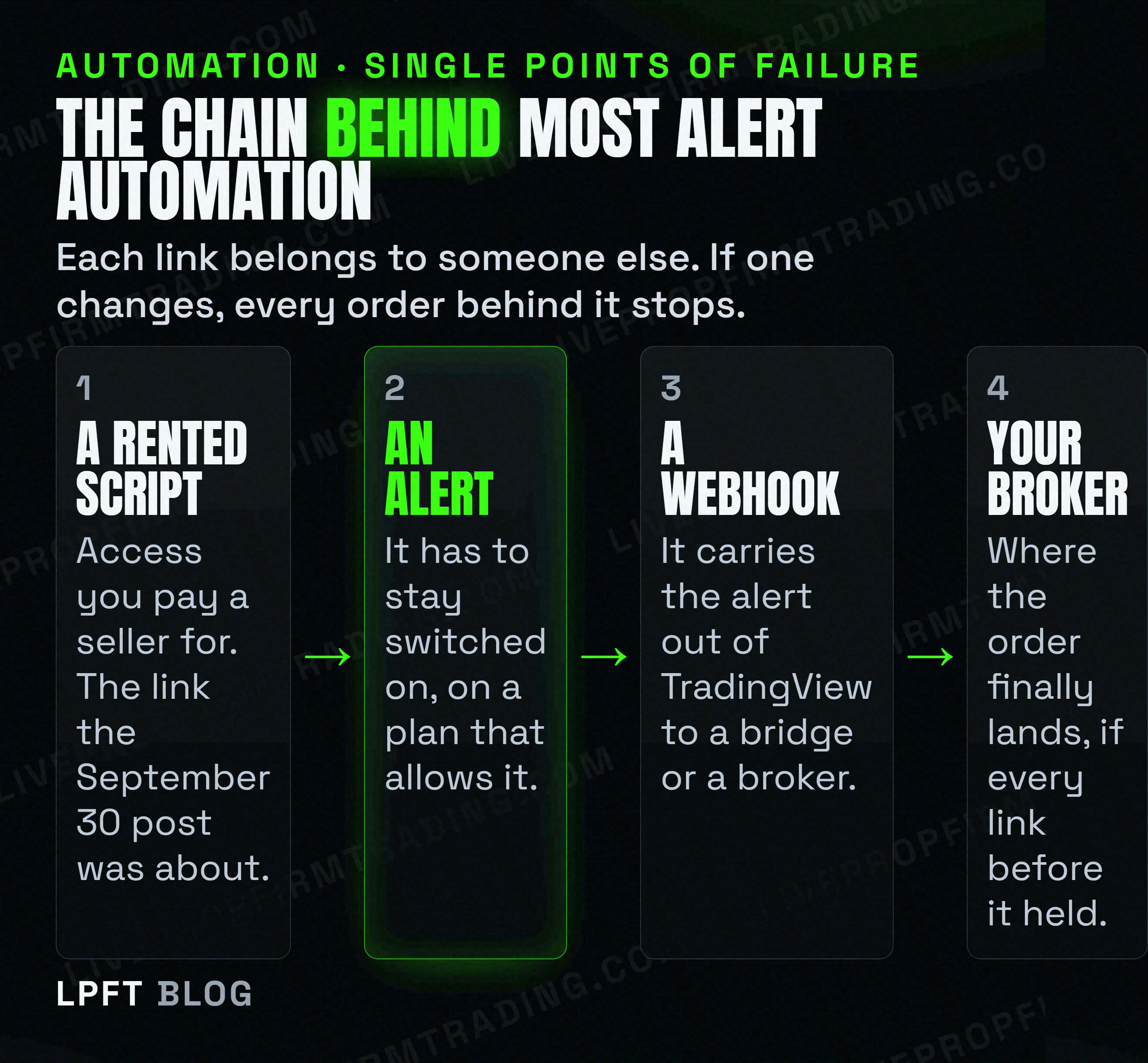
A script you rent from a seller. An alert on your chart that has to stay switched on. A webhook that carries the alert out, which needs a paid TradingView plan, as covered in our guide to TradingView free vs paid automation. And the broker at the end. Every one of those links is owned by someone else, and the September post showed how quickly the first one can be put in question.
That is not a reason to panic. It is a reason to know your plan B before you need it.
- Know where your logic actually lives. If the strategy only exists inside a script you rent, you cannot move it. Know what you own.
- Test a second route on a simulated account while nothing is wrong, not on the day something breaks.
- Keep exactly one signal source switched on. Two live sources for one account means one order placed twice.
- Keep your own records. Statements from your broker are the record that survives any platform change.
If you are new to the alert side of this, start with whether you can automate trading on TradingView at all, and how the pieces connect.
LPFT runs its bot inside NinjaTrader on your own computer, and the LPFT Copilot places the orders on your own prop firm or futures account. No TradingView plan, no alert to keep alive. The 7-day free trial is offered until December 31, 2026. Futures trading carries a substantial risk of loss.
Start your 7-day free trialWhat we did at LPFT, and why we are staying
We were in exactly that chain. LPFT's bot ran on a TradingView chart and sent an alert out to each member's app. After the September announcement we rebuilt it to run inside NinjaTrader, on the member's own Windows computer, with their own market data.
Before a single member switched, we ran both versions side by side on live markets for nine sessions, October 19 to 23, and they gave the same signals in every one. The NinjaTrader version went live for members on October 26. The full story of how we checked it is in TradingView to NinjaTrader: we moved a live bot.
TradingView has since paused its change, and we are staying on NinjaTrader anyway. Members no longer need a TradingView plan, there is no alert that can be switched off, and nothing in their automation now waits on another company's next decision. The trade-off is real too: NinjaTrader runs on Windows, so a Mac needs Windows as well, and TopstepX accounts cannot connect to it.
What to watch next
- The updated terms, due the week after November 1, per TradingView's October 27 post.
- The FAQ published alongside them, for buyer questions.
- Your seller's answer about how they will sell under the new terms.
- This page, which we will update the day the terms are out.
Trading futures carries a substantial risk of loss and is not suitable for every investor. Nothing here is legal or financial advice. Read TradingView's own posts, linked above, and decide for yourself.
Frequently asked questions
No. On October 27 TradingView said nothing will change on November 1 for sellers or their users, and that the current experience stays the same while it finalises its updated terms.
That selling access to an invite-only script, or including that access in another paid product or service, would no longer be permitted from November 1, 2026, and that paid access would move to the TradingView Marketplace.
November 1 is the last day for vendors of invite-only indicators to send TradingView their transition requests. TradingView says it will publish updated terms and an FAQ the following week.
TradingView's October 27 post says the new terms will give sellers more flexibility, for example selling indicators on their own website or as part of a trading course. The details come with the updated terms.
Under the September 30 plan, buyers kept access for the period already purchased, including lifetime access. The October 27 post does not address buyers beyond saying nothing changes on November 1, so check the updated terms when they are published.
Nothing changes on November 1. It is still a good moment to know which parts of your setup you own, to test a second route on a simulated account, and to keep exactly one signal source switched on.
Eli Y.
Eli builds and runs rules-based automated futures systems on NinjaTrader and Tradovate, and helps traders take emotion out of the screen. He writes about futures automation, prop-firm evaluations, and the tools that connect them - plainly, and without hype.
Risk disclosure: Trading futures involves substantial risk of loss and is not suitable for everyone. This article is educational content only and is not financial advice or a recommendation to trade. Past performance is not indicative of future results. Some links are affiliate links.