
Are Prop Firms Legal? Yes, and Legal Is Not the Same as Regulated

Heads up: some links below are affiliate links. If you sign up through them we may earn a commission at no extra cost to you - it never changes what we recommend.
Yes. Trading at a prop firm is lawful in the United States, and no US court has held the funded-account model unlawful. The useful question is a different one. Legal, regulated and recoverable are three separate things, and only the first is settled.
The LPFT Copilot runs a tested, rules-based method on your own futures account, with the risk limits built in. Start a 7-day free trial and watch how it behaves.
Start your 7-day free trialAre prop firms legal? Yes, and that is the least useful true thing about them
Search this question and look at who is answering it. On the day this was written, the first page of results was almost entirely pages published by prop firms themselves, plus comparison sites paid a commission when you sign up. That does not make any of them wrong. It does mean that nobody ranking for the question has a reason to tell you which part of the arrangement protects you and which part does not.
So here is the short version. No US statute names the funded-account business and makes it illegal. Buying an evaluation is not a crime, taking a payout is not a crime, and no US court has held the model unlawful. If that is all you came for, the answer is yes and you can stop reading.
The reason to keep going is that "legal" is doing far less work than people think. Three different questions get collapsed into it, and they have three different answers.
- Is it lawful? Yes, as far as anyone can show. This is the question the whole search results page answers.
- Is it regulated? That depends entirely on what the firm actually does with your orders and your money, and it is answered entity by entity rather than for the industry.
- If it goes wrong, what do you get back? This is the one that decides what happens to you, and almost nobody writes about it.
Number one is settled. Number three is where the money is. The rest of this page is about two and three, using what regulators and a federal court have actually put in writing.
Unregulated and illegal are not the same word. Plenty of lawful businesses sit outside financial regulation. The difference shows up only when something fails, which is exactly when you find out which rulebook you were under.
What is regulated in the chain, and exactly where it stops
A funded futures account is not one thing. It is a chain, and the links are not equally supervised. At one end is the exchange and its clearing house, which are overseen by federal regulators and are about as rule-bound as finance gets. At the other end is the agreement you clicked through. Somewhere in the middle, the chain stops being regulated and starts being a contract.
The regulator decides where that happens by looking at conduct rather than at branding. The National Futures Association puts it plainly on its own registration page: the Commodity Exchange Act "requires certain firms and individuals that conduct business in the derivatives industry to register with the CFTC", and "depending on a firm's business activity, registration is required unless it qualifies for an exemption or exclusion."
The two categories worth knowing are separated by one phrase. A futures commission merchant "solicits/accepts orders" for futures and similar products "while accepting customer funds". An introducing broker does the same thing "without accepting customer funds". Who holds the money is the hinge, which is why it is also the hinge for you.
And here is what that registration actually buys, in the regulator's own words. The CFTC's page on segregation says that "all customer funds for trading on designated contract markets (exchanges) must be kept apart ('segregated') from the futures commission merchant's (FCM's) own funds", and that customer funds in segregation "have a bankruptcy preference in the event of FCM insolvency." That is a real, specific protection. Note precisely what it attaches to: customer funds, held at a registered broker.
When you pay a firm for an evaluation, you are buying a service from a company. You are not depositing margin into a segregated customer account at a futures broker, so the segregation language above is not describing your fee. We are not lawyers and this is not a legal conclusion about your contract. It is a note about which sentence covers which pot of money.
None of this is an argument against funded accounts. It is an argument for knowing which link you are standing on. The same split runs through the automation question, where the law and the firm agreement give different answers, covered in are trading bots legal and firm by firm in which prop firms allow automated trading.
The one case that was meant to settle this, and how it really ended
If the model were plainly unlawful, you would expect a court to have said so. There is exactly one well-known US attempt, and the way it finished is the most useful fact on this entire topic. It is also the fact no firm-owned page will walk you through.
In August 2023 the CFTC sued Traders Global Group Inc., a company doing business as My Forex Funds, in federal court in New Jersey. Reading the complaint itself, the agency alleged that the firm acted as the counterparty to its own customers' trades and therefore should have been registered as a retail foreign exchange dealer, and it alleged fraud in connection with leveraged retail forex. On registration the complaint stated the company "is not, and has never been, registered with the Commission in any capacity."
That November the court ruled on the CFTC's request to freeze the business, granting it in part and denying it in part on a prima facie standard, which is a long way short of deciding the case. In its findings the court described the firm's own programs in the firm's own words, including an evaluation phase requiring "simulated profits" in a "demo account" before a trader "graduated to a so-called 'live account' or 'funded account'."
Then it went somewhere nobody expected. In May 2025 a Special Master filed a report recommending that the defendants' motion for sanctions "be granted and the complaint dismissed with prejudice", along with reasonable attorneys' fees and costs. On the regulator's conduct the report found that the CFTC "had the opportunity correct the false statements and impressions that had been made, yet it chose to go a different route in violation of its duty of candor to the Court." The CFTC's own press room carries the Acting Chairman's statement on the sanctions the same day, together with staff placed on administrative leave and a reorganisation of its enforcement division.
The case ended because of how the regulator litigated it, not because a court examined the business model and approved it. So there is no US precedent holding the funded-account model unlawful, and there is no precedent holding it lawful either. A page telling you "a court cleared prop firms" is as wrong as one telling you a court condemned them.
Two more things to keep straight. That case was about leveraged retail forex, not exchange-traded futures, and the two sit under different rules. And an allegation in a complaint is an allegation. Nothing in it was ever proven, and the complaint was dismissed. Treat it as a map of what a regulator thinks matters, which is useful, rather than as a finding about anybody.
Your firm sets its rules and a regulator sets theirs. Your process is yours. The LPFT Copilot runs a tested, rules-based method on your own futures account with the risk limits built in, so the thing you are judged on is something you can actually hold still.
Start your 7-day free trialSimulated, funded, and whose money is actually whose
This is the part that decides question three, and it is usually skipped because it sounds like a technicality. It is not. Whether your orders reach the exchange changes who is holding what, and therefore which rulebook applies when something breaks.
Futures firms are not hiding this. Reading one firm's own program page the day this was written, it describes itself in three short sentences: "trade real market conditions in a simulated trading environment", "simulated trading, real payouts", and that you get the ability to trade with the firm's money. That is a clear and honest description of the arrangement. We read one firm directly, so treat it as one firm rather than as every firm, and go and read yours.
Follow the consequence through. In a simulated account, the prices are real and the decisions are real, but your orders are not margin sitting in a segregated customer account at a registered futures broker. So the protection quoted earlier is not the protection you have. What you have instead is a commercial agreement with a company, and the quality of that agreement is the quality of your safety net.
- What you are owed comes from a contract. Payout terms, rule breaches and account closures are governed by the document you accepted, and a firm can change its published rules without telling you personally.
- The fee is spent when you pay it. Nobody is holding it for you in a designated account, which is why concentrating a large amount with one firm is a different decision from funding a brokerage account.
- "Unregulated" cuts both ways. It usually means fewer hoops for you and fewer obligations for them. The second half only matters on the worst day.
- Breaking a firm rule is not a legal event at all. It costs the account and often the balance, with no regulator involved, which is covered for automation in running a trading bot on a prop firm account.
A related confusion is worth naming while we are here. People assume that if a firm permits something, it must be lawful, and that if the law permits something, their firm must allow it. Neither follows. The same trap shows up with mirrored orders in is copy trading legal, where the lawful version and the permitted version are not the same set.
Check the firm yourself, in the regulator's own database
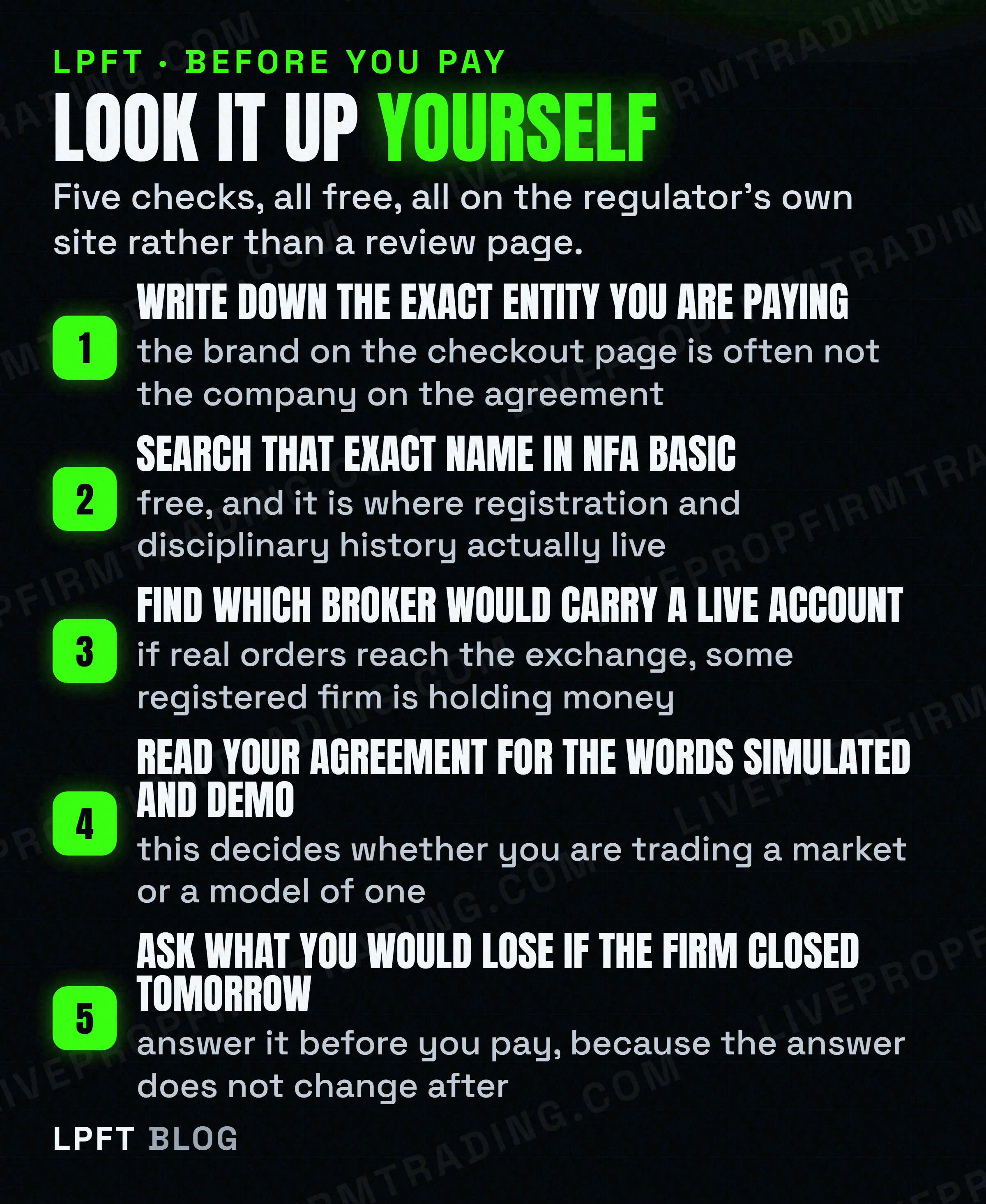
You do not have to take anybody's word for this, including ours. The CFTC tells the public exactly what to do, and it is one sentence: "before working with any person or firm to trade in commodity futures, commodity pools, options, forex, or other derivatives, verify that the entity is properly registered with the CFTC."
The same page is refreshingly blunt about what that check is worth, which is why it is worth quoting rather than paraphrasing. "While registration and a clean disciplinary record won't protect you from fraud, most scams involve unregistered entities, people, and products." And the sentence that matters most for the question on this page: "if you lose money to fraud or other bad practices, you are less likely to be protected if you do business with entities that are not registered with the CFTC."
The lookup it points you to is BASIC, run by the National Futures Association, which describes it as "a free tool that NFA Members and investors can use to research the background of derivatives industry professionals." You can search by firm name or NFA ID, by individual, or by pool. It also warns that an entity may hold licences beyond what the NFA oversees, and points to FINRA BrokerCheck for the securities side.
| What to look up | Where | What it actually tells you |
|---|---|---|
| The exact company name on your agreement | Your own paperwork | Which legal entity you have a contract with, which is frequently not the brand on the website |
| That entity in NFA BASIC | The regulator's free database | Whether it is registered, in what category, and whether there is disciplinary history |
| Whoever would carry a live account | Your agreement, then BASIC | If real orders reach the exchange, a registered firm is holding money and segregation rules are in play |
| The words simulated, demo and live | The agreement and the program page | Whether you are trading the market or a model of it, which decides which protections exist |
| The payout and breach terms | The agreement, dated and saved | What you are owed and what ends it, since this is the rulebook you are actually under |
Save a copy of the terms the day you accept them. Published rules change without an announcement, and the version you agreed to is the only one you can point at later.
What this actually changes about how you trade
Nothing above is a reason to avoid funded accounts. They solved a real problem, which is that futures is expensive to learn on your own money. The point is to stop treating "is it legal" as the safety question, because it was never the one that could hurt you.
- Assume you are under a contract, not under a regulator. Read the agreement like it is the only rulebook, because for the part you bought it mostly is.
- Size the fee like an expense, not a deposit. If losing it entirely would change your month, that is the number to look at before anything else.
- Do not concentrate everything at one firm. This is counterparty thinking, the same habit that makes people keep brokerage and savings separate.
- Run the five checks above once per firm. It takes a few minutes and you never have to wonder again.
- Own your process, since it is the only link you control. The exchange, the broker and the firm all run on rules you did not write. How you decide and how you limit a bad day are entirely yours.
That last one is the honest reason this question keeps getting asked. Traders want reassurance that the structure will look after them. It will not, in either direction. Trading futures involves a substantial risk of loss, the firm is a company rather than a guardian, and the only part of the chain you can hold still is your own behaviour.
The LPFT Copilot runs the whole stack for you on Tradovate - start a 7-day free trial and watch it work.
Start your 7-day free trialFrequently asked questions
Yes. No US statute names the funded-account business and prohibits it, buying an evaluation is not unlawful, and no US court has held the model illegal. The more useful question is whether the specific firm is regulated, because registration is decided by what a company does with orders and customer money, not by what the industry is called.
That is answered entity by entity rather than for the industry. The National Futures Association lists registration categories based on conduct, and the key split is that a futures commission merchant accepts customer funds while an introducing broker does not. The way to find out about your own firm is to search the exact company name on your agreement in the NFA BASIC database, which is free.
No. The best-known US attempt was a CFTC case filed in 2023 against Traders Global Group Inc., doing business as My Forex Funds. In May 2025 a Special Master recommended that the complaint be dismissed with prejudice as a sanction, finding the agency had violated its duty of candor to the court. Nothing alleged was ever proven, and no court examined and approved the model either.
The protection written into futures rules attaches to customer funds held at a registered broker, where the CFTC says such funds must be kept apart from the firm's own and have a bankruptcy preference if that broker fails. An evaluation fee paid to a company is a payment for a service rather than margin in a segregated account, so read your agreement and ask what you would lose if the firm closed tomorrow.
No, and the two questions are unrelated. Firms describe this openly, and one futures firm's own program page says it offers real market conditions in a simulated trading environment with real payouts. Simulation changes which rulebook covers your money, which is worth understanding. It is not evidence of bad faith on its own.
Yes, and this is the outcome people actually experience. Breaching a rule in the agreement you accepted costs the account and often the balance, with no regulator and no legal process involved. That is a contract consequence rather than a legal one, which is why the document matters more than the question of legality.
Eli Y.
Eli builds and runs rules-based automated futures systems on TradingView and Tradovate, and helps traders take emotion out of the screen. He writes about futures automation, prop-firm evaluations, and the tools that connect them - plainly, and without hype.
Risk disclosure: Trading futures involves substantial risk of loss and is not suitable for everyone. This article is educational content only and is not financial advice or a recommendation to trade. Past performance is not indicative of future results. Some links are affiliate links.