
Is Copy Trading Legal? Yes, and Who Copies Whom Decides the Rest

Heads up: some links below are affiliate links. If you sign up through them we may earn a commission at no extra cost to you - it never changes what we recommend.
Yes. Mirroring orders is not unlawful, and in US futures the phrase usually means one person copying their own order into their own accounts. Direction decides the rest. Trading for others raises a registration question, and the firms we read refuse a second person in the loop.
The LPFT Copilot runs a tested, rules-based method on your own futures account, with the risk limits built in. Start a 7-day free trial and watch how it behaves.
Start your 7-day free trialIs copy trading legal? Start by splitting the word in two
Almost every page that answers "is copy trading legal" is answering a question about retail forex. The picture it has in mind is a social feed inside a broker platform, where you browse strangers by their equity curve, tick a box, and their trades appear in your account. That is one real meaning of the phrase, and the answer for it is mostly yes.
It is not the meaning most futures traders are asking about. In futures, and especially around funded accounts, copy trading almost always describes something close to the opposite. Topstep defines its own tool in one sentence on their site: "A trade copier is a tool that lets you place a trade in one account and automatically copy that order into your other accounts." Your order. Your other accounts. No second human anywhere in it.
And they go further, because the confusion is common enough to be worth heading off. The same page says: "You might have heard of the term trade copying as an alert service. Where a 'Guru' sends you their entries and exits, and you copy them. That is not what we're talking about here (and we would never recommend doing that)."
The two meanings have different legal questions and opposite outcomes with a prop firm. One is widely permitted and one will close your account. An article that treats them as one topic cannot tell you which one you are about to do.
Three directions, three different answers
Once you ask who is copying whom, the whole subject stops being vague. There are only three directions a copied trade can travel, and each one sits in a different place.
- You into your own accounts. You place one order, software repeats it in the other accounts in your name. Nobody is advised, nobody is paid, and there is no customer. This is the common futures case and the one firms write rules for.
- Somebody else into your account. You follow a person or a paid service and their decisions land in your account. Lawful for you as the account holder. The question lands on the person selling the calls, not on you, and separately this is the direction prop firms refuse.
- You into somebody else. You run a copier into a friend's account, manage a relative's account, or sell your entries. Now you are advising or trading for another person, and that is where the registration question actually lives.
Notice that the software is identical in all three. The same copier, the same wiring, the same button. What changes is who benefits and who decided, which is exactly what the rules are written about. It is the same lesson as are trading bots legal, where the law turns out to care about conduct rather than about code.
The LPFT Copilot runs a tested, rules-based method on your own futures account, with the risk limits built in. Nothing is mirrored from another person, so there is no second human in the loop for a firm to object to.
Start your 7-day free trialWhat the law actually asks, and it is not about software
In US futures the relevant definition is the commodity trading advisor, and the NFA words it as an individual or organisation that, for compensation or profit, advises others, directly or indirectly, as to the value of or the advisability of buying or selling futures contracts, options on futures, retail off-exchange forex contracts or swaps. Read "advises others" and "for compensation or profit" slowly, because those two phrases carry the whole thing.
The clause that settles the copy-trading case is the one explaining what direct advice includes. The NFA says direct advice includes exercising trading authority over a customer's account, or giving advice based on or tailored to the positions or circumstances of particular clients. Pressing the button inside somebody else's account is named in the definition. Pressing it inside your own is not, because there is no customer and no advisory relationship to be in.
There are exemptions, and NFA summarises them from CFTC Regulation 4.14 on its own page. Advice given to fifteen or fewer people in the past twelve months while not generally holding yourself out to the public as a trading advisor. Advice that is solely incidental to another CFTC-registered business. Advice that is not based on or tailored to a particular customer account or trading activity. That last one is why a published newsletter sits differently from running a copier into a client account.
We build and run systems, we are not lawyers, and the summary above is here so you know which questions exist. If you are about to take money to trade for somebody, or to sell your entries, that is the moment for a futures lawyer in your own jurisdiction rather than an article.
What the futures firms permit, read on their own pages today
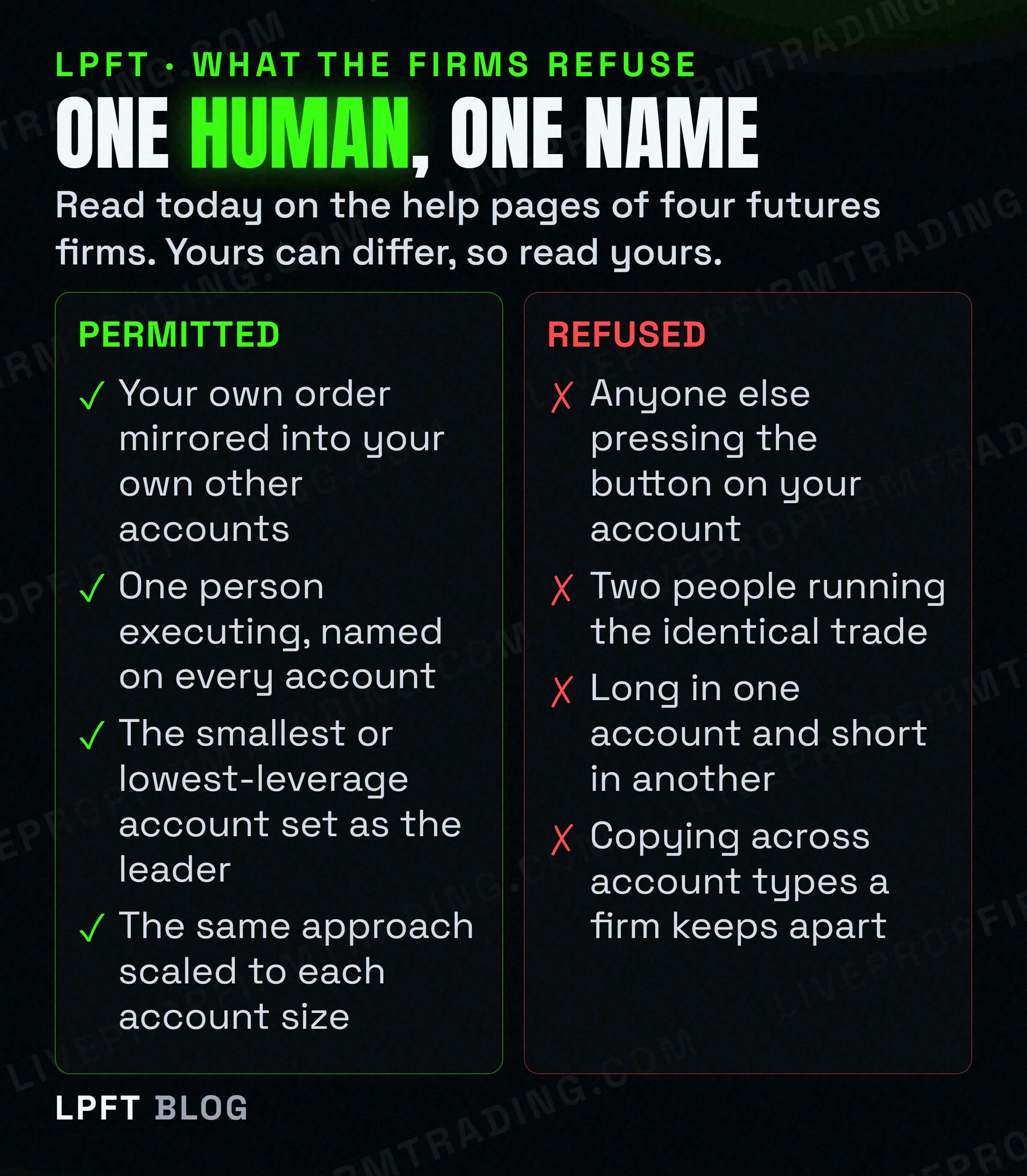
Legality and permission are two different rulebooks, and the second one is the one that closes accounts. So we read four firms on their own help pages the day this was written. The pattern was the same at all four, and it matches the law's line for a completely different reason.
| Firm | From their own help pages, read 3 October 2026 |
|---|---|
| Topstep | Prohibited conduct includes "Trading on behalf of others - including sharing incentives as part of any business arrangement" and "performing trades in concert with others (including unconnected accounts or third parties) to pool risk, hedge aggregate positions, or trade the same or opposite strategy simultaneously". |
| TradeDay | "Trade copiers are allowed from your personal accounts or other evaluations in to your TradeDay account." A trader may trade up to ten accounts in total, copying between the funded live side and the evaluation or funded sim side is not permitted, and there is one username and one user per household. |
| Alpha Futures | "Copy trading in general is permitted as long as it is a single user executing the trades, and it is the single individual listed on the Alpha Futures Accounts." Automated, group and reverse trading are strictly prohibited, and they are "not liable or able to fix any issues you may face while using a trade copying software". |
| MyFundedFutures | "MyFunded Futures allows copy trading across all account types", with the user assuming full responsibility and the firm disclaiming liability and support. Separately, all accounts in a challenge must be "exclusively traded by the account owner", and shared devices are forbidden. |
Put the four side by side and the permitted shape is narrow and consistent. Your own order, into accounts that carry your name, executed by one human being. The refused shape is just as consistent, and every version of it has a second person in it. Somebody else trading your account. Two traders running the same trade. Opposite legs held across accounts so the risk cancels out and a payout becomes arithmetic rather than trading.
That last one deserves its own warning, because traders walk into it while trying to be careful. Holding long in one account and short in another looks like hedging and reads to a firm as manufacturing a pass. Topstep names pooling risk and hedging aggregate positions across accounts in its prohibited conduct, and this is the fastest way to lose several accounts at once rather than one. The funded-account side of automation is covered in running a trading bot on a prop firm account, and the firm-by-firm automation picture is in which prop firms allow automated trading.
Two of the biggest names in futures prop would not serve us their rules pages at all on the day this was written. We are not going to tell you what their copy-trading policy says, because we could not read it. Neither should anyone else who has not read it today.
The costs nobody mentions, even when copying is allowed
Permission is the beginning of the question rather than the end of it. A copier that is entirely within the rules can still be the thing that ends a good month, in four ways that have nothing to do with legality.
- Nobody owns it when it breaks. Two of the four firms above say in writing that they are not responsible for copier problems and are not obliged to help you troubleshoot one. The copier is a third piece of software sitting between your decision and several accounts, and when it misbehaves you are the support desk.
- A mismatch silently stops copying. Alpha Futures suggests setting the smallest or lowest-leverage account as the leader, because unequal buying power breaks the copy. A follower account that quietly stopped receiving orders is not obvious until you look, and by then the accounts have different positions.
- One bad trade becomes several. Copying multiplies the decision, not the quality of it. The upside is covered everywhere and the symmetry rarely is. A day that would have cost one account its daily limit can now cost all of them.
- The account types do not mix. At least one firm forbids copying between its live funded accounts and its evaluation or sim accounts, and forbids holding live positions in both at once. A single copier pointed at everything can breach that without you placing a single extra order.
None of this argues against copiers. It argues for knowing that a copier is infrastructure you now own, with its own failure modes, and that it deserves the same suspicion you would give any other piece of the stack. A copied trade is still a trade you are responsible for, which is also the difference between a copier and a futures trading bot that decides on its own rules.
A checklist before you connect a copier to anything
- Write down which direction you are copying. Into your own accounts, from somebody else, or out to somebody else. The answer decides every other question on this page, and people skip it because it feels obvious.
- Read your own firm's page today. Not the version you remember, and not a roundup article. These pages change without an announcement, and the only one that matters is the one live right now on the firm's own site.
- Check whether the rule changes between phases. Firms routinely treat evaluation accounts and funded accounts differently, and at least one forbids copying between the two sides entirely.
- Confirm every account is in your name and traded only by you. The single condition that appeared at every firm we read was one human, named on each account. Household members and shared machines are explicitly a problem at some firms.
- Never hold opposite sides across accounts. Long in one and short in another is prohibited by name and is treated as gaming the evaluation, not as risk management.
- Ask what happens when the copier fails, before it does. Decide now how you will notice a follower account that stopped receiving orders, because nothing will tell you.
Do those six and you have answered both halves of the question. The legal half was never the dangerous one.
Frequently asked questions
Yes. There is no law against software repeating an order, and copying trades through your own account is a normal activity. The legal question attaches to whoever is advising or trading for other people for compensation, because US futures rules define a commodity trading advisor as someone who, for compensation or profit, advises others about trading futures.
Not to copy your own order into your own accounts, because you are advising nobody and there is no customer. The question becomes live when you exercise trading authority over somebody else's account or sell tailored advice, which the NFA names as direct advice. There are exemptions, including advice to fifteen or fewer people while not holding yourself out to the public as a trading advisor, and that is a question for a futures lawyer rather than a blog.
Yes, and this is the distinction that decides what actually happens to you. Legality comes from law and permission comes from the agreement you signed. Breaching a firm rule costs you the account and often the balance, with no legal process involved at all, and firms differ enough that only your own firm's current page can answer it.
At the four futures firms we read, yes, with conditions. The consistent requirement is that one person executes and that person is the individual named on every account. Firms add their own limits on how many accounts, which account types may be linked, and which account must lead, so read the page belonging to your firm before you connect anything.
Buying information is not unlawful for you. Two things are worth separating. The seller may fall inside the trading advisor definition depending on compensation and how tailored the advice is, and separately your prop firm may forbid the arrangement outright. Several futures firms prohibit trading in concert with others or having anybody else decide your trades.
No, and the difference matters to a firm. A copier repeats a decision that a human already made, so the question is who that human was. A bot makes the decision itself from fixed rules, so the question becomes whether automation is allowed and whether the system is genuinely yours rather than purchased or shared.
Eli Y.
Eli builds and runs rules-based automated futures systems on TradingView and Tradovate, and helps traders take emotion out of the screen. He writes about futures automation, prop-firm evaluations, and the tools that connect them - plainly, and without hype.
Risk disclosure: Trading futures involves substantial risk of loss and is not suitable for everyone. This article is educational content only and is not financial advice or a recommendation to trade. Past performance is not indicative of future results. Some links are affiliate links.