
Prop Firm Evaluation vs Funded Account: What Actually Changes When You Pass

Heads up: some links below are affiliate links. If you sign up through them we may earn a commission at no extra cost to you - it never changes what we recommend.
Sometimes, and which firm you signed with decides it. One firm allows bots through its API and bars that same API on live funded accounts. Another applies one rulebook to every stage by name. The evaluation is a different environment, not a smaller funded account.
The LPFT Copilot runs a tested, rules-based method on your own futures account with the risk limits built in. Start a 7-day free trial and watch how it behaves before anything is riding on it.
Start your 7-day free trialProp firm evaluation vs funded account: what changes depends on the firm
Most people meet this question in the worst order. They buy an evaluation, pass it, and then find out what the funded account does differently. By that point the useful moment has gone, because the thing you would have changed was the firm you picked.
Look at who answers the question when you search it. On the day this was written the first page was bridge and copier vendors, affiliate sites paid when you sign up, and firms writing about their own funnel. At the firms, "evaluation vs funded" quietly turns into a pricing choice between an evaluation and instant funding, which is a different question. Not one result quoted a firm agreement on whether the rules themselves travel with you.
So five firms were read directly, on their own help pages and agreements, on one day. They gave three different shapes of answer, and two of them contradict each other outright. That disagreement is the real finding, because it means there is no industry answer to inherit.
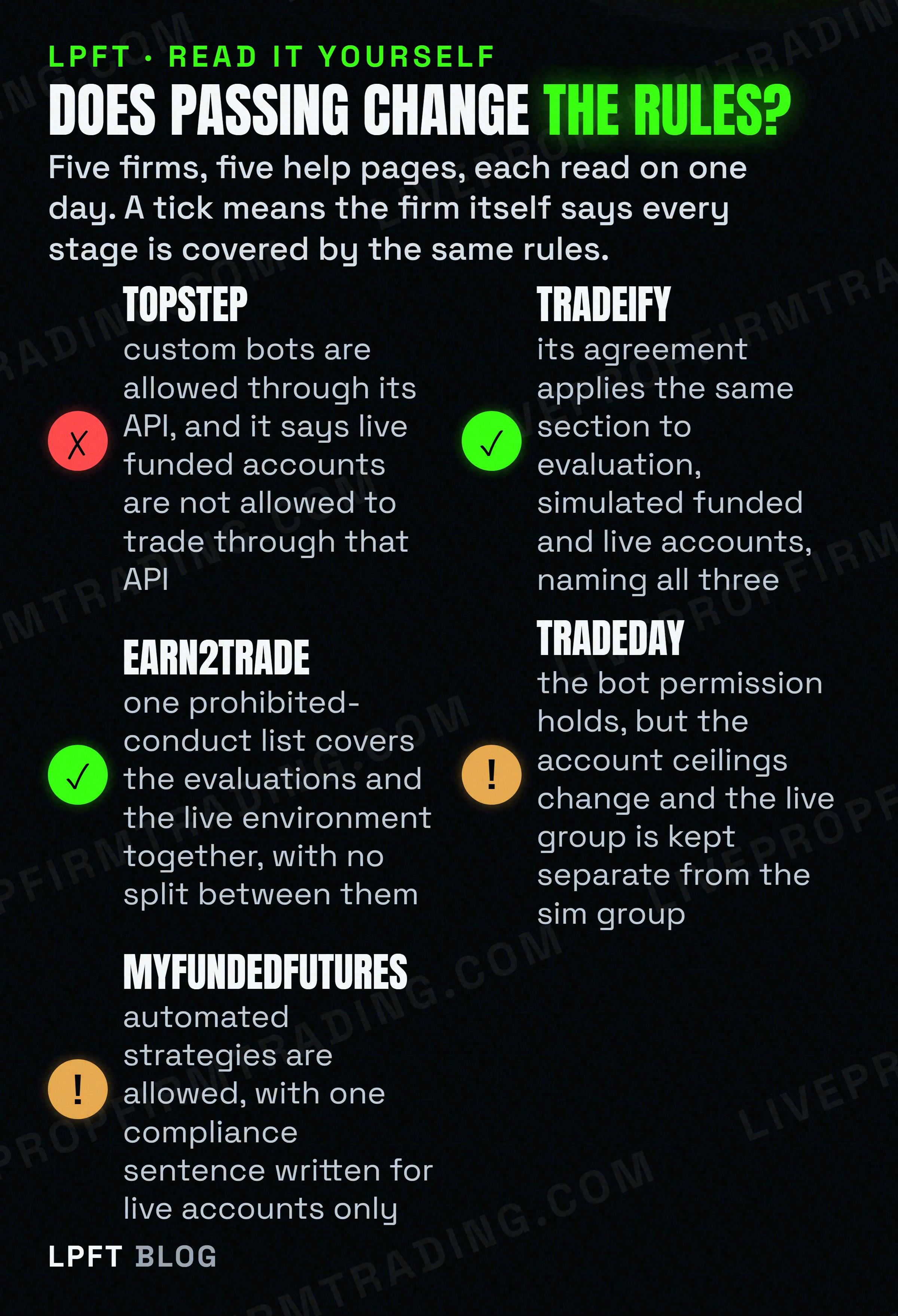
- The permission can stop at the funded line. One firm allows custom bots through its own API and states that live funded accounts may not trade through that API at all.
- Or the agreement can say nothing changes, by naming every stage. One firm puts evaluation, simulated funded and live accounts in a single clause so the question cannot be argued.
- Or the permission holds and the structure moves instead. The bots stay allowed, while the number of accounts and the separation between sim and live change underneath you.
Those are not three opinions about one rulebook. They are three different rulebooks, and the only way to know which one you are under is to read the one you accepted.
Everything below is per firm, as published on one day. Firms change rules without telling anybody personally, and these five already disagree with each other. Treat every line here as a reason to go and read your own agreement, never as a substitute for it.
The evaluation is a different environment, and one firm says so against its own interest
Before the rules, the ground they sit on. An evaluation is usually a simulated environment, and a simulated environment fills orders with an algorithm rather than with a real counterparty. That sounds like a technicality until you notice which party is willing to say it out loud.
Reading one futures firm's own fair-play page the day this was written, it states that "certain trading strategies may exploit the simulated fill algorithm, performing well in the evaluation stage but inevitably resulting in losses when transitioned to live markets." That is the firm selling the evaluation telling you that its own evaluation can be passed by something that then loses money in live markets.
The same page names the mechanism. Under the heading on slippage and bracket usage it says that "exploiting the absence of slippage and utilizing tight brackets to gain from favorable fills are not permitted." Slippage is the gap between the price you asked for and the price you got. In simulation that gap can be close to nothing, and anything tuned to that absence is tuned to a condition that does not survive the trip.
A second firm, read the same day, treats it as prohibited conduct rather than as a warning. Its prohibited-strategies page lists "running scalping algorithms designed to exploit unrealistic SIM fills" and "repeatedly exploiting the relative lack of slippage in SIM to achieve impossible stop-loss execution." Two firms, independently, naming the fill engine as the thing a strategy can be built to game.
It is evidence about the evaluation. That is not nothing, and it is less than it sounds, because the environment that produced the result is one the firms themselves describe as different from live markets. Nobody can tell you what any method will do next, here or anywhere.
This is also why the honest version of the question is not "will my bot still be allowed". It is "was the thing I proved a property of my method, or a property of the simulator". Those come apart in exactly the way the first firm described, and the groundwork for telling them apart is covered in paper trading versus live bot testing.
Where the permission itself stops at the funded line
Now the rules. The sharpest case comes from the firm with one of the more permissive automation policies in futures, which is what makes it worth reading closely.
Its API documentation page says plainly that "custom automated strategies and bots are allowed via the TopstepX / ProjectX API, subject to standard platform rules" and its prohibition on high-frequency trading. Read that and you would reasonably conclude that automation is settled at this firm.
Further down the same page, in answer to its own question, it says: "No, Live funded accounts are not allowed to trade through the ProjectX API." The API that the permission is granted through operates in simulated environments only. The bots are allowed. The route they use is closed on live funded accounts.
Be precise about the scope, because it is easy to over-read. That page applies its rules uniformly across the evaluation and the express accounts and states no difference between those two. The stage-dependent line is this one, about live funded accounts specifically. It is not a general warning that this firm's automation rules change when you pass.
The same page carries a second rule that catches automated traders regardless of stage. "All trading activity must originate from your personal device. The use of VPS, VPNs, and remote servers is prohibited." On a private server it allows research, logging and read-only dashboards, while "placing, modifying, or cancelling orders" and any automated trigger that can reach the order endpoints are barred. Its own summary is the clearest line on the page: "your server can watch and record, but it cannot trade."
Which firms allow what, and where each policy is published, is the subject of its own page in which prop firms actually allow automated trading. The point here is narrower and easy to miss: a permission can be real at one stage and unreachable at the next.
Firms rewrite rules and close routes whenever they like. Your own process is the one input that is yours. The LPFT Copilot runs a tested, rules-based method on your own futures account with the risk limits built in, so what you are judged on is something you can hold still.
Start your 7-day free trialWhere the agreement says in writing that nothing changes
The opposite answer exists, and it is more reassuring to read than any marketing page, because it is written in the document that would be used against you.
One firm's funded trader agreement, read directly the day this was written, closes the question by listing the stages. Its prohibited-activity sections state that "this Section applies at all times and to every account type, including without limitation evaluation accounts, Simulated Funded Accounts, and Tradeify Elite Live accounts." There is nothing to interpret. Three stages, one set of rules, named in the clause.
What those rules are matters as much as their reach. The same agreement says "personal bots are allowed as long as they are not high-frequency trading (HFT) bots", requires that "the Trader must be able to prove that the Trader is the sole owner of the bot or strategy", and states that using it across multiple firms is against policy because "the bot must be solely for the Trader's own use." It also sets a hold-time floor: "50% or more of the Trader's account profit must come from trades held longer than ten (10) seconds."
Two consequences worth sitting with. A purchased or shared bot fails the sole-ownership test at every stage, not just the funded one. And the ten-second floor is measured on where your profit came from rather than on any single trade, so it is a property of the whole account rather than a rule you break once.
A second firm reaches the same place by how it organises its rules. Its prohibited-conduct article covers its evaluations and its live trading environment in one title, and the list underneath does not separate them. The automation clause bans "utilizing software, artificial intelligence, or ultra-fast data entry techniques that could potentially manipulate the trading environment or provide an unfair advantage." Worth noting that this firm does not use the term high-frequency trading at all, so do not translate its wording into another firm's vocabulary.
Naming every account type in one clause costs a firm nothing except the ability to reinterpret the rule later. When the stage question is answered in the agreement rather than in a blog post, there is less for either side to argue about on the day it matters.
Where the permission holds and the structure moves instead
The third shape is the one that catches people who scaled something up. The bots stay allowed and the sentence you relied on does not change. What changes is the shape of the thing you are allowed to run it on.
One firm, read directly, allows up to ten accounts in total, described as "any mix of accounts types, with a max of 10 evaluation accounts, 5 Funded Sim accounts and 5 Funded live accounts." Its copier rules then split along the same line. You "may copy trade any combination of Evaluation and Funded Sim accounts, with 2 to 10 accounts total" and "may copy trade between up to 5 Funded Live accounts", while copying between those two groups is "not permitted."
It goes further than a ceiling. The same page says "you cannot have active trades simultaneously across a Funded Live account and an Evaluation or Funded Sim account", regardless of whether a copier is involved, because each account type "must be managed and executed independently." An operation that grew comfortably across evaluations meets a lower ceiling and a hard wall the moment live accounts are in the mix.
A quieter version of the same thing appears at the firm quoted earlier about simulated fills. Its automation rules are stage-neutral until one sentence, which says that "traders trading live accounts with automated trading must abide by CME guidelines." The permission did not move. An obligation was added, and it was written for live accounts only.
| The firm says | What moves at the boundary | Where it is written |
|---|---|---|
| Bots allowed through our API | the API itself is closed to live funded accounts, so the route disappears | the firm's own API help article |
| Every account type, named in the clause | nothing, and that is the point of naming all three stages | the funded trader agreement |
| One list for evaluations and live | nothing, the prohibited-conduct rules are not split by stage | the firm's prohibited-conduct article |
| Copiers allowed, up to ten accounts | the ceiling per type, plus a ban on mixing live with sim | the multiple-accounts help page |
| Automated strategies allowed | an extra compliance obligation attached to live accounts only | the fair-play and prohibited-practices page |
Read down that middle column and the pattern is clear. Three of the five change something at the funded line, and only one of those three changes the permission. The other two change the plumbing, which is the kind of rule people discover by tripping over it rather than by reading it.
None of this touches the loss limits, which run on their own logic and are the most common way a funded account actually ends. Those are covered in automated trading and prop firm drawdown rules.
What to do before you pass, which is the only time it is cheap
Everything above is answerable in about twenty minutes, for free, before you spend anything. After you pass, the same questions cost you the time you already put in.
- Search your firm's help centre for the word "live" and read every hit. That single word is where the stage-dependent rules were hiding at three of the five firms read for this page.
- Find out whether your automation route is allowed on the account you will end up on, not just on the one you are buying. A permission granted through an API is only as good as that API's access at the funded stage.
- Check whether the agreement names the account types. A clause that lists evaluation, simulated funded and live has answered the question. Silence has not.
- Look for the account ceilings and any wall between sim and live before you build anything that spans more than one account.
- Save the terms the day you accept them, with the date. Published rules change without an announcement, and the version you agreed to is the only one you can point at later.
- Ask what your result would be worth in live conditions. Two firms say in writing that the simulator can flatter a method. Price that in while it is still a question rather than a surprise.
And keep the two halves of this separate in your head. The firm owns its rulebook and can rewrite it. You own your process. Trading futures involves a substantial risk of loss, no method can be shown to work in advance, and the only part of the arrangement that does not change when you pass is how you decide and how hard you cap a bad day. The habits that get you through an evaluation without doing damage are the same ones the funded account rewards, which is the argument made in how to pass a futures prop firm evaluation without overtrading.
The LPFT Copilot runs the whole stack for you on Tradovate - start a 7-day free trial and watch it work.
Start your 7-day free trialFrequently asked questions
At some firms yes, at others no, and the firms disagree with each other in writing. One futures firm allows custom bots through its API and states that live funded accounts are not allowed to trade through that API. Another firm's agreement applies the same section to evaluation, simulated funded and live accounts by name. There is no industry default, so the only reliable answer comes from the agreement you accepted.
An evaluation is the stage where a firm measures whether you can reach an objective while respecting its risk rules, and a funded account is the stage where payouts and scaling become possible. The difference that catches automated traders is that the two are often different environments rather than different sizes of the same one, and some rules are written for only one of them.
One futures firm says so on its own fair-play page, stating that certain trading strategies may exploit the simulated fill algorithm and perform well in the evaluation stage but inevitably result in losses when transitioned to live markets. Another firm prohibits scalping algorithms designed to exploit unrealistic simulated fills. Treat a pass as evidence about the evaluation environment rather than as a forecast.
Not at the firms read for this page. One firm caps accounts separately by type, allowing a maximum of ten evaluation accounts, five simulated funded accounts and five live funded accounts, and says each account type must be managed and executed independently. It also bars holding active trades simultaneously across a live funded account and an evaluation or simulated funded account.
That depends on the firm and it is one of the rules most likely to change at the funded boundary. One firm permits copying across a combination of evaluation and simulated funded accounts, and separately between up to five live funded accounts, while copying between those two groups is not permitted. Check the account-type wording rather than the headline account count.
Read the firm's own help centre and agreement rather than a comparison site, and search them for the word live, which is where stage-specific rules tend to sit. Confirm that your automation route is permitted on the account type you will finish on, check whether the agreement names the account types explicitly, and save a dated copy of the terms on the day you accept them.
Eli Y.
Eli builds and runs rules-based automated futures systems on TradingView and Tradovate, and helps traders take emotion out of the screen. He writes about futures automation, prop-firm evaluations, and the tools that connect them - plainly, and without hype.
Risk disclosure: Trading futures involves substantial risk of loss and is not suitable for everyone. This article is educational content only and is not financial advice or a recommendation to trade. Past performance is not indicative of future results. Some links are affiliate links.