7 Trading-Bot Myths That Quietly Cost Beginners Money

Heads up: some links below are affiliate links. If you sign up through them we may earn a commission at no extra cost to you - it never changes what we recommend.
The costly trading bot myths are that a bot can be left alone, that a backtest predicts live results, that more trades mean more money, and that a VPS is required. Each one is contradicted by the platform documentation or by a prop firm rule page, and each one is cheap to check before it costs you an account.
The LPFT Copilot runs a tested, rules-based method on your own Tradovate account, with the monitoring and the rule limits built in rather than assumed. Start a 7-day free trial.
Start your 7-day free trialHow these seven were chosen
Every myth below is one we have seen cost somebody real money, and every correction is taken from the documentation of the platform or firm it concerns rather than from a blog with an affiliate link at the bottom. Where we could not read a rule on the company's own site, we left the firm out instead of repeating what an aggregator claimed.
That constraint matters more than it sounds. Most of what circulates about automated trading is a paraphrase of a paraphrase, and the details that get lost in the retelling are exactly the ones that end accounts.
Myth 1: a bot can be set up and left alone
This is the myth the whole category is sold on, and it is wrong in two separate ways at once.
The first is technical. If any part of your setup runs on your own machine, it stops when the machine stops. NinjaTrader's own support material is explicit that locally held orders only work while the platform is up and running and do not continue working on a server, and that the platform cannot submit or manage stop-loss or profit-target orders while it is shut down. A laptop lid closing is a real failure mode, not a theoretical one.
The second is contractual. Several funded-account firms write their rules on the assumption that a person is present. Alpha Futures permits a semi-automated approach where an indicator produces a signal and a human executes it, while prohibiting fully automated mechanisms. If your plan depends on nobody being at the desk, check that the firm agrees before you fund anything.
Automation removes the need to make decisions in the moment. It does not remove the need to be reachable when something breaks. Those are different promises and only the first one is true.
Myth 2: a good backtest tells you what live trading will look like
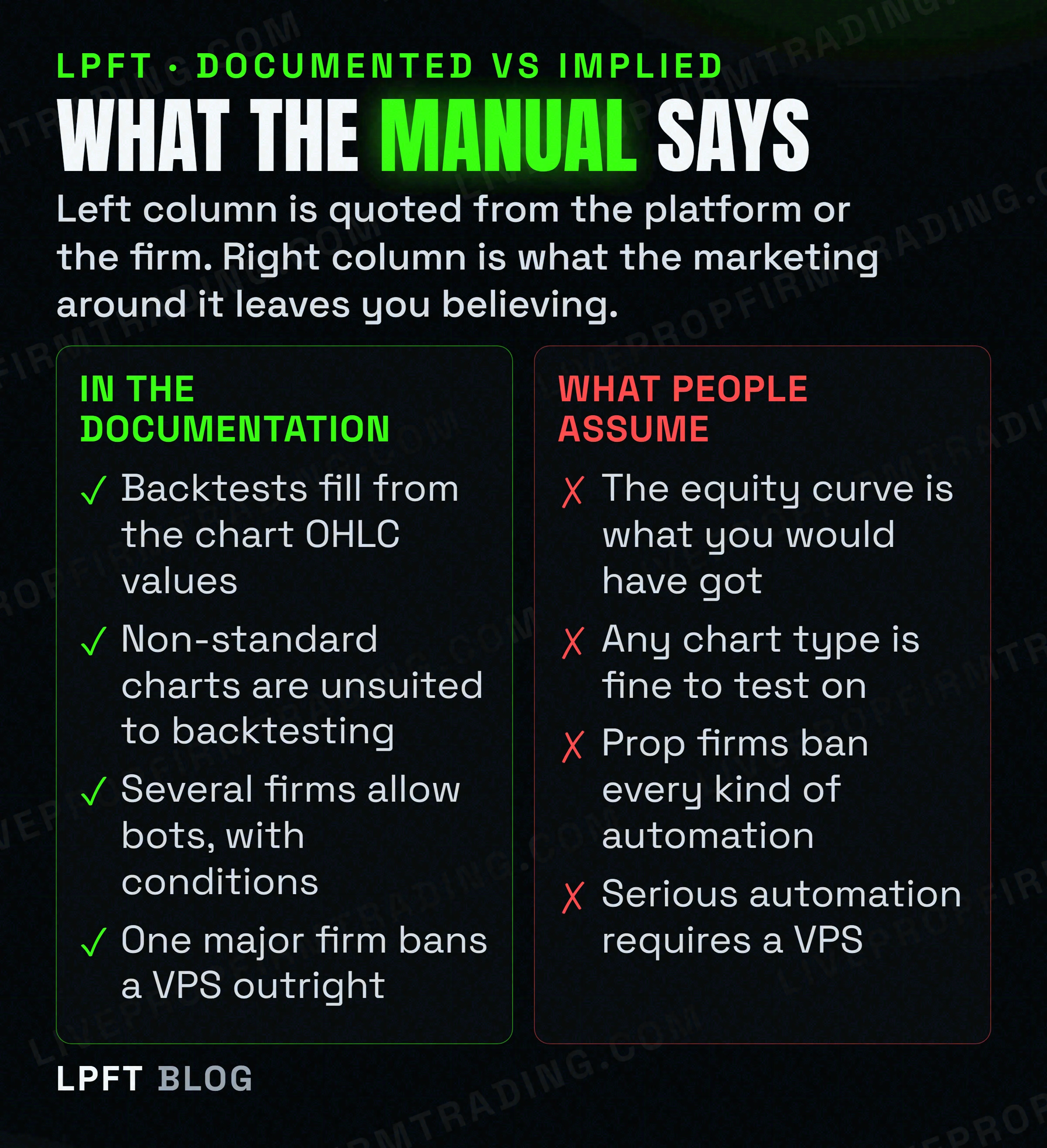
TradingView documents the limits of its own strategy tester more honestly than most people selling backtests do. Strategy orders are filled using the chart's OHLC values, and the broker emulator makes assumptions about how price moved inside each bar. On historical bars a strategy acts at the close, so the next possible fill is the start of the following bar.
None of that is a flaw so much as a boundary. A simulated fill is derived from four numbers per bar. A real fill comes from an order book with a spread, a queue and a finite number of contracts on the other side. The gap between those two shows up as slippage, and it shows up in proportion to how often the system trades.
TradingView also warns that certain settings cause repainting, where the behaviour of a strategy simulated on historical bars differs from what it does live, and that one option which reacts to order fills may produce unrealistic results on historical bars specifically because the simulation can see confirmed bar data a live trader would not have yet.
Ask what commission and slippage assumptions the equity curve was generated with, and ask to see the same period forward-tested rather than fitted. A vendor who cannot answer the first question has not read their own report.
Myth 3: you can backtest on whatever chart type you like
This one is specific, documented, and expensive. TradingView states that non-standard chart types such as Heikin Ashi and Renko are not suited for strategy backtesting or automated trading system execution, because the prices and time intervals do not match market prices and times.
On Renko charts they go further, noting that results are calculated using the chart's synthetic prices, which most likely do not reflect the actual order fills you would get if you were trading for real. TradingView moderates community publications built on this precisely because the resulting equity curves look extraordinary and are not achievable.
The practical rule is simple. A smoothed or synthetic chart is a fine thing to look at. It is not a thing to measure fills against, and a backtest run on one is not evidence about money.
Myth 4: prop firms ban trading bots
This is the myth that stops people using automation they are entitled to use. It is mostly false, and the truth is more specific.
Topstep states that custom automated strategies and bots are allowed via their TopstepX and ProjectX API, subject to standard platform rules and a prohibition on high-frequency trading. MyFundedFutures states that traders may use automated strategies tailored to their own settings, as long as those tools do not aim to exploit the favourable fills offered in the simulated environment. TradeDay permits self-built strategies on supported platforms while prohibiting bots purchased from a third party.
So the objection is rarely automation itself. It is whether the system is genuinely yours, how fast it trades, and whether it is aimed at the simulator rather than at the market. The full picture is in which prop firms actually allow automated trading, and the speed question specifically in which prop firms allow high-frequency bots.
Apex Trader Funding and Take Profit Trader both have rules pages we could not load directly. Their policies may well be strict. We are not going to describe a company's contract from somebody else's summary, so read their current pages yourself before trading there.
The LPFT Copilot runs the whole stack for you on Tradovate - start a 7-day free trial and watch it work.
Start your 7-day free trialMyth 5: more trades means more money
Frequency is the one variable beginners increase first and understand last. Every trade pays commission, exchange fees and some amount of slippage, and those costs scale linearly with how often the system fires while the edge per trade usually does not.
Funded-account firms have noticed. TradeDay states plainly that it does not allow strategies producing more than 200 trades in a day. Alpha Futures flags high-frequency behaviour, particularly where it results in more than 100 trades a day. MyFundedFutures specifically prohibits exploiting the absence of slippage and using tight brackets to profit from favourable fills.
Read those three together and a pattern appears. The rules exist because a high-frequency strategy can extract money from a simulated fill engine that it could never extract from a real order book. If frequency is where your edge comes from, you have a backtest artefact rather than a method.
Myth 6: you need a VPS, and it makes you faster
Two claims bundled into one, and they fail for different reasons.
On speed, a retail futures setup is not latency-sensitive in any way a VPS improves. If your method depends on a few milliseconds, the constraint is your entire infrastructure rather than where a small script is hosted.
On necessity, it depends entirely on where your code runs. TradingView sends webhook alerts from its own servers, and a cloud bridge such as TradersPost describes itself as software as a service hosted in a shared cloud environment, working independently of your computer. On that path there is no machine of yours in the order route at all, so there is nothing for a VPS to keep alive.
Worse, a VPS can be the thing that costs you the account. Topstep's page states that all trading activity must originate from your personal device and that the use of a VPS, VPN or remote server is prohibited by their terms of use. We went through the whole question in do you need a VPS for automated trading.
Myth 7: overfitting is a quant problem, not a beginner problem
Overfitting sounds academic, which is why it gets skipped. It is the single most likely reason a backtest that looks wonderful loses money the week you switch it on.
The reference work here is Pseudo-Mathematics and Financial Charlatanism by Bailey, Borwein, Lopez de Prado and Zhu, published in the Notices of the American Mathematical Society in 2014. Their finding is that a high simulated performance is easy to reach after trying a relatively small number of strategy configurations, and that because almost nobody reports how many configurations they tried, a reader cannot judge how overfit a result is. They also show that an overfit strategy can produce negative expected returns out of sample rather than merely mediocre ones.
You do not need a research budget to fall into this. Adjusting a setting, rerunning, and keeping the version with the better curve is the entire mechanism. Doing that twenty times on an afternoon is a search, and the winner of that search is usually noise.
How to check any claim like this yourself
- Find the sentence on the vendor or firm domain. Not a review site, not a listicle. If it is not on their own page, treat it as unconfirmed.
- Check whether it applies to the evaluation, the funded account, or both. Firms frequently treat those phases differently and the funded side is usually stricter.
- Look for the two silent limits. A daily trade ceiling and a minimum holding time disqualify more otherwise-permitted strategies than any outright bot ban.
- Ask what the backtest assumed. Commission, slippage, chart type and the number of configurations tried. Those four answers separate a result from a picture.
- Screenshot the rules page on the day you sign up. Terms change, and the version you agreed to is worth more than your memory of it.
For the wider context, how trading bots actually work covers the mechanics, and can you make a living with automated trading covers the part where expectations do the most damage.
Frequently asked questions
That a strong backtest predicts live results. TradingView documents that its strategy tester fills orders using the chart OHLC values and that its broker emulator assumes how price moved inside each bar, so a simulated fill is derived from bar data rather than from a real order book. The difference shows up as slippage, in proportion to how often the system trades.
It depends where it runs and whose rules apply. If any component runs on your own machine it stops when the machine stops, and NinjaTrader states that its locally held orders do not continue working on a server. Separately, some firms permit only a semi-automated approach where a human executes the signal, so a fully hands-off setup can breach the agreement even when it works.
Usually not outright. Topstep allows custom automated strategies and bots via its API subject to platform rules and an HFT prohibition, MyFundedFutures allows automated strategies that do not target favourable simulated fills, and TradeDay allows self-built strategies while banning purchased ones. The refusals tend to be about ownership, speed and simulator exploitation.
Because TradingView states those chart types are not suited to strategy backtesting, since their prices and time intervals do not match market prices and times. On Renko they add that results use the chart synthetic prices, which most likely do not reflect the fills you would actually get.
Not in any way that matters for a retail futures setup. If the path is TradingView firing a webhook to a cloud bridge, none of your hardware is in the order route to begin with. A VPS matters only when a local platform has to stay running, and at least one major firm prohibits one entirely.
Ask how many variations were tried before that result appeared. Research published in the Notices of the American Mathematical Society shows strong simulated performance is easy to reach after a relatively small number of configurations, and that the count is almost never reported. A result held out of sample, or forward-tested, is worth far more than a fitted one.
Eli Y.
Eli builds and runs rules-based automated futures systems on TradingView and Tradovate, and helps traders take emotion out of the screen. He writes about futures automation, prop-firm evaluations, and the tools that connect them - plainly, and without hype.
Risk disclosure: Trading futures involves substantial risk of loss and is not suitable for everyone. This article is educational content only and is not financial advice or a recommendation to trade. Past performance is not indicative of future results. Some links are affiliate links.