
Trading Bot Subscriptions vs One-Time Purchases: Check the Second Invoice

Heads up: some links below are affiliate links. If you sign up through them we may earn a commission at no extra cost to you - it never changes what we recommend.
A subscription keeps billing until you cancel and is usually refundable early. A one-time purchase in futures automation often is not actually one-time, because the large upfront fee can sit on top of a monthly licence, and those upfront fees are commonly non-refundable. Check what still bills after you pay, before you compare the two prices.
The LPFT Copilot is $297 a month, month to month, with no activation fee and no lifetime tier to buy. Start a 7-day free trial first and decide afterwards.
Start your 7-day free trialThe arithmetic everyone does, and the line item it leaves out
Search this question and you get break-even sums. A one hundred and twenty dollar purchase against a twenty dollar monthly plan pays for itself in six months, so if you will use it for longer than that, buy it outright. One of the top results is Wikipedia's article on buy-to-play video game pricing, which tells you how closely these pages are engaging with futures trading.
The sum is not wrong. It is just answering a question that assumes something nobody checked: that the one-time purchase stops costing money. In futures automation that assumption is frequently false, and when it is false the whole calculation collapses, because you are comparing a monthly fee against a different monthly fee plus several thousand dollars.
So before any arithmetic, one question. After the one-time payment clears, what still arrives on your card every month? The answer is printed on the vendor's own pricing page and it takes about ninety seconds to find.
Not "how many months until it pays for itself?" but "does it actually stop billing, and can I get my money back if I hate it?" Those two answers often point the opposite way from the price tags.
In futures automation, "one-time" often means activation fee
The clearest published example sits on QuantVue's own pricing page, and the useful part is that they say it out loud rather than hiding it. Read on their site on 21 October 2026, their ATS Program is sold as a one-time fee by tier: Core at $5,000, Premium at $7,000 and Alpha at $12,000.
Then, on the same page, verbatim: "It is a one-time activation fee for your tier. It is separate from the monthly licensing plan, and it does not unlock lifetime access on its own." The monthly licensing plan is printed alongside it at $199 a month plus $25 a month for external data, with the Alpha tier listed at a $174 monthly licensing fee and the data cost described as waived via rebate.
Read that structure carefully, because it is the whole post. The large number is not the price of the software. It is the price of being allowed to start paying the monthly price. Instalment plans are offered on the same page, listed as $3,000 down plus two payments of $1,000 on days 30 and 60 for Core, scaling up through the tiers.
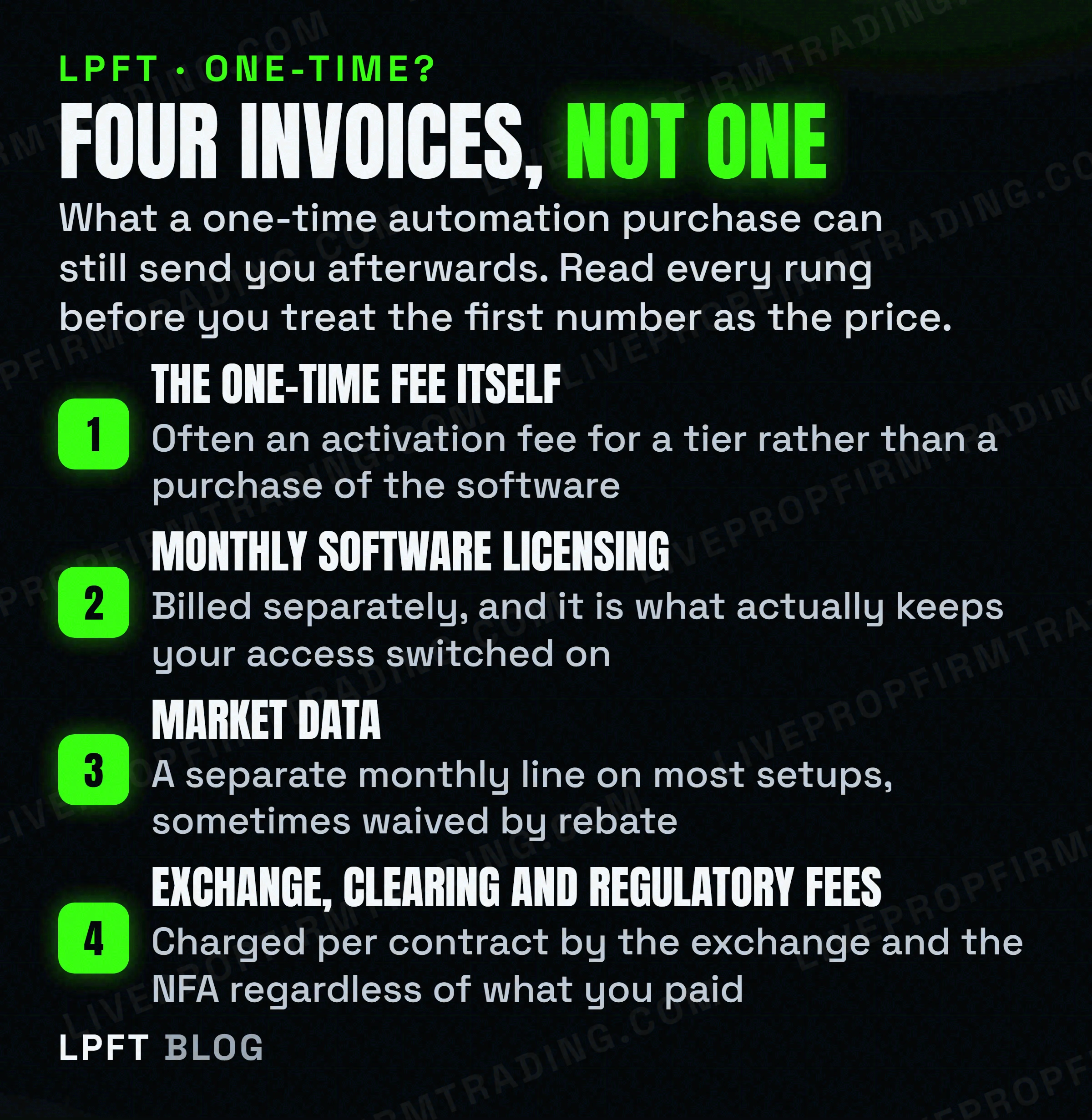
None of this is hidden and none of it is unusual. It is simply not what a buyer hears in the phrase one-time purchase, and no result on the search page for this question checks for it. If you are specifically weighing that product, we went through it in detail in is QuantVue worth it and priced the alternatives in QuantVue alternatives.
The refund terms run opposite to the price
Here is the part that genuinely surprised us when we read the pages side by side. In this market, the small cancellable monthly products tend to be the refundable ones, and the large "you own it" purchases tend to be final. Every row below was read on the vendor's own domain on 21 October 2026.
| Product | What you pay | What the refund wording says |
|---|---|---|
| QuantVue Pro | $197 USD a month or $1,497 USD a year | A 30-day money back guarantee that "only applies to first time customers" |
| QuantVue Elite | $447 USD a month or $2,897 USD a year | Same guarantee and the same first-time-customer limit |
| QuantVue ATS | $5,000 to $12,000 once, plus $199 a month plus $25 data | "All ATS Program sales are final and there is no trial period" |
| LuxAlgo | Promotional tiers, annual from $224.91 for the first year | A refund on your first payment within 30 days, and renewals are not eligible |
| TradersPost | $41.65 to $254.15 a month, billed yearly | A 7-day trial, free until you are ready |
| NinjaTrader | $1,499 once, or $99 a month, or a free tier | No refund wording was published on the pricing page we read |
| LPFT | $297 a month, month to month | A 7-day free trial, and no activation fee to recover |
Two details worth lifting out of that table. QuantVue's guarantee carries a qualifier, in their own words, that the "30 day money back guarantee only applies to first time customers," so a returning subscriber is not covered. LuxAlgo is equally explicit that the guarantee covers only your first payment and that "renewal charges aren't eligible." Neither is a trick. Both are terms that a buyer skimming for the phrase money-back guarantee will read as something much broader than it is.
And the one that matters most: the most expensive product on that list is the one you cannot undo. "All ATS Program sales are final and there is no trial period" is their own FAQ answer. If you are spending five figures on trading software, the absence of a trial is the single most important sentence on the page.
First-time customers only. First payment only. Within thirty days of signing up. These are normal terms and they are also the difference between a real safety net and a marketing phrase. Read the qualifier, not the headline.
TradersPost publishes its plans as a monthly figure billed yearly, from $41.65 up to $254.15, and offers a 7-day trial that is free until you are ready. Read its own pricing page so you know which plan covers how many live accounts.
See TradersPostReal one-time purchases exist, and they buy a platform rather than a strategy
None of the above means the one-time model is a con. It means the word is doing different work in different places, and the cleanest counter-example is a platform licence rather than a strategy.
NinjaTrader publishes three options on its pricing page, read on 21 October 2026. A free tier with no monthly fee, a monthly plan at $99 a month, and a lifetime licence at "$1,499 one-time payment" which they describe as offering the lowest commissions for a one-time fee and which "waives the recurring monthly platform fee charged on the Monthly plan."
That is a genuine one-time purchase and the arithmetic behind it is honest. What you are buying is a commission rate and the removal of a platform fee. Their printed rates move from $0.39 per micro contract on the free tier to $0.29 on monthly and $0.09 on the lifetime licence, with standard contracts at $1.29, $0.99 and $0.59. If you trade enough contracts, the licence pays for itself in commissions alone.
- What a lifetime platform licence does buy. Lower per-contract costs and no recurring platform fee, for as long as the company exists and supports it.
- What it does not buy. A strategy, a signal, or anybody's judgement. The platform is where you run your own rules.
- What still bills either way. The same page states that "Exchange, clearing, and NFA fees apply," and lists order-flow tooling, market replay and one of their indicators as requiring a funded account.
So the distinction is not subscription against one-time. It is whether the one-time fee buys a durable tool with a published rate card, or an entry ticket to a monthly relationship. The first is a normal purchase. The second is a subscription wearing a purchase label, and it is the one with no refund. If you are choosing the platform underneath all this, Tradovate versus NinjaTrader is the more direct read.
The arithmetic, done with every line included
Now the sum is worth doing, because now it has all its terms. Take the first twelve months, which is the horizon where most of these decisions are actually regretted.
- A one-time tier with a monthly licence. Using QuantVue's published ATS Core figures: $5,000 once, plus $199 a month for twelve months, which is $2,388, plus $25 a month for data, which is $300. First-year total $7,688, and no trial beforehand.
- A monthly system. Using ours, because we are not going to quote a competitor where we can quote ourselves: $297 a month is $3,564 across twelve months, or $2,970 if you take the yearly option where two months are free. A 7-day free trial comes first, and nothing has to be recovered if you leave in month two.
- A platform licence. NinjaTrader's $1,499 once, against $99 a month which is $1,188 a year, so the licence is behind after one year and ahead after two, before you count the commission difference.
Those are cost comparisons and nothing else. We are not comparing results, ours included, and anybody who hands you a first-year cost table with a profit column attached is selling rather than explaining. Futures trading carries a substantial risk of loss, and the cheaper option loses money just as efficiently as the expensive one if the rules underneath it do not work.
The horizon is also where the break-even logic quietly fails. Six months of subscription might cost less than a purchase, but you can stop paying in month two. Spending five figures assumes the software still fits the market in year three, that the company is still answering email, and that you still want to trade this way. Those are real risks and they all sit on the one-time side of the ledger. We put honest numbers on the whole picture in how much money you actually need.
Five questions before you pay either way
Open the vendor's pricing page, not a review of it, and answer these. It takes less time than reading one comparison article.
- After the one-time fee, what still bills monthly? If the answer is anything above zero, you are buying a subscription with a deposit, and the comparison is monthly against monthly plus the deposit.
- Is there a trial, and is there a refund? Find the exact sentence. Then find the qualifier attached to it, because there is almost always a qualifier.
- What does the fee buy if the company disappears? A platform licence you have installed is a different asset from an activation tier on somebody's cloud service.
- Who updates it when the market or the API changes? This is the strongest honest argument for a subscription, and it is the one subscription vendors under-sell.
- Can you read the rules before paying? If not, the pricing model is the least of your problems. That question is the subject of signals versus a full trading system.
If you are automating on a funded account there is a sixth question, and it can veto the purchase entirely regardless of price. Some firms prohibit automated systems bought from a third party outright, in those words, which makes the subscription argument irrelevant because neither model is permitted. We laid out which parts of a stack your firm actually controls in prop firm automation stacks. Read your own firm's rules page before you pay anybody.
Our own position, for transparency, is a monthly subscription with no activation fee and a free trial first, and that is a commercial choice rather than a moral one. The reason we hold it is that it keeps the burden of proof on us every month rather than collecting five figures from someone who has not seen the thing run yet.
The LPFT Copilot runs the whole stack for you on Tradovate - start a 7-day free trial and watch it work.
Start your 7-day free trialFrequently asked questions
Not reliably, because many one-time purchases in futures automation are not actually one-time. QuantVue, for example, states on its own pricing page that its ATS fee "is a one-time activation fee for your tier" which "is separate from the monthly licensing plan, and it does not unlock lifetime access on its own," with that monthly licence printed at $199 plus $25 for data. Add every recurring line before comparing.
Often less so than the monthly plans sold by the same vendor, which is the opposite of what most buyers assume. QuantVue's own FAQ, read on 21 October 2026, states "All ATS Program sales are final and there is no trial period," while its monthly and yearly plans carry a 30-day money back guarantee that applies only to first-time customers.
Usually a platform licence rather than a strategy. NinjaTrader publishes a lifetime licence at $1,499 as a one-time payment which waives the recurring monthly platform fee charged on its monthly plan and carries its lowest commission rates. It buys the software you run your own rules in. It does not supply the rules.
Yes, in almost every case. Exchange, clearing and regulatory fees are charged per contract regardless of what you paid for software, and NinjaTrader states plainly on its pricing page that "Exchange, clearing, and NFA fees apply." Market data and, with some vendors, a separate monthly software licence are also common recurring lines.
A trial followed by a monthly plan, for one reason that has nothing to do with price: you can stop. A beginner is still discovering whether automated futures trading suits them at all, and a non-refundable five-figure commitment made before that question is answered is the most expensive way to find out. Futures trading carries a substantial risk of loss.
Their strongest argument is genuine and worth weighing: platform APIs change, markets shift, and somebody has to maintain the software. A subscription funds that work, whereas a one-time purchase leaves the vendor with no revenue tied to keeping your version working. The counter-argument is equally genuine, which is that you keep paying whether anything is maintained or not.
Eli Y.
Eli builds and runs rules-based automated futures systems on NinjaTrader and Tradovate, and helps traders take emotion out of the screen. He writes about futures automation, prop-firm evaluations, and the tools that connect them - plainly, and without hype.
Risk disclosure: Trading futures involves substantial risk of loss and is not suitable for everyone. This article is educational content only and is not financial advice or a recommendation to trade. Past performance is not indicative of future results. Some links are affiliate links.