
Signals vs a Full Trading System: Count What Actually Arrives

Heads up: some links below are affiliate links. If you sign up through them we may earn a commission at no extra cost to you - it never changes what we recommend.
A signal is one trade idea. A trading system is the full set of rules that produces every trade idea and also decides the exit, the position size and the days you stand aside. The practical difference is a count: a signal usually carries two or three of the six decisions a trade needs, and you supply the rest in a hurry.
The LPFT Copilot is a complete system rather than an alert. Entry, exit, position size, the session window and the daily loss limit all travel together on your own Tradovate account. Start a 7-day free trial and watch it run.
Start your 7-day free trialThe answer everyone gives, and why it does not help you buy anything
Search this and nine pages tell you the same thing in slightly different words. A signal gives you an answer, a system teaches you how to reach one. A signal is one input, a system is the whole framework. It is accurate, it is tidy, and it is close to useless at the moment you are deciding whether to pay somebody.
It is also written for a different market. Nearly every result on that search is a forex or CFD broker, or a signal vendor describing its own category. None of them is talking about a funded futures account with a daily loss limit attached to it, which is where this distinction stops being academic and starts costing money.
Here is a version you can actually use. Stop asking which one is better and count what arrives. A trade is not one decision, it is six. Write them down, then look at what turns up in the alert.
Not "signals or a system?" but "how many of the six decisions arrive, and who makes the others?" The ones left over are rarely the fun ones. They are the risk controls.
A trade needs six decisions
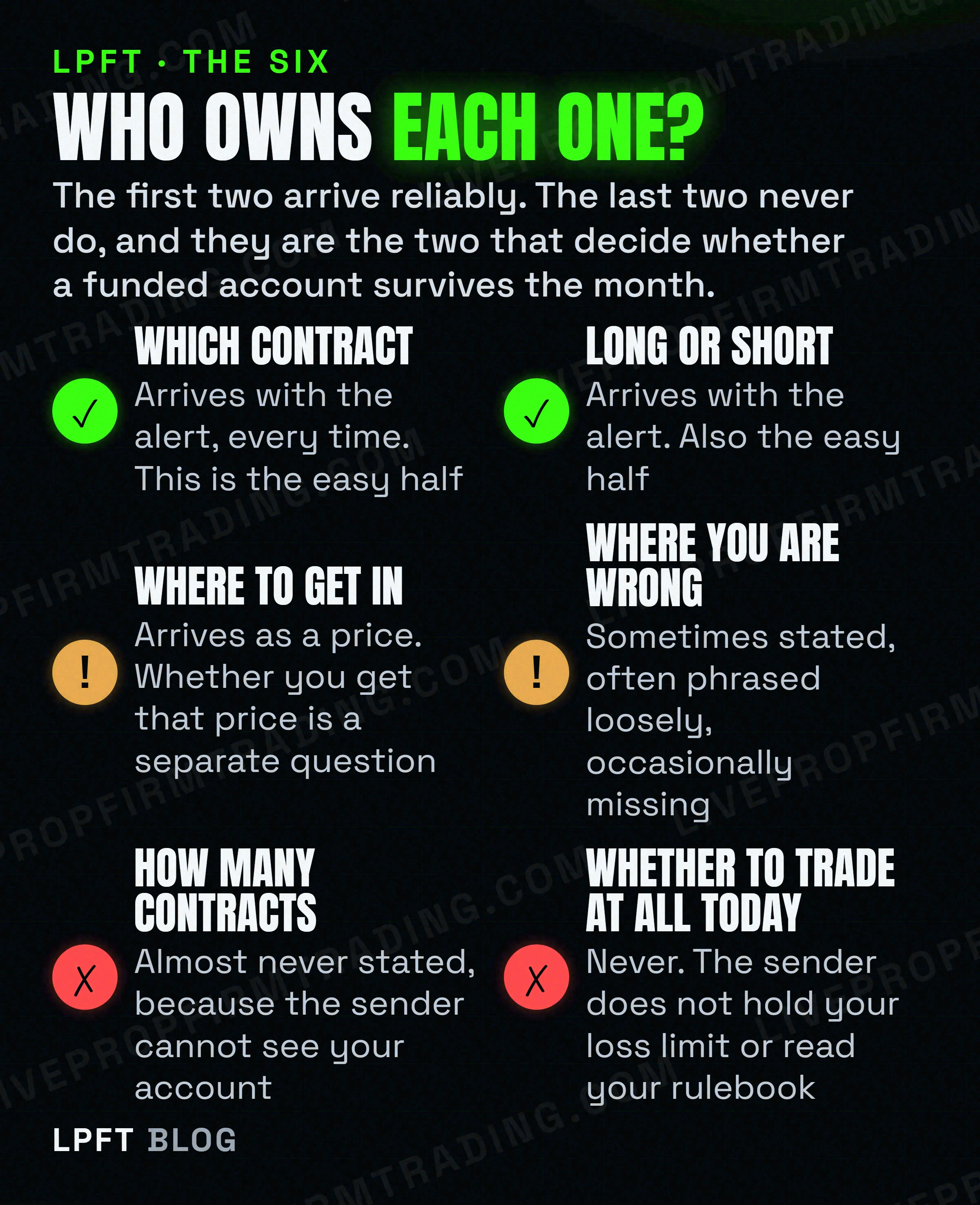
Every futures trade, automated or not, resolves six questions before it is over. There is no way to skip one. If you do not answer it deliberately, you answer it by accident at the worst moment.
- Which contract. MES, MNQ, the full-size version, something else.
- Which direction. Long or short.
- Where you get in. A price, or a condition that produces one.
- Where you are wrong. The point at which the idea is dead and you are out.
- Where you take money off. A target, a trail, a time, or a rule that chooses.
- How many contracts. The one that converts a decent idea into a survivable trade or an account-ending one.
A bare alert reliably carries the first two and names the third. Better services add the fourth. Almost none carries the sixth, and for a defensible reason: the sender cannot see your account. The same idea at one contract and at ten is two completely different trades, and only one of them is still open tomorrow.
There is a seventh question sitting above all of them, and no signal has ever answered it. Should this trade happen at all today? Not "is the setup valid" but "am I inside my own limits, is this a day my rules say I trade, has my account got room for this to go wrong." A system owns that question. An alert does not know you exist.
The sender cannot see the thing that decides your outcome
This is not a criticism of signal providers. Several of the better ones say it plainly themselves, which is more than most of the pages comparing them manage.
LuxAlgo, on its own pricing page read on 21 October 2026, states that "LuxAlgo does not execute trades and does not provide personalized investment advice." Read that as a scope statement rather than legal boilerplate, because that is what it is. The tool produces a read. Execution is yours, and anything that depends on your particular circumstances is yours too. Position size depends entirely on your particular circumstances.
Topstep draws the same line from the other direction when it describes its trade copier. In its own words: "You might have heard of the term trade copying as an alert service. Where a 'Guru' sends you their entries and exits, and you copy them. That is not what we're talking about here." The firm is separating a tool from a subscription to somebody's opinions, and the sentence it lands on is the one worth keeping: "It's still your plan, your trading strategy, and your trade execution."
That is the honest description of life with a signal service. The plan stays yours. What you bought was one input into it. If you do not have a plan for the other four decisions, buying better inputs does not help, and the question of whose decision you are actually running is covered properly in copy trading versus automated systems.
TradingView is where most indicator and alert services actually live, and its alerts fire from its servers whether your computer is on or not. Worth knowing that an alert is a message, not an order, before you build anything on top of it.
See TradingViewIn a funded account, the leftover decisions belong to the rulebook
This is the part the whole search result page misses, and it is the reason a futures trader should care more about this distinction than a retail forex trader does. The four decisions a signal leaves you are not neutral. Your prop firm has opinions about every one of them, and they are written down.
Topstep publishes a prohibited-strategies page. Read on its own site on 21 October 2026, it names, verbatim, "Purposefully trading your full Maximum Position Size directly into a scheduled major news event." An alert arriving at 8:29 in the morning has no idea what time it is in your economic calendar. You do. That is decision six and decision seven arriving together, and they arrive as your problem.
The same page prohibits "Using software, AI, ultra-high speed systems, or mass data entry that manipulates, abuses, or provides an unfair advantage on the platform or in the program," lists "Running scalping algorithms designed to exploit unrealistic SIM fills" among its simulator-abuse examples, and states that "We retain the right to reject profit claims if abuse is suspected." Note what is actually prohibited there. It is software that abuses, not software that places an order.
Every firm words this differently and the wording moves. The quotes above are one firm on one day. Open your own firm's rules page before you act on anybody's alert, and especially before you let software act on one.
There is a quieter version of the same problem. Most signal services publish a result history measured from the signal price. Your fill is not the signal price, your size is not their assumed size, and your firm may have closed you out of the session their best trade happened in. None of that is dishonesty. It is the gap between an input and a trade, and it is the gap you are responsible for. More on where that goes wrong in why most automated traders fail, and on the firm-side mechanics in Topstep automation rules.
What a system owns, in exchange for being less exciting
A system is not a better signal. It is a smaller promise made about more of the trade. All six decisions are settled in advance, written down, and the same next Tuesday as they were last Tuesday. That is genuinely duller to read about and it is the entire value.
| A signal service | A full system | |
|---|---|---|
| What you receive | Trade ideas, as they occur | A ruleset that generates them |
| Who sets the stop | Sometimes them, often you | The rules, in advance |
| Who sets position size | You, with no guidance | The rules, from your account |
| Who decides to sit out | You, in the moment | The rules, before the day starts |
| Can you check it in advance | Only their published history | Yes, if the rules are stated |
| What arrives when they stop sending | Nothing. Your trading stops | The rules are still yours |
| Who answers to your rulebook | You, alone | You, with the limits coded in |
Two honest caveats, because the table above is flattering and the reality is narrower. A system settles the six decisions, it does not supply an edge. Rules that lose money lose it very consistently, which we were blunt about in do automated trading bots actually work. And a coded loss limit only protects you if it is coded rather than suggested. A system you override at 10:14 in the morning is a signal service with extra steps.
The second caveat is that a signal is the right purchase for some people. If you already own the exit, the size and the stand-aside rule, and what you lack is ideas, then ideas are a reasonable thing to buy. The failure mode is buying ideas while believing you bought a method. That is a labelling problem, not a product problem, and it is the same confusion that makes the manual versus automated question harder than it needs to be.
Twenty minutes of questions before you pay for either
You do not need to audit anybody. You need five answers, and the first two end most conversations.
- Where is the exit rule, in writing? Not "we manage it dynamically." A sentence you could hand to a stranger. If the exit is discretionary and the discretion is theirs, you cannot run this without them watching.
- What size does the published history assume? If the answer is a fixed number of contracts, that history describes an account that is not yours.
- What happens on a news day, and who decides? Any answer is fine. No answer means decision seven is yours and you were not told.
- Can it be tested before money? A stated ruleset can be checked against history. Start with how to backtest before you automate and insist on real fills rather than assumed ones.
- What does your firm allow, in its own words? Open the page. Not a forum thread about the page.
If the honest conclusion is that you want all six decisions to arrive together, that is what a complete system is, and the thing to check before buying one is whether you can read its rules and whether the limits are coded. If the conclusion is that you want ideas and you already own the rest, buy ideas and stop paying for the word system. Either way, the pricing models dress this up in ways worth understanding before you commit, which is the subject of subscriptions versus one-time purchases.
Futures trading carries a substantial risk of loss, and neither an alert nor a ruleset changes that. What a system changes is how many of the six decisions you are making under pressure, which is a real improvement and a much smaller claim than the one most of this industry makes. Test in simulation before real size, and keep the loss limit on your side of the wire.
The LPFT Copilot runs the whole stack for you on Tradovate - start a 7-day free trial and watch it work.
Start your 7-day free trialFrequently asked questions
A signal is one trade idea, usually naming the instrument, the direction and an entry price. A trading system is the complete ruleset that produces every idea and also settles the exit, the position size and the days you do not trade. In practical terms a trade needs about six decisions, a signal typically carries two or three of them, and the trader supplies the rest.
They are worth paying for if what you lack is trade ideas and you already own your exit rule, your position sizing and your rule for standing aside. They are a poor purchase if you expect them to function as a method, because the decisions a signal leaves open are the risk controls. Futures trading carries a substantial risk of loss either way.
Because the sender cannot see your account. Position size depends on your balance, your drawdown limit and your funding firm, and the same idea is a sensible trade at one contract and an account-ending one at ten. Some vendors say this directly. LuxAlgo states on its own site that it does not execute trades and does not provide personalized investment advice.
That depends entirely on your firm and on how the signal reaches the market, so read your own firm's current rules page. The decisions a signal leaves to you are the ones firms write rules about. Topstep, on its own prohibited-strategies page read on 21 October 2026, names purposefully trading your full Maximum Position Size directly into a scheduled major news event as prohibited conduct.
There is no reliable evidence that either approach improves returns by itself, and it is not a claim worth trusting from anyone selling one. What a stated system changes is that the exit, the size and the stand-aside rule are decided in advance rather than improvised, which reduces the number of decisions you make under pressure.
Not necessarily, and the labels hide it. Several products marketed as automation are routing somebody else's signal rather than running your rules. QuantLynk describes itself on its own site as a cloud-based trade copier and alert connector that routes alerts from external sources, and TradersPost states that you can connect strategies other traders have created and published on TradingView. Always ask where the decision originates.
Eli Y.
Eli builds and runs rules-based automated futures systems on NinjaTrader and Tradovate, and helps traders take emotion out of the screen. He writes about futures automation, prop-firm evaluations, and the tools that connect them - plainly, and without hype.
Risk disclosure: Trading futures involves substantial risk of loss and is not suitable for everyone. This article is educational content only and is not financial advice or a recommendation to trade. Past performance is not indicative of future results. Some links are affiliate links.