
Copy Trading vs Automated Systems: Who Is Still Making the Decision?

Heads up: some links below are affiliate links. If you sign up through them we may earn a commission at no extra cost to you - it never changes what we recommend.
Copy trading mirrors decisions a person is still making in real time, so your account depends on them continuing to trade. An automated system executes a fixed ruleset, so it depends on the market and your uptime instead. In futures the phrase usually means something narrower: copying your own order into your own other accounts.
The LPFT Copilot runs a tested, rules-based method on your own prop firm or Tradovate account, with the session windows and loss limits built in. Nobody has to be awake for it to work. Start a 7-day free trial and watch it run.
Start your 7-day free trialThe comparison everyone writes, and why it misses
Search this and you get the same paragraph repeatedly. Copy trading suits people who want somebody else's judgement, bots suit people who want control. Copy trading adapts because a human can read context, a bot follows fixed code. Pick based on your temperament.
It is tidy and it answers the wrong question, for two reasons. The first is that temperament is close to the least useful input you have here. The second is bigger: nearly every page on that search is describing retail forex and CFD copy trading, where a stranger's positions are mirrored to you through a broker's social feed, usually with a cut of your profit going to the leader.
If you trade futures, and especially if you trade a funded account, that is probably not what the word means where you are standing.
Not control versus convenience. The question is whether a human decision is still being made while you are asleep, and what happens to your account when that person stops making it.
In futures, copy trading usually means the opposite thing
Here is the definitional problem, in a prop firm's own words rather than ours. Topstep defines a trade copier like this: "A trade copier is a tool that lets you place a trade in one account and automatically copy that order into your other accounts."
Your trade. Your other accounts. Nobody else is involved. And Topstep goes out of its way to separate that from what the forex pages are describing, verbatim: "You might have heard of the term trade copying as an alert service. Where a 'Guru' sends you their entries and exits, and you copy them. That is not what we're talking about here."
Then the sentence that is really the whole article: "It's still your plan, your trading strategy, and your trade execution."
So in futures, a trade copier is usually a position-scaling tool, not a way to outsource judgement. It copies nobody. That matters because the two meanings have opposite dependency profiles, and a page answering the forex one will mislead you about the futures one.
- Mirroring a stranger. You are hiring a person. Your results track their decisions, their discipline and their availability.
- Mirroring yourself across accounts. You are hiring a multiplier. The decision was already yours, and the tool just applies it in more places.
- Running an automated system. You are hiring a ruleset. The decision was made once, in advance, and written down.
Those are three different purchases. Only the first one makes your account dependent on another human being. The legal side of all this, including who counts as an advisor and what the firms permit, is covered properly in is copy trading legal, so we will stay on the practical question here.
The dependency difference nobody writes about
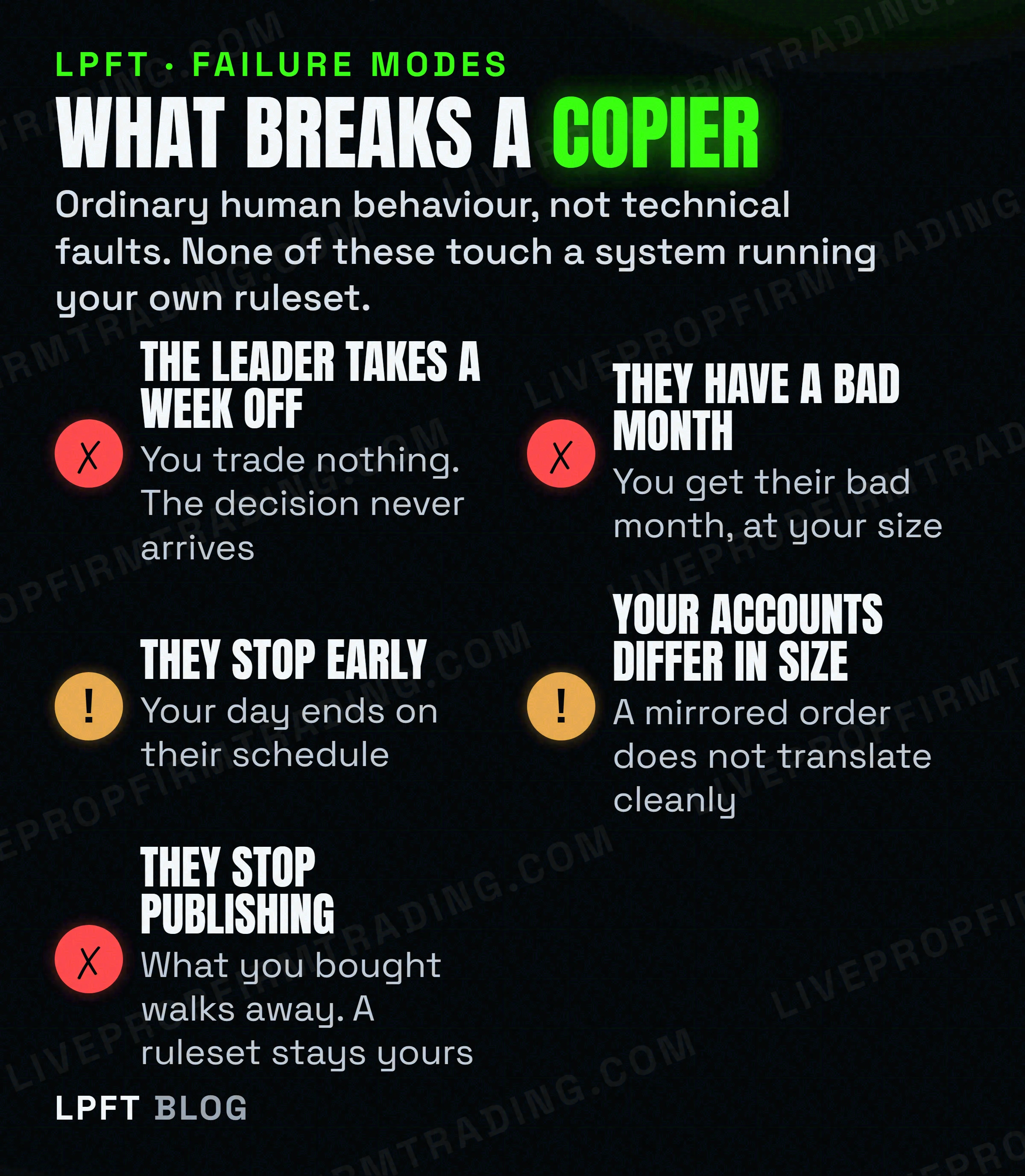
This is the part that decides real outcomes, and it is almost absent from the comparisons. A copier needs its leader to be trading right now. Not historically. Right now.
Work through what that means on an ordinary Tuesday. Your leader takes a week off and you trade nothing. They have a bad month and you have their bad month, at your size. They stop early because they hit their own target and your day ends on their schedule. Their connection drops mid-position and your account is holding something theirs is not. None of that is hypothetical plumbing failure, it is the normal behaviour of a human being who does not work for you.
An automated system has a different and smaller dependency list: the market has to open, your connection has to hold, and the rules have to still fit conditions. No person has to be in a mood. That is not automatically better, it is differently fragile, and the fragility is at least the kind you can inspect.
If the accounts have different buying power, a mirrored order does not translate cleanly. Alpha Futures, for instance, advises making the smallest or lowest-leverage account the leader so the copy does not break. If you are copying someone much larger than you, the arithmetic is working against you before the strategy even matters.
There is one more asymmetry, and it is the one we would weigh most heavily. A ruleset can be tested before you risk money on it. A track record cannot be re-run. You can take a stated strategy, apply it to history, and see how it behaved in conditions the seller never mentioned. With a leader, all you have is their past and your hope that it continues, which is the ground we cover in how to backtest before you automate.
Side by side, on the things that actually differ
Profit is deliberately not a row here. Neither approach supplies an edge and anybody ranking them by returns is comparing two samples of their own choosing.
| Copying a person | An automated system | |
|---|---|---|
| Where the decision is made | In the moment, by someone else | In advance, by whoever wrote the rules |
| Needs a human awake | Yes, theirs | No |
| Can you test it first | No. Only their past results | Yes, if the rules are stated |
| Adapts to something genuinely new | Yes, if they judge it well | No. It knows only the rules it was given |
| What happens if they quit | Your trading stops | Not applicable |
| Who owns your loss limit | Effectively them, unless you cap it yourself | You, if it is coded and not optional |
| Typical cost shape | Often a share of profits | A subscription or a one-off build |
The adaptability row is the strongest genuine argument for a human, and it is real. A person can read a headline and stand aside, and no ruleset does that unless somebody anticipated it. We would just note that the same flexibility is what lets a leader abandon their plan on a bad afternoon, and you inherit that too. Flexibility is not a one-way benefit.
If you are weighing the broader machine-versus-human question rather than this specific pair, manual versus automated trading is the more direct read.
The blurred middle, where most buyers actually end up
Here is the thing that makes this comparison genuinely confusing rather than merely mislabelled: a lot of products sold as automation are carrying somebody else's decision. The categories are not as separate as the marketing implies.
Two examples straight from the vendors' own pages. TradersPost's FAQ says "You can easily connect strategies to TradersPost that other traders have created and published on TradingView." QuantLynk describes itself as "a cloud-based trade copier and alert connector" in a single phrase, which tells you how close those two jobs sit in practice.
A bridge running somebody else's published strategy is automated, and the decision still is not yours. It has the dependency profile of copying a person, with the interface of a bot. Ask where the signal originates, every time.
So the honest question when you evaluate anything in this space is not "is it automated?" but "whose rules are these, and can I read them?" An automated product running a strategy you cannot inspect, written by someone who can stop publishing it, is closer to copy trading than to owning a system. We broke the plumbing down in how trading bots actually work.
TradersPost receives a webhook server-side and routes it to a supported broker, and it is explicit that you can connect either your own strategy or one another trader published. Worth reading its FAQ yourself so you know which you are doing. Free 7-day paper trial.
See TradersPostChoosing, and the questions that settle it
Five questions, in this order. Most people find the answer lands by question three.
- Can you read the rules before you pay? If no, you are buying a person or a black box, whatever the product is called. That is allowed, just price the risk honestly.
- What happens to your account if the source stops? A leader quits, a signal service closes, a publisher unlists their script. If that ends your trading, you rented your edge rather than acquiring it.
- Who holds your loss limit? If the answer is not "me, in code," fix that before anything else. It is the single control that most reliably saves funded accounts.
- Does the size translate? For any copier, check the leader is not running a much larger account than yours. Lead from the smallest account where you can.
- What does your firm allow? This can veto the whole plan, and the rules are narrower and stranger than most traders expect.
On that last point, the direction of the copy is usually what decides it. Firms broadly permit your own order flowing into your own accounts under one name, and refuse arrangements with another person in the loop. TradeDay, read on its own page on 17 October 2026, allows copiers "from your personal accounts or other evaluations in to your TradeDay account," permits 2 to 10 accounts across Evaluation and Funded Sim and up to 5 Funded Live accounts, and does not permit copying between Funded Live and Evaluation or Funded Sim.
That is one firm on one day and yours will differ. The full picture, including what the advisor rules actually turn on, is in is copy trading legal. Read your own firm's page before you connect anything.
What we would tell a friend
If the appeal of copy trading is that somebody competent is in charge, be clear that you are buying their continued attention, not their past results. That is a real thing to buy and it is also the least durable asset in this comparison, because it can take a holiday, change its mind or disappear.
If the appeal of automation is that nothing depends on a mood, that holds, with one honest caveat: a system only protects you from your own impulses if the limits are coded rather than suggested. An automated system you can override at 10:14 in the morning is a manual strategy with extra steps, which is the failure pattern in why automated traders fail.
And if you are hoping either one means you stop paying attention, neither does. Handing over execution is not handing over responsibility, and the weekly review of what actually happened against what you expected is still your job. We were blunt about that in set and forget expectations.
Futures trading carries a substantial risk of loss either way. Neither copying a person nor running a system reduces that, and anyone presenting either as low risk is selling rather than explaining. Test with real fills before real size, and keep the loss limit on your side of the wire.
The LPFT Copilot runs the whole stack for you on Tradovate - start a 7-day free trial and watch it work.
Start your 7-day free trialFrequently asked questions
Copy trading mirrors decisions a person is making in real time, so your account depends on that person continuing to trade. An automated system executes a ruleset decided in advance, so it depends on the market and your own uptime instead. The practical consequence is that a copier stops when its leader stops, while a system keeps following its rules.
Usually not, and this causes real confusion. Most online copy-trading content describes retail forex and CFD trading, where a stranger's positions are mirrored to you. In futures and prop trading the phrase typically means your own order copied into your own other accounts. Topstep defines a trade copier as a tool that lets you place a trade in one account and automatically copy that order into your other accounts.
No. A trade copier duplicates an order that already exists, so something or someone else decides when to trade. A trading bot generates the decision itself from rules. Topstep makes the point directly about its own copier: it is still your plan, your trading strategy, and your trade execution. The copier adds no decision of its own.
Neither is safe, and they fail differently. Copy trading concentrates risk in one person's ongoing judgement, availability and discipline, and you cannot test it in advance because a track record cannot be re-run. An automated system concentrates risk in a fixed ruleset that will not adapt to genuinely new conditions, but it can at least be tested beforehand. Futures trading carries a substantial risk of loss in both cases.
Yes, and this is the most commonly missed distinction. TradersPost states in its own FAQ that you can connect strategies that other traders have created and published on TradingView, and QuantLynk describes itself as a cloud-based trade copier and alert connector. A bridge executing a published strategy is automated while the decision still is not yours, so always ask where the signal originates.
Many allow it in one direction and forbid it in another, so read your own firm's current page. TradeDay, read on 17 October 2026, allows copiers from your personal accounts or other evaluations into your TradeDay account, permits 2 to 10 accounts across Evaluation and Funded Sim and up to 5 Funded Live accounts, and does not permit copying between Funded Live and Evaluation or Funded Sim accounts. The pattern across firms is that one named human must be behind every account.
Eli Y.
Eli builds and runs rules-based automated futures systems on NinjaTrader and Tradovate, and helps traders take emotion out of the screen. He writes about futures automation, prop-firm evaluations, and the tools that connect them - plainly, and without hype.
Risk disclosure: Trading futures involves substantial risk of loss and is not suitable for everyone. This article is educational content only and is not financial advice or a recommendation to trade. Past performance is not indicative of future results. Some links are affiliate links.