
Best Futures Trading Bots Compared: Most of the List Is Not a Bot

Heads up: some links below are affiliate links. If you sign up through them we may earn a commission at no extra cost to you - it never changes what we recommend.
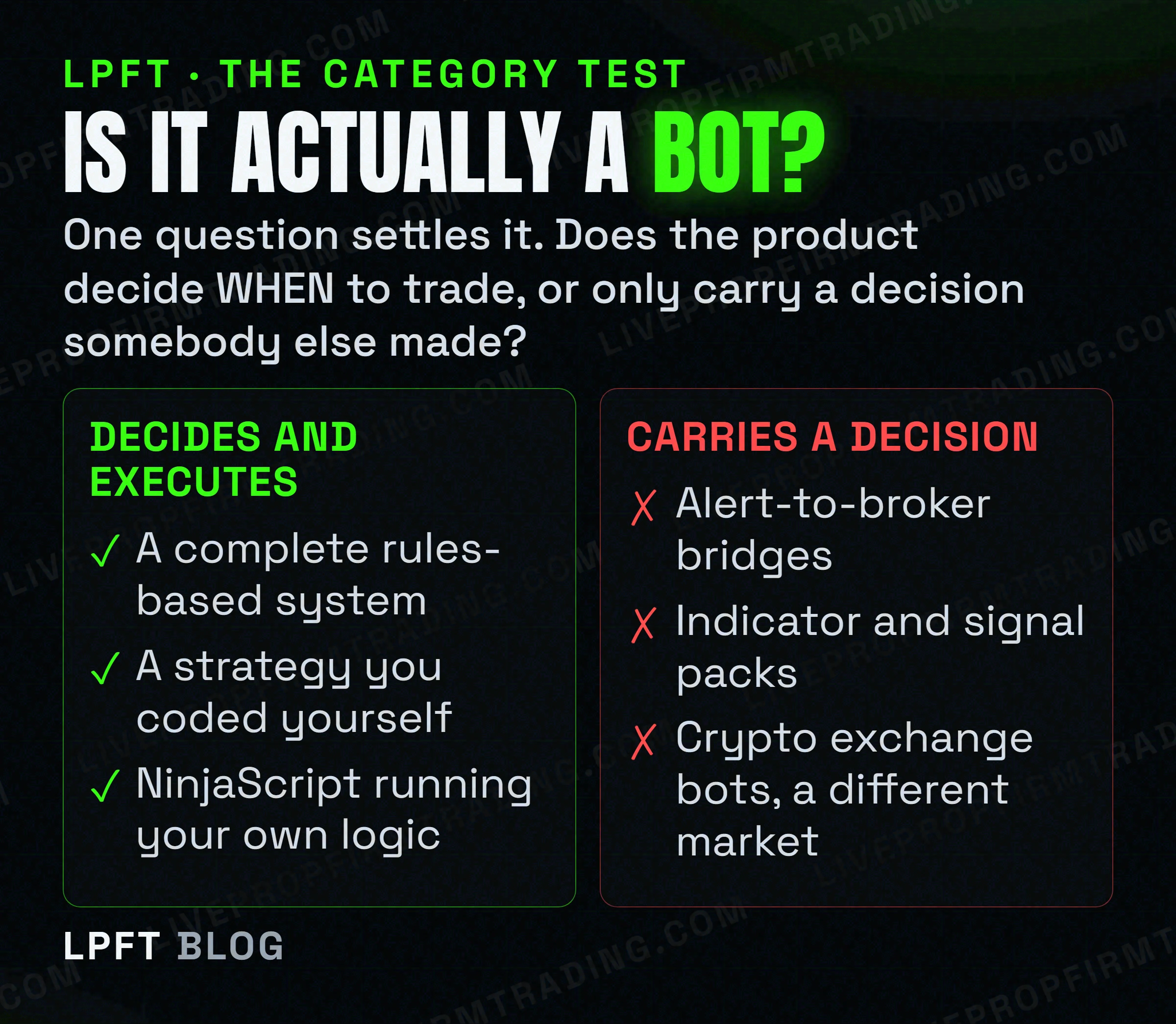
Most products on this list are not bots. They are routers that carry a signal somebody else generated, or indicator packs that decide but cannot execute. A real futures trading bot does both: it decides when to trade and it places the order. Sort the market by that one question and the comparison becomes straightforward.
The LPFT Copilot is a complete system rather than a router: a tested, rules-based method running on your own prop firm or Tradovate account with session windows and loss limits built in. Start a 7-day free trial and watch it run.
Start your 7-day free trialWhat you actually get when you search this
We ran the query and read the page. Two things stand out before any product comparison starts, and both of them should change how you read every list you find.
First, the most recommended products are crypto exchange bots. They are real products and they have nothing to do with CME futures. If you came here about the ES, the NQ or their micros, the top recommendation on several of those pages cannot trade your market at all.
Second, the futures entries that remain are mostly order routers, and each one says so on its own website. That is the finding worth the whole article, so here it is in their words rather than ours.
- TradersPost, from its own FAQ: "You can easily connect strategies to TradersPost that other traders have created and published on TradingView." The product's own description of where the decision comes from is somebody else.
- QuantLynk, on its own home page: "QuantLynk is a cloud-based trade copier and alert connector." It routes alerts from external sources and does not generate signals.
- PickMyTrade, on its own site: "Automate your futures trading with your own TradingView alerts." Your alerts. It carries them.
They are plumbing, and good plumbing is worth paying for. But a product that moves a signal it did not generate is not a trading bot, and calling it one hides the question that matters: where is the decision coming from?
A third thing, while we are being blunt about sources. Two of the nine results sell VPS hosting and one is a regional news site running what reads as paid placement. We have no problem with any of those businesses, but a ranking list written by a company that sells one of the inputs is a sales page with a table in it.
The four categories, and what each one can and cannot do
Group the market by the job you are hiring it for and the whole thing clarifies. There are four jobs, and most confusion comes from products in different categories being ranked against each other as though they compete.
| Category | Decides when to trade | Places the order |
|---|---|---|
| Router or bridge TradersPost, QuantLynk, PickMyTrade | No. It carries a signal you or someone else supplied | Yes |
| Indicator or signal pack LuxAlgo, QuantVue Pro and Elite | It suggests. You or a bridge act on it | No. LuxAlgo states plainly that it does not execute trades |
| Platform automation you code NinjaScript, Pine plus a bridge | Yes, because you wrote the rules | Yes, with the caveats in the next section |
| Complete system Done-for-you services, including ours | Yes, to a defined ruleset | Yes |
| Crypto exchange bot The names topping that SERP | Varies | Not on CME futures. Wrong market |
The useful consequence: a router and an indicator pack are two halves of one thing. If you buy only the indicator you have a decision with no way to act on it, and if you buy only the router you have a delivery van with nothing to deliver. Plenty of people buy one and are surprised they are not finished.
For what a bot genuinely is and is not, we laid out the mechanics in what is a futures trading bot and the evidence question in do automated trading bots actually work.
Prices, read on each vendor own site today
Every figure below was read on the vendor's own domain on 17 October 2026. Prices move, and one of these rows had already moved since we last checked a week earlier, so re-read before you buy. We have labelled the billing basis on every row because a few of these are not the month-to-month price.
| Product | Job | Price as printed |
|---|---|---|
| TradersPost | Router | Starter $41.65, Basic $84.15, Pro $169.15, Premium $254.15 per month, each billed yearly. Free 7-day paper trial. Extra live account $10/mo |
| QuantLynk | Router | $99/mo or $996/yr. Beyond a 30-day money-back window, all sales are final |
| PickMyTrade | Router | A flat $50/mo headline with a 7-day free trial. Their plan detail did not load for us, so we are not printing tiers we could not read |
| LuxAlgo | Indicators | A free tier, then promotional rates today of $18.74, $27.99, $35.99 and $54.00 per month against list prices of $24.99, $39.99, $59.99 and $119.99 |
| QuantVue Pro / Elite | Indicators and strategies | $197/mo or $1,497/yr, and $447/mo or $2,897/yr. Figures from our 10 October read, not re-read today |
| QuantVue ATS | Done-for-you | Core $5,000, Premium $7,000, Alpha $12,000 one-time, plus $199/mo licensing and $25/mo data |
| LPFT (ours) | Complete system | $297/mo, two months free billed yearly, month-to-month, no entry fee |
Two refund details deserve their own line, because they run opposite to what the reviews say. QuantVue's money-back guarantee on Pro and Elite applies, in their words, only to first-time customers. And on the expensive product their pricing FAQ says: "All ATS Program sales are final and there is no trial period." The cheap thing is refundable and the five-figure thing is not.
A router plus an indicator subscription is two bills, and a done-for-you entry fee sits on top of a monthly licence and a data fee. First-year arithmetic on QuantVue ATS Core is $5,000 plus $2,388 licensing plus $300 data, which is $7,688. We publish that so you can do the same sum on us: $3,564 monthly or $2,970 yearly. Compare costs, never claimed results.
And one deliberate omission. We are not repeating the latency numbers on that SERP. Several pages quote millisecond figures for various bridges, all of them vendor marketing, none of them timed by us or by anyone showing their method. A number nobody measured is not a specification.
If you are automating on a platform instead of buying a product
Rolling your own is a legitimate fifth option and it is usually cheaper in cash and dearer in evenings. Two realities decide which platform you build on, and both are documented by the platforms themselves.
- NinjaScript runs on your machine. NinjaTrader's own NT8 help guide states that when the chart containing an automated strategy is closed, "the strategy will not persist" and "it will be disabled and removed." Reopening the platform brings it back with Enabled set to false. So it is capable and it is tied to your hardware staying up.
- A TradingView alert cannot place the order. A webhook alert notifies an external app by POSTing to a URL you provide, and a Pine strategy is backtest only. The trigger does run on TradingView's servers though, so it fires with your computer off. That is exactly why the router category exists.
We compared those two routes properly in auto executing a TradingView strategy at a futures broker, and if you are shopping routers specifically, TradersPost alternatives covers that shelf on its own.
TradersPost receives a TradingView webhook server-side and routes it to a supported broker including Tradovate. Its own FAQ notes that TradingView alerts and TradersPost both work in the cloud and independently of your computer, and you can paper trade free for 7 days before paying anything.
See TradersPostHow to vet any of these in about twenty minutes
The same five questions expose almost everything, and none of them requires you to trust a review site.
- Does it decide, or does it carry? Ask where the signal originates. If the answer is "connect your TradingView strategy", you are buying a router and you still need a strategy.
- What is the total first-year number? Entry fee plus monthly licence plus data plus any router you still have to buy. Write the sum down. Vendors quote the smallest component.
- What exactly is refundable, and for whom? Read the FAQ, not the badge. A 30-day guarantee that applies only to first-time customers, or not at all on the flagship, is a common and legal arrangement that marketing does not foreground.
- Where does it run when your computer is off? This single question separates the cloud products from the ones quietly assuming a machine that never sleeps, and it is the reason the VPS question is in this post.
- What does your prop firm allow? Covered below, and it can veto everything above.
If a vendor will not answer the first or the third of those in writing, that is your answer. More patterns worth recognising are in trading bot myths.
If the account is funded, your firm decides before you do
No product comparison survives your firm's rulebook, and this is where buyers get hurt most expensively, because the money is spent before the rule is read.
Two firms, read on their own pages on 15 October 2026. Rules change often, so go and read yours rather than trusting this paragraph in six months.
- TradeDay forbids "algos and bots purchased from a third party and employed by the trader," and states that to use an automated trading system you must use one of its supported platforms, naming NinjaTrader, Tradovate, TradingView, Jigsaw and Quantower. It also does not allow strategies producing more than 200 trades in a day.
- Topstep allows custom automated strategies and bots via its TopstepX and ProjectX API, subject to platform rules and a prohibition on high-frequency trading, but requires that "all trading activity must originate from your personal device" and bars VPS, VPNs and remote servers. Detail in our Topstep automation rules post.
No firm publishes a vendor-by-vendor approval list, so anybody handing you one is guessing with your funded account. Note the shape of the risk though: a purchased third-party system is named in one firm's prohibited list, and a cloud router conflicts with a personal-device requirement at another. Read your own firm's page before you buy.
The broader map of which firms permit what is in prop firms that allow automated trading and running a bot on a prop firm account.
So which is best
There is no best, and any list that gives you one is ranking products that do different jobs. What there is, is a right category for your situation.
- You have a tested strategy and need execution. Buy a router. That is the cheapest honest answer on this page.
- You have neither a strategy nor the time to build one. You are shopping for a complete system, and the thing to interrogate is the ruleset and the cost structure, not the dashboard.
- You want signal ideas and will act yourself. An indicator pack, and remember it cannot execute.
- You trade crypto. The top of that SERP is genuinely for you. Nothing else on this page is.
We sell one of these categories, so weigh this accordingly: our own product is $297 a month with a 7-day free trial, two months free billed yearly, and no entry fee. We have put our number in the same table as everyone else's because a comparison that hides the author's price is not a comparison. What we will not do is tell you it performs better than anything else here, because we cannot show you that and neither can they.
Whatever you pick, test it with real fills before it sees real size. Futures trading carries a substantial risk of loss, automation does not reduce that risk, and a tool that executes a weak strategy simply loses more consistently. Start with paper trading versus live bot testing and be slow about it.
The LPFT Copilot runs the whole stack for you on Tradovate - start a 7-day free trial and watch it work.
Start your 7-day free trialFrequently asked questions
There is no single best, because the products usually compared are doing different jobs. Routers like TradersPost and QuantLynk carry a signal they did not generate, indicator packs like LuxAlgo decide but state that they do not execute trades, and complete systems do both. Decide which job you are hiring for first, then compare only within that category.
Often not. Several of the most recommended futures products describe themselves as routers on their own sites: TradersPost says you can connect strategies other traders published on TradingView, QuantLynk calls itself a cloud-based trade copier and alert connector, and PickMyTrade advertises automating your own TradingView alerts. None of those generates the trading decision.
Read on each vendor site on 17 October 2026: routers run from a flat $50 a month up to $254.15 a month billed yearly, indicator subscriptions from about $19 a month promotional up to $447 a month, and done-for-you programs from $5,000 to $12,000 one-time plus monthly licensing and data fees. Complete subscription systems sit in between, ours at $297 a month. Always add the whole stack.
Because the keyword attracts both audiences and crypto products have larger affiliate programs. Several top results lead with crypto exchange bots that cannot trade CME futures such as the ES or NQ at all. Check that any product named actually supports the contracts you intend to trade before reading anything else about it.
It depends on the firm and you must read their current page. TradeDay, for example, forbids algos and bots purchased from a third party while requiring automated systems to run on a supported platform, and Topstep permits custom bots through its own API but requires all trading activity to originate from your personal device and bars remote servers. No firm publishes vendor-by-vendor approvals.
No, and nobody can honestly promise that. A bot executes the rules it is given, so a weak strategy automated loses more consistently rather than less. Futures trading carries a substantial risk of loss. Compare these products on what they do and what they cost, test with real fills before real size, and treat any performance claim without verifiable evidence as marketing.
Eli Y.
Eli builds and runs rules-based automated futures systems on NinjaTrader and Tradovate, and helps traders take emotion out of the screen. He writes about futures automation, prop-firm evaluations, and the tools that connect them - plainly, and without hype.
Risk disclosure: Trading futures involves substantial risk of loss and is not suitable for everyone. This article is educational content only and is not financial advice or a recommendation to trade. Past performance is not indicative of future results. Some links are affiliate links.