
How Do Prop Firms Detect Bots? Every Order Already Carries a Flag

Heads up: some links below are affiliate links. If you sign up through them we may earn a commission at no extra cost to you - it never changes what we recommend.
Usually they do not go looking for the bot. Every futures order already carries an exchange flag for whether a human entered it, and the firms that publish rules say they analyse your record and account relationships rather than your software.
The LPFT Copilot runs a tested, rules-based method on your own futures account with the risk limits built in, and it leaves a record you can hand to anyone who asks. Start a 7-day free trial and watch how it behaves before anything is riding on it.
Start your 7-day free trialHow do prop firms detect bots? The question has the wrong subject
The question almost everybody asks is whether a firm can spot the software. It is the wrong subject, and reading the firms own documents is what makes that obvious. The things that actually end funded accounts are measured off your trade record, and your trade record is already in front of the firm without anybody hunting for anything.
Look at who answers this when you search it. On the day this was written, page one was copier vendors, bridge vendors and comparison sites, and every single result was written about MetaTrader expert advisors. A futures prop account does not run an expert advisor. It sends exchange orders, and an exchange order carries a piece of information MetaTrader has no equivalent of. Not one result mentioned it.
Not one result cited a firm policy page either, while several printed precise-sounding detection numbers with no source anywhere on the page. Three of those numbers contradicted each other across the same page of results. So this post does the boring thing instead. Six futures firms, one government paper and one tool vendor, all read directly on their own domains on one day, and nothing included that could not be quoted from them.
- The exchange already labels the order. Every order into the matching engine carries a manual or automated value, and it has since 2012.
- The label is not a bot test. By the published definition a person clicking buy inside third-party order software can be stamped automated, which cuts the wrong way for anyone treating the flag as proof.
- The rules that bite are arithmetic. Trade counts and holding times are counted from your record, so there is nothing to detect.
- When a firm does take an interest, it asks you. Two agreements put the burden of proof on the trader, and a bought bot cannot meet it.
This is not a guide to hiding automation, and nothing here will help anyone do that. It exists because the published rules are knowable in advance and most people only meet them after a payout is refused. If your firm bans bots, the only answer on offer here is to not run one there, or to go and trade somewhere that permits what you actually do.
Every futures order already says whether a human entered it
Start with the part that sits underneath every futures prop firm, because none of them invented it and none of them can switch it off.
A 2015 working paper by two economists at the Commodity Futures Trading Commission, Richard Haynes and John Roberts, was written to measure how much futures trading is automated. To do it, they first needed a way to tell. Their paper puts the mechanism in one sentence. "CME Group exchanges require that each order entered into GLOBEX includes a binary value that identifies whether the order was entered manually (MAN) or automatically (ATS)." Their footnote names where it lives, saying "this information is contained in FIX Tag 1028" and that "the indicator was codified in each Exchange's rulebook on October 8, 2012."
Read that slowly. The identification is not something a prop firm builds. It is a field on the order, it is required, and it has been required since 2012. Anyone telling you that nobody can tell whether an order came from a program is arguing with the exchange, not with the firm.
And now the part that cuts the other way
The same paper defines the automated value, and the definition is wider than people expect. Orders count as automated if they are "generated and/or routed without human intervention." Then it goes further, and this is the sentence worth the whole section. That set "is not restricted to those that are directly generated by algorithms, or those associated with HFT firms. Instead, it includes a much broader category, such as those which are generated manually but make use of automated spreading functionality, or even those where manual traders use the order submission management of third-party trading systems."
A person deciding a trade by hand, who then routes it through third-party order software, can land in the automated set. So the flag answers a question about how the order reached the exchange. It does not answer who decided the trade, which is the question every prop firm rule is actually about. Treating the flag as a bot detector gets you a false positive on a discretionary trader and tells you nothing useful about a bot.
That paper measured data from 2012 to 2014 and the authors say the views are theirs rather than the Commission's. The requirement and the definition are what is being quoted here, not any figure about how much trading is automated today. Nobody publishes which fields a prop firm reads, so this page never claims one does.
Whether your route is even allowed is a separate question from whether it is visible, and firms answer it very differently. That is mapped firm by firm in which prop firms actually allow automated trading.
One firm says in writing that the software is not what it checks
This is the part no comparison site seems to have read, and it is sitting in public on a firm help centre.
One futures firm bans automation about as flatly as it can be written. Its universal policies open with "no trading bots or algos" and spell it out: "automated trading systems, bots, or algorithmic execution tools are not permitted." The scope is not left vague either. Those policies "apply to all TakeProfitTrader accounts, including Test, PRO, and PRO+." The firm also explains where the rules come from, saying they "align with CME exchange compliance and regulatory requirements."
Now read its trade copier policy, a different article in the same help centre, updated more recently than the one above. It says "TakeProfitTrader monitors execution data and account behavior for signs of coordinated or non-independent trading activity." That is a firm stating that it monitors. And then it says what the monitoring is for, and it is not what you would guess from page one of a search result.
Verbatim from that policy, read on its own domain: "Enforcement decisions are based on behavioral, statistical, and technical analysis of execution data and account relationships, not the specific copier software used." A futures prop firm wrote down that its enforcement does not turn on identifying your software.
So the firm that bans bots in rule one is also the firm telling you that identifying a tool is not how enforcement works. Those two sentences only look contradictory until you find the third one. Its independent execution policy says "you are free to use tools that assist with order execution or trade management, including trade copiers," as long as "each account must represent an independently operating trader making discretionary trading and execution decisions."
Put the three together and the line the firm is drawing is about who decides, not about whether software is involved. It is policing independence. One of its listed prohibitions is to "operate in a way that results in statistically improbable execution patterns across multiple accounts," which is a test on the pattern in the record rather than on any file on your machine. It also says "traders may manually follow or learn from other traders. However, trading decisions and executions must be independently made by the account holder."
That firm permits copiers from a named approved list, five products plus the platform-native tools, with one of them approved only in a particular compliance edition. A firm that publishes an approved list is not trying to catch you using software. It is telling you which software it has already assessed. It also reserves the right to "verify compliance and modify the list of approved trade copiers at any time."
If that who-decides line sounds familiar, it is the same test that decides the legal question about following somebody else, which is worked through in is copy trading legal.
The uncomfortable part of every rule above is being asked to explain your own trading. The LPFT Copilot runs a tested, rules-based method on your own futures account with the risk limits built in, and every decision it takes is written down where you can read it back.
Start your 7-day free trialThe rules that end funded accounts are counted, not detected
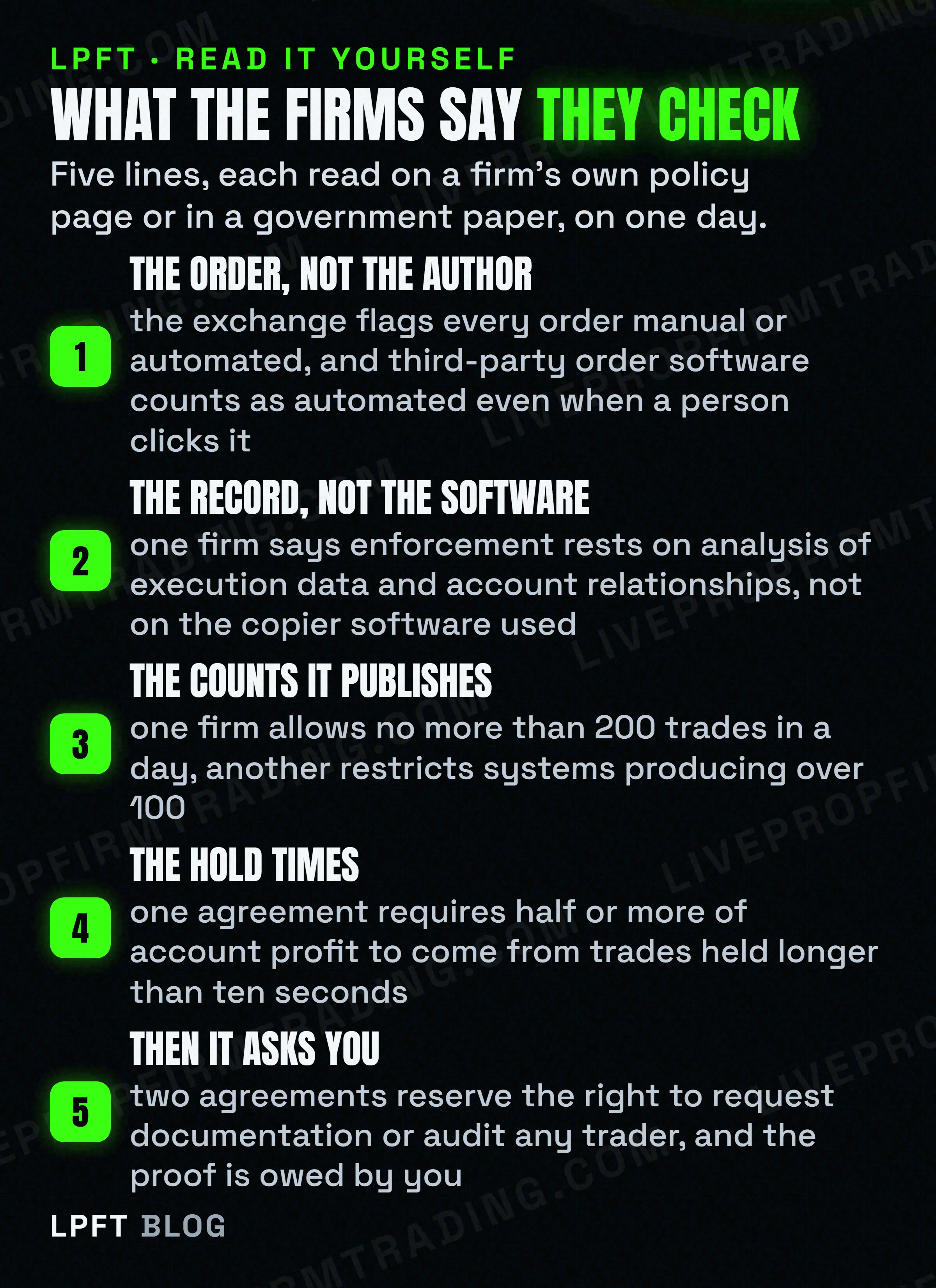
Here is the practical reason the detection question is a distraction. Most of the rules that actually cost people funded accounts are arithmetic on a record the firm already holds. No investigation is needed to apply them, and no clever bot avoids them.
One firm prohibits "using automated trading systems designed to scalp at an extremely high frequency" and then puts a number on it, saying "we do not allow strategies that produce more than 200 trades in a day." A second firm "restricts the use of automated systems designed for high-frequency trading (HFT), particularly those resulting in over 100 trades per day." Those are counts. A firm does not need to know what produced your trades to count them.
A third firm reaches the same place through holding time instead. Its funded trader agreement sets the floor directly: "50% or more of the Trader's account profit must come from trades held longer than ten (10) seconds." Read what that is measured on. It is measured on where your profit came from across the account, not on any single trade, so it is a property of the whole record and not a rule you break once by accident.
A fourth takes aim at the environment rather than the speed. It allows automation, saying "traders may make use of automated trading strategies tailored to their own specific settings so long as these automated tools do not aim to exploit the favorable fills offered in the Simulated Environment," and separately that "exploiting the absence of slippage and utilizing tight brackets to gain from favorable fills are not permitted." Slippage is the gap between the price you asked for and the price you got. In a simulated account that gap can be close to nothing, and a method tuned to its absence is tuned to a condition that does not survive the trip to live markets.
| The published rule | What it is measured on | Where it is written |
|---|---|---|
| No more than 200 trades in a day | a count of your fills, no investigation required | TradeDay terms and conditions |
| Over 100 trades per day, restricted | the same count, with a lower ceiling | Alpha Futures prohibited practices |
| Half or more of profit from holds over ten seconds | where the account's profit came from, across the whole record | Tradeify funded trader agreement |
| No exploiting the absence of slippage | the fills themselves, and the conditions they happened in | MyFundedFutures fair play page |
| Bots allowed by API, barred on live funded accounts | which account type the order arrived on | Topstep API help article |
| No bots or algos, any account type | independence of the decision, by the firm's own wording | TakeProfit Trader universal policies |
Then there is the line which retires the question entirely. The firm with one of the more permissive automation policies in futures writes it down: "all trading activity remains subject to Topstep's Trading Guidelines regardless of which platform executes the trades. A rule violation is treated the same whether it originates from manual trading or third-party automation."
If the penalty does not depend on what sent the order, then being identified as automated was never the thing which decided the outcome. Your record was. The same firm also puts the responsibility where you might not want it: "you remain the owner of your bot and are solely responsible for its design, performance, and behavior."
Trade-count ceilings and the HFT wording are the single most misread part of this subject, because almost every firm bans a term it never defines. That is pulled apart in HFT prop firms.
When a firm does take an interest, you are the one who has to prove it
Three firms publish what happens when something in a record looks wrong, and none of them describes a detective. They describe a request, and the direction of that request is the whole point.
One agreement says the firm "reserves the right to request information or documentation if our risk measures flag the Trader's account for potential violations," and separately: "the Company reserves the right to audit and review the trading activities and styles of all Traders to ensure compliance with the Company's rules." Note the word all. The audit right is not reserved for suspects.
The same agreement pairs it with an evidence test few people can pass. It allows "personal bots" if they are not HFT bots, and then adds the condition. "The Trader must be able to prove that the Trader is the sole owner of the bot or strategy and that no one else has access to or is using it." It adds that "while the Trader may use the bot on the Trader's personal accounts, using it across multiple firms is against Tradeify's policy."
A purchased or shared system cannot be proven to be solely yours, because it is not. At that firm the problem is never detection. The problem is being asked for proof you were never able to give. Another firm skips the evidence question and simply prohibits "using trading bots or Automated Trading Systems (ATS) purchased from a third party."
A second firm publishes what starts a look, and it is not a software signature. It says "excessive or unrealistic single day trades or single trade profits will be subject to review" for possible violations, and that if it "identifies trading activity that, in its sole discretion, relates to Prohibited Conduct," it "reserves the right to, in its sole discretion, delete the trading day and all profits, or restart or close the Account." The trigger named is an outlier in the result.
A third firm names the moment: "all passed evaluations are subject to review, and traders found guilty of policy ignorance or abuse will not be funded and may not be eligible for refunds." The review is attached to passing, which is exactly the moment people assume they are finished being assessed. What else changes at that boundary is covered in prop firm evaluation versus funded account.
The route itself is less private than people assume
One more source, and it is a useful one because it has no reason to say this. A bridge vendor published a page answering whether firms can tell it is being used. Its own answer, from 2024: "when using TradersPost, there is a chance that a prop firm could become aware of it because of the relationship between brokers and prop firms," and "brokers often have designated accounts for prop firm trading, and the order flow from TradersPost is flagged accordingly."
It then draws the same distinction the firms do, saying "although brokers recognize orders coming from TradersPost, it is up to the prop firms to enforce their policies," and "most prop firms aren't explicitly against tools like TradersPost, as long as traders remain compliant with their specific rules." A tool telling you the route is visible, and that the question is compliance rather than concealment, is worth more than any aggregator guess about milliseconds.
None of which settles whether automation belongs on a funded account in the first place. That argument, including the reasons to keep it off one, is in can you run a trading bot on a prop firm account.
What to do instead of trying to be invisible
Every rule quoted above was published, free to read, and findable before anybody spent a dollar. The expensive version of this knowledge is the one you get after a payout is refused. Here is the cheap version.
- Read your own firm's automation rule, on its domain, today. Not a comparison site and not a forum. Policy pages carry an updated date, and two of the ones read for this page had been revised during 2026.
- Find the numbers and check your record against them. The ceilings on trades per day and the floors on holding time are the rules you are most likely to break without noticing, because they are properties of a whole account.
- Ask whether you could prove the system is yours. If the honest answer is no, that is a decision made for you at any firm with a sole-ownership clause, whatever anybody detects.
- Check which account type your route is allowed on. A permission granted through an API can be real on one account type and closed on the next, which is a rule people discover by tripping over it.
- Save the terms on the day you accept them, with the date. Firms revise rules without telling anybody personally, and the version you agreed to is the only one you can point at later.
- If a firm bans automation, believe it and go elsewhere. One firm applies its ban to every account type by name and lists profit forfeiture, account closure and removal from the platform among the consequences. There is no clever version of ignoring that.
And notice what the better answer to the original question turned out to be. Not that firms cannot tell, and not that they run surveillance nobody can describe. The firms that write any of this down say they analyse the record, they may ask you for evidence, and the penalty is the same whichever hand sent the order. A record you are comfortable explaining is the asset. Everything else is an attempt to win an argument you will be having with the party that holds the money.
Trading futures involves a substantial risk of loss, no method can be shown to work in advance, and nothing on this page is a prediction about any firm's future rules or about any result. What it is, is an argument for building the kind of trading you would be happy to hand over for review, which is the same case made in can you use EAs or bots to pass a prop firm challenge.
The LPFT Copilot runs the whole stack for you on Tradovate - start a 7-day free trial and watch it work.
Start your 7-day free trialFrequently asked questions
Mostly they do not look for the software. Every order sent to a CME Group exchange carries a required value identifying whether it was entered manually or automatically, so automated order entry is already labelled at the exchange. On top of that, the firms that publish enforcement wording describe analysing execution data and account relationships, counting trades per day, measuring holding times, and asking the trader for documentation. One firm states outright that enforcement is not based on the specific software used.
An exchange-level flag exists, so the idea that nothing distinguishes automated order entry is wrong. That flag is not a bot test though. By the published definition an order counts as automated if it was generated or routed without human intervention, and a government paper on the subject says that includes orders where manual traders use the order submission management of third-party trading systems. It describes how the order was sent, not who decided the trade.
Usually a published rule measured on your own record rather than any discovery about your software. Real examples read on firms own pages include a limit of no more than 200 trades in a day at one firm, a restriction on automated systems producing over 100 trades per day at another, and an agreement requiring that half or more of account profit comes from trades held longer than ten seconds. Buying the bot is its own problem, because one firm prohibits third-party purchased systems and another requires proof of sole ownership.
One futures firm publishes that all passed evaluations are subject to review and that traders found guilty of policy ignorance or abuse will not be funded. Another says excessive or unrealistic single day trades or single trade profits will be subject to review. So review moments tied to results and milestones are real and published at those firms. No firm read for this page publishes a detection method, a reaction-time threshold or a correlation figure, so treat any specific number you see as unsourced.
Not at every firm, and the distinction they draw is about who decides rather than whether software is involved. One firm bans trading bots and algorithmic execution tools outright while separately permitting trade copiers from a named approved list for managing accounts you own and control, and stating that traders are free to use tools that assist with order execution or trade management. The same firm prohibits coordinated trading across different users and statistically improbable execution patterns across multiple accounts.
Read your own firm policy page on its own domain and check the updated date, because these are revised without any personal notice. Compare your actual record against the published trade count and holding time rules rather than against the headline permission. Confirm the rule for the account type you will finish on, not only the one you are buying. If the firm bans automation, take the ban at face value and trade somewhere that permits what you do, because the published consequences include profit forfeiture and account closure.
Eli Y.
Eli builds and runs rules-based automated futures systems on NinjaTrader and Tradovate, and helps traders take emotion out of the screen. He writes about futures automation, prop-firm evaluations, and the tools that connect them - plainly, and without hype.
Risk disclosure: Trading futures involves substantial risk of loss and is not suitable for everyone. This article is educational content only and is not financial advice or a recommendation to trade. Past performance is not indicative of future results. Some links are affiliate links.