
Futures Margin and Leverage: Two Numbers Wear the Same Name

Heads up: some links below are affiliate links. If you sign up through them we may earn a commission at no extra cost to you - it never changes what we recommend.
Futures margin is a performance bond, and two different numbers carry the name. The exchange sets an initial and maintenance requirement it will not fix in advance, and your broker sets its own intraday day margin. Leverage is arithmetic from those, not a published figure.
The arithmetic on this page tells you what a position can do to an account. The LPFT Copilot is the part that stops it: a tested, rules-based method on your own prop firm or Tradovate account, with a daily loss cap and a trading window built in rather than remembered. Start a 7-day free trial.
Start your 7-day free trialWhat the exchange actually calls it, and what it refuses to tell you
Start with the vocabulary, because the English word margin is doing two jobs here and the confusion is structural rather than careless. CME's own FAQ, read on 6 November 2026, opens with the definition, verbatim: "Performance Bonds, also known as margins, are deposits held at CME Clearing to ensure that clearing members can meet their obligations to their customers and to CME Clearing. Performance bond requirements vary by product and market volatility."
A deposit held at the clearing house. Notice what that sentence does not describe. There is no lender in it, nothing is advanced to you, and nothing accrues. We read that page in full and the words loan, borrow and interest do not appear anywhere on it. What it describes instead is an account being "debited and credited" as prices move, every day, in both directions.
That is worth being precise about rather than sloganeering about. We are not quoting CME saying futures margin is not a loan, because CME does not say that. We are pointing out that the exchange describes the mechanism entirely without the vocabulary of lending, and that if you came from stock trading, the thing you called margin there is a different arrangement with a different cost.
Then the part that frustrates everybody. CME will not give you a figure. Its Micro E-mini FAQ answers the margin question with "Margins are based on current market conditions and, thus, are subject to change" and a set of links. The performance bond FAQ adds a structural limit, verbatim: "Currently, only the exchange margins for our futures products are available online. Portfolio and options margins can only be calculated in SPAN."
Initial against maintenance, and the direction nearly everyone gets backwards
Two exchange numbers, not one. CME states both and then states what happens between them, and the last clause is the one worth reading twice. Verbatim:
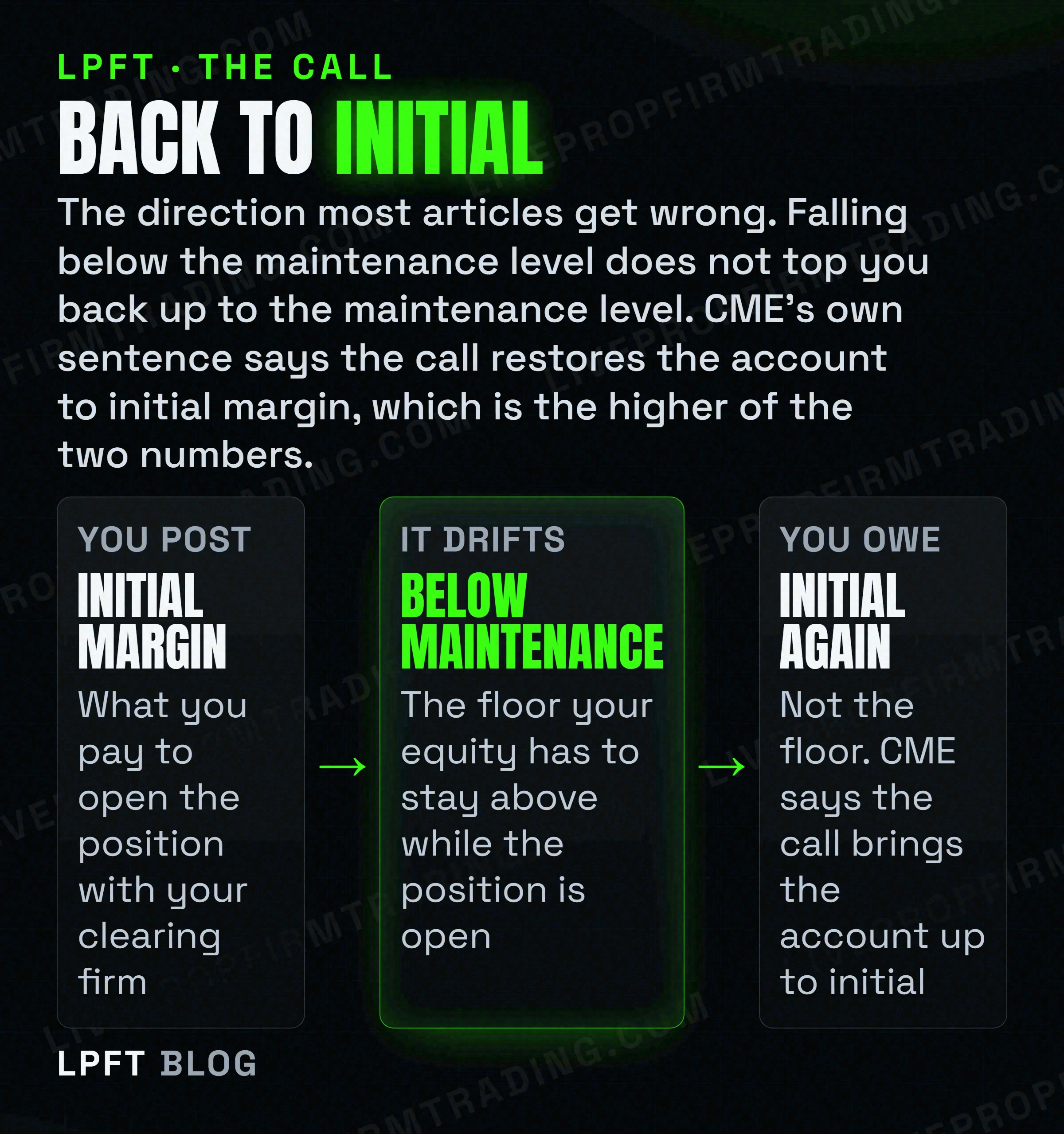
"Initial margin is the margin that market participants must pay when they initiate their position with their clearing firm whereas maintenance margin is the minimum level at which market participants must keep in their account, or "maintain" in their account over time. If subsequently margin equity falls below maintenance margin, a call must be issued to bring the account up to initial margin."
Up to initial margin. Not up to maintenance. Several pages ranking for this question describe it the other way round, as though touching the floor only obliges you to return to the floor. The exchange's own sentence says the call restores you to the higher number, which means the amount you owe at that moment is larger than the gap that triggered it.
That has a shape worth seeing before it happens to you. Drift down past the maintenance level by a dollar and the obligation is not a dollar. It is the whole distance back up to where you started. For anything automated, that is the difference between a position that quietly survives a drawdown and an account that needs funding at an hour you were not watching.
CME also publishes its own worked illustration of the mechanism, and the figures in it are explicitly historical rather than current. It describes a September E-mini S&P 500 bought "on June 13, when the contract was trading at 1050.00 points," with an "Initial Performance Bond: $4,000," a "Maintenance Performance Bond: $3,200," a "Contract Value Factor: $50/point," and a contract "valued at $52,500." The page carries a footer stating that all its examples "are hypothetical interpretations of situations and are used for explanation purposes only."
An index level of 1050 dates that example on sight. It is useful for the ratio and the mechanism, which is why CME wrote it, and it is not a current requirement for anything. Any article printing those four numbers as today's margin has copied an illustration and dropped the label.
The number you will actually meet is your broker's, and it is much smaller
Here is where the two meanings separate. Alongside the exchange requirement, a broker sets its own intraday figure for positions opened and closed inside a session. That one is a competitive product feature, which is why it is on the front of a pricing page rather than buried in a clearing document.
Both pages below were read on 6 November 2026, and they belong to the same company. Tradovate's footer says so: "2026 NinjaTrader Group, LLC. All rights reserved."
| Published today | NinjaTrader | Tradovate |
|---|---|---|
| Headline claim | "$50 day trading margins" | "day trading margins starting at $10" |
| Micro contracts | $50 intraday | $50 |
| Standard contracts | $500 | $500, with a footnote |
| Smallest tier | $10 to $20 for e-Nano | $10 Nano, $25 Smalls |
| Account minimum | Not stated on the page | "Any funding amount" |
Same company, same week, two different headline numbers, because they are selling access to different tiers of contract. Neither is wrong. Both are the broker's choice, and neither is the performance bond CME holds at clearing.
Hold that against CME's illustration for a moment. The exchange's example of an initial performance bond on a full E-mini was $4,000. A broker advertises $500 intraday on a standard contract and $50 on a micro. Those numbers are not in conflict, because they answer different questions, and the question they answer is the one that matters: what gets you into a position today, against what is required to hold one.
A day margin is permission to open a position you may not be funded to hold. If it is still open when the intraday window ends, the requirement that applies is the higher one, and the difference has to come from somewhere. Read your own broker's margin page for what it does at that moment, because that behaviour is the broker's policy rather than the exchange's, and it is not the same everywhere.
One more exchange detail most people never see, from the same FAQ. Some requirements shrink as a month passes. Verbatim: "Eroding margins are margins that decrease in value over time. Many products have eroding margins because the margins are based on the average price for the month and thereby, they present less risk than regular margins." CME prints the formula as "price scan *(calendar days remaining/total calendar days in the month)". So in some products the requirement itself is a function of the date, which is one more reason a figure in an article has a short shelf life.
Why this page will not print a leverage ratio
Every result on this search gives you a ratio and a recipe. Divide the notional value by the margin requirement and there is your leverage. The recipe is correct. The problem is both inputs.
Notional value needs a current index level, and CME dates its own. Its Micro E-mini FAQ carries a notional column headed with a date in early 2023, which means the exchange itself treats those figures as a snapshot rather than a fact. Margin, as established above, is the thing CME says is "subject to change" and declines to fix. Divide one undated number by another unpublished number and you get a figure that looks authoritative and is not checkable.
Several of those pages also state that futures margin runs "typically 3% to 12% of the contract's notional value." We could not find a source for that band on any exchange page and so it is not repeated here. It may well be a fair description of history. It is not something we read, and a range presented without an owner is exactly the kind of number that gets copied for a decade.
So the method, instead, and it takes two lines. Take the multiplier the exchange publishes for your contract, which is a specification and therefore stable. Multiply it by the index level on your own screen right now. That is your notional. Divide it by the margin your own broker is holding against your own position, which is on your own statement. The result is your leverage, today, and it is the only version of the number that is true.
The multipliers themselves and the trap inside the micro family are in micro futures explained, the contract-by-contract arithmetic is in MES vs MNQ, and the unit conversion everything here depends on is in tick size and tick value.
Position size is a decision that has to survive the trip to the broker, so whatever carries the order is part of your risk model. TradersPost publishes which broker connections it supports and states that following your own firm's rules is your responsibility, which is the right division of labour. Free 7-day trial.
See TradersPostWhat leverage does to an automated account specifically
Leverage is usually explained as a multiplier on outcomes, which is true and not very useful. For something running without you watching, the sharper framing is that leverage shortens the time between a mistake and a consequence.
- It compresses your reaction window. A requirement met at nine in the morning can be unmet by lunchtime, and a call that has to restore the account to initial rather than to maintenance arrives larger than the move that caused it.
- It makes position size a risk control, not a preference. The only input you fully control is how many contracts. Stop distance comes from the method, multipliers come from the exchange, margin comes from the broker. Size is yours, and it is the lever that decides whether a bad day is survivable.
- It punishes an inherited number. Margin varies with volatility by CME's own description, erodes with the calendar in some products, and sits behind a broker policy that can change. A size calculated once and left in a config file is a number that was right on a day that has passed.
- It has nothing to say about whether the method works. Leverage scales a result, in both directions, and a method that loses slowly without it loses quickly with it. That ordering matters: prove the rules first, size them second.
The account-size version of this question is in how much money you need for automated futures trading, the mathematics of being wiped out by a run of losses is in risk of ruin math, and what comes off every round turn before any of this applies is in how much it costs to trade micro futures.
Futures trading carries a substantial risk of loss, and leverage is the reason that sentence is not boilerplate. Nothing on this page is advice about how much to trade or at what size. It is the exchange's own definitions, the broker's own published numbers, and the arithmetic you have to do yourself because nobody can honestly do it for you in advance.
The LPFT Copilot runs the whole stack for you on Tradovate - start a 7-day free trial and watch it work.
Start your 7-day free trialFrequently asked questions
It is a deposit rather than a loan. CME calls it a performance bond and defines it as "deposits held at CME Clearing to ensure that clearing members can meet their obligations to their customers and to CME Clearing," adding that requirements "vary by product and market volatility." The word margin then gets used for a second thing: the intraday day-trading margin your broker sets and advertises, which is a different and usually much smaller number for the same contract.
CME states it directly: "Initial margin is the margin that market participants must pay when they initiate their position with their clearing firm whereas maintenance margin is the minimum level at which market participants must keep in their account." The part most summaries get wrong is what follows: "If subsequently margin equity falls below maintenance margin, a call must be issued to bring the account up to initial margin." The call restores the higher number, not the floor you fell through.
Because they are two different numbers answering two different questions. The exchange holds a performance bond against a held position and recalculates it against market volatility. A broker sets a separate intraday margin for positions opened and closed inside a session, as a competitive feature. Two brokers that are part of the same company published headline figures of "$50 day trading margins" and "day trading margins starting at $10" in the same week. A day margin is permission to open a position you may not be funded to hold overnight.
Multiply the contract multiplier published by the exchange by the current index level to get notional value, then divide that by the margin actually held against your position. Both inputs have to be current, which is why a leverage ratio printed in an article is not reliable: CME dates its own notional column to early 2023, and answers the margin question with "Margins are based on current market conditions and, thus, are subject to change." Do it with your own statement and your own screen.
They are different arrangements. CME describes futures margin as a deposit held at its clearing house, with the account "debited and credited" as prices move, and the words loan, borrow and interest do not appear on its performance bond FAQ at all. Stock margin is a borrowing arrangement with an interest cost. The practical consequence is that futures leverage comes from contract size rather than from credit, and that daily settlement moves cash in and out of your account rather than accruing a balance.
Yes, and the exchange says so in several ways. CME states that "Performance bond requirements vary by product and market volatility" and that margins are "subject to change." Some products use what CME calls eroding margins, which "decrease in value over time" on a published formula of "price scan *(calendar days remaining/total calendar days in the month)." Broker day margins can also change under the broker's own policy. A position size calculated once and never revisited is sized against conditions that have moved.
Eli Y.
Eli builds and runs rules-based automated futures systems on NinjaTrader and Tradovate, and helps traders take emotion out of the screen. He writes about futures automation, prop-firm evaluations, and the tools that connect them - plainly, and without hype.
Risk disclosure: Trading futures involves substantial risk of loss and is not suitable for everyone. This article is educational content only and is not financial advice or a recommendation to trade. Past performance is not indicative of future results. Some links are affiliate links.