
Micro Futures Explained: One Tenth of What, Exactly?

Heads up: some links below are affiliate links. If you sign up through them we may earn a commission at no extra cost to you - it never changes what we recommend.
A micro future is a CME contract sized at one tenth of one specific larger contract, not one tenth of the other micros. CME lists six Micro E-minis, and their multipliers run from $0.50 to $10 an index point, so two of them cost more per point than MES.
Reading a spec sheet is the easy half. The LPFT Copilot runs a tested, rules-based method on your own prop firm or Tradovate account, with the session windows and the daily loss cap built in so a contract you chose on paper cannot quietly become a bigger position than you planned. Start a 7-day free trial.
Start your 7-day free trialWhat a micro actually is, in the exchange's own words
CME states the definition in one sentence, and the sentence contains a qualifier that almost every article drops. Read on 5 November 2026, the Micro E-mini FAQ says the suite features "multipliers 1/10 the size of their E-mini counterparts (i.e., $5 multiplier for Micro E-mini S&P 500 futures contract vs. $50 for ES futures)."
The qualifier is "their E-mini counterparts." A micro is one tenth of the one named contract it was cut down from. It is not one tenth of a standard size, there is no standard size, and it is certainly not one tenth of the other micros. That distinction sounds pedantic until you put the six contracts side by side, which is the next section and the reason this page exists.
The same page dates the family: "Since their inception in May 2019, numerous new participants have entered the market as a function of the notionally smaller-sized Micro E-mini futures." So these are not new instruments any more, and the information about them has had years to settle into a shape that is slightly wrong.
One more structural detail from the same FAQ, because it surprises people who assume the whole family lives in one place. Five of the six list under CME and the Micro E-mini Dow lists under CBOT. Both are CME Group exchanges, so nothing about your access changes, but a fee schedule and a rulebook chapter are per-exchange documents and the Dow micro reads from a different one.
The two Micro E-minis nobody lists, and why they break the rule of thumb
Question 1 of that FAQ lists six products: Micro E-mini S&P 500, Nasdaq-100, Dow, Russell 2000, S&P MidCap 400 and S&P SmallCap 600. Every result on the first page of this search names four at most, usually the two index micros plus gold and crude, and the two that get dropped are the two that matter for the point being made.
Here is CME's own multiplier table, with the Micro column beside the E-mini column it was derived from. These are contract specifications, so they are stable and safe to print.
| Index family | Micro multiplier | E-mini multiplier |
|---|---|---|
| S&P 500 | $5 | $50 |
| Nasdaq-100 | $2 | $20 |
| Dow Jones | $0.50 | $5 |
| Russell 2000 | $5 | $50 |
| S&P MidCap 400 | $10 | $100 |
| S&P SmallCap 600 | $10 | $100 |
The MidCap 400 and SmallCap 600 micros are ten dollars an index point. MES is five. So two members of the family labelled "micro" carry double the per-point exposure of the one that everybody recommends to beginners, and the ratio in the name is still perfectly accurate, because each is one tenth of a hundred-dollar E-mini.
One tenth is a statement about a relationship between two contracts. It is not a statement about how much money a trade puts at risk. A $10 micro and a $0.50 micro are both exactly one tenth of their own sibling, and they are twenty times apart from each other.
A multiplier does not tell you a tick value, and a tick value does not tell you a multiplier
This is the second thing the family gets wrong, and it is cleaner than the first. MES and M2K share a multiplier. They do not share a tick value. CME's product pages state each one plainly: "The Micro E-mini S&P 500 futures contract is $5 x the S&P 500 Index and has a minimum tick of 0.25 index points," and "The Micro E-mini Russell 2000 futures contract is $5 x the Russell 2000 Index and has a minimum tick of 0.10 index points."
Same five dollars a point, different minimum increment, so one tick is $1.25 on MES and $0.50 on M2K. Two numbers describe a contract and neither one predicts the other. The full set, from the FAQ's own table under its line that "The tick increments will follow their E-mini counterparts," looks like this.
| Contract | Outright tick | Calendar spread tick |
|---|---|---|
| Micro E-mini S&P 500 futures | 0.25 Index points= $1.25 | 0.05 Index points= $0.25 |
| Micro E-mini Nasdaq-100 futures | 0.25 Index points= $0.50 | 0.05 Index points= $0.10 |
| Micro E-mini Dow futures | 1.00 Index points= $0.50 | 1.00 Index points= $0.50 |
| Micro E-mini Russell 2000 futures | 0.10 Index points= $0.50 | 0.05 Index points= $0.25 |
| Micro E-mini S&P MidCap 400 futures | 0.10 Index points= $1.00 | 0.05 Index points= $0.50 |
| Micro E-mini S&P SmallCap 600 futures | 0.10 Index points= $1.00 | 0.05 Index points= $0.50 |
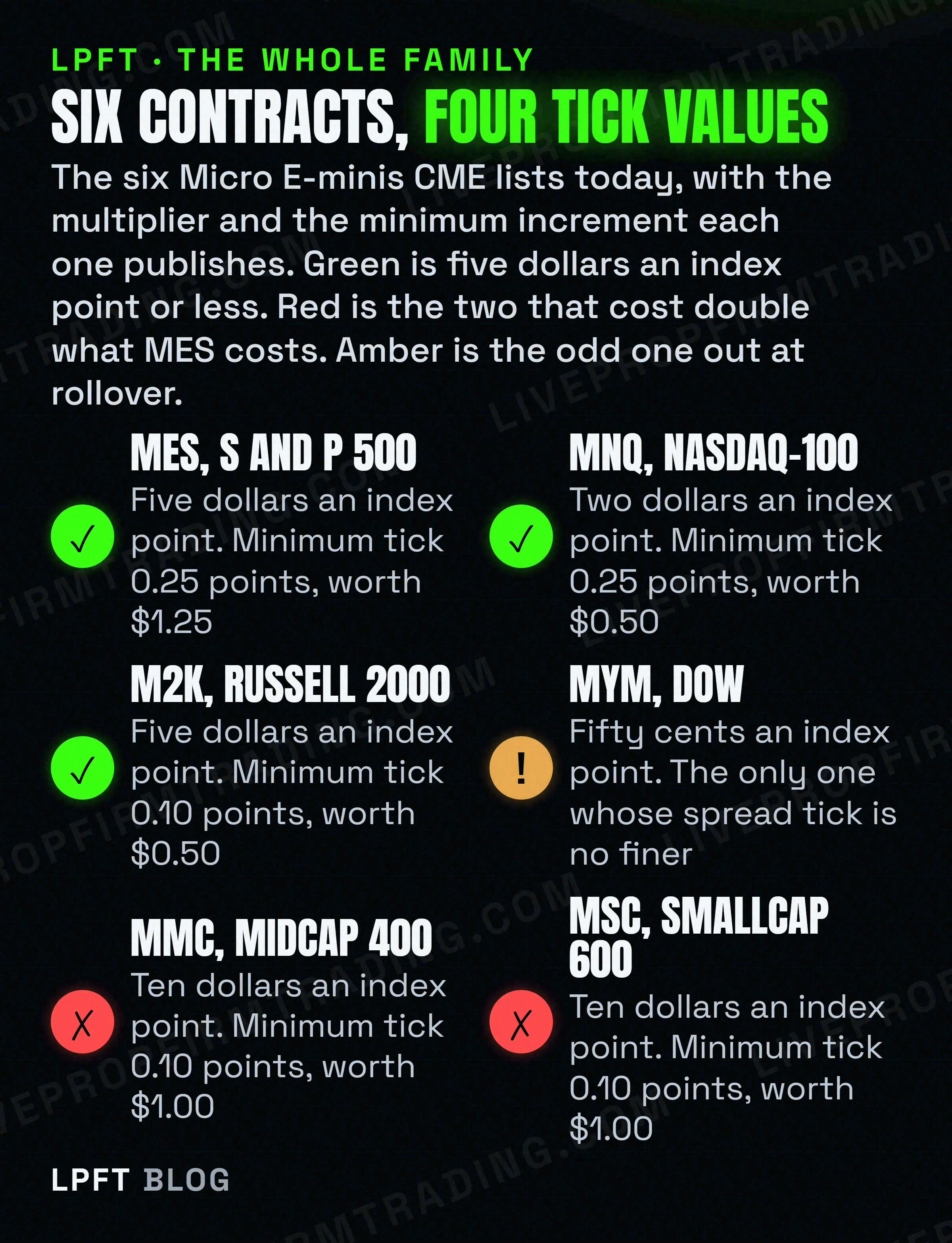
Two more things fall out of that table. The right-hand column is the increment you transact in on a calendar spread, which is what you are doing when you roll a position, and it is finer than the outright increment on five of the six. The exception is the Dow micro, where both columns read "1.00 Index points= $0.50." It is the one contract in the family that gets no finer increment at rollover, and we have not seen that written anywhere else.
For the two contracts most people actually choose between, the same arithmetic done properly is in MES vs MNQ, and the general version of why a tick is the wrong unit to think in is in tick size and tick value.
Outside the equity index family, one tenth is stated as a ratio and not a dollar
The micro brand extends past the stock indices, and the metals and energy pages describe themselves the same way the FAQ does. Micro Gold, read on its own CME page on 5 November 2026, is offered "At 1/10 the size of benchmark Gold futures and options contracts," and elsewhere on that page as "sized at 1/10 of Gold (GC) futures and Gold (OG) options." Micro WTI Crude Oil is "At 1/10 the size of benchmark WTI Crude Oil contracts," and CME describes what that buys you as the ability to "fine-tune your crude oil market exposure up or down in 100-barrel increments."
Notice what those pages give you and what they do not. They give a ratio and a physical unit. They do not give a dollar multiplier, because gold is quoted per troy ounce and crude per barrel rather than in index points. We did not read a tick value for either contract, so this page does not print one. If you trade them, read the increment off the contract specification for the contract you are actually sending an order to.
There are micro-sized CME contracts in crypto, treasury yields and FX as well. Their specification pages would not open for us on the day this was written, so this article does not tell you their sizes and does not tell you whether the one-tenth ratio holds for them. An article that lists a size it could not read is the thing you are trying to avoid. There are also no margin figures here, because CME answers that question with "Margins are based on current market conditions and, thus, are subject to change" and a set of links rather than a number.
What changes when a machine is placing the orders
A person reading a spec sheet picks a contract once and remembers the quirks. A script does not remember anything, so the quirks have to be written into it. Four from the pages above are worth encoding.
- The listing cycle is not the same length for every micro. CME states it directly: "CME will list five months in the March Quarterly Cycle (Mar, Jun, Sep, Dec) for CME Group products. For Dow, it will be four months." Anything that walks a fixed number of forward contracts will walk off the end of the Dow micro.
- The expiry is a fixed calendar event. The family lists on the customary cycle with "five concurrent futures that expire against the opening index value on the third Friday of March, June, September, and December," and final settlement uses the same Special Opening Quotation as the matching E-mini.
- The daily mark comes from the bigger contract. Verbatim: "Daily settlement for Micro E-mini futures is based on the 30-second volume-weighted average price (VWAP) of Globex trades between 3:59:30 p.m. and 4:00:00 p.m. ET of their E-mini counterpart." The number on your statement was computed from trades in a contract you never touched.
- There is a halt inside the trading day. CME gives the hours for these contracts as "Sunday - Friday 6:00 p.m. - 5:00 p.m. ET with a trading halt from 4:15 p.m. - 4:30 p.m. ET." Fifteen minutes where an order will not behave the way a backtest assumed it would.
The roll mechanics are in futures contract rollover explained, the settlement chain between a micro and its E-mini is the whole subject of ES vs MES, and the session-window side of it is in best times to trade futures.
Whichever contract you land on, something has to carry the decision to the broker. TradersPost publishes which broker connections it supports and states that following your own firm's rules is your responsibility, which is the right division of labour. Free 7-day trial.
See TradersPostSo which micro, and what to do with the numbers
The useful answer is not a ticker, and it is not "the smallest one" either, because you now know the family does not sort cleanly by size. The right contract is the one your rules were tested on, priced in dollars, on the hours you intend to trade.
The sum is two lines long. Measure the stop your rules actually use, in index points, off your own chart. Multiply it by that contract's published multiplier. Hold the result against your daily loss limit, and if one stop eats a serious slice of the limit then the contract is too big for the account no matter what the word "micro" implies. Redo it when your account size changes, and redo it at every rollover, because the increment you transact in is a different one.
If this is early days, automated futures trading for beginners is the ground-up version, how much money you need for automated futures trading is the account-size version of the same arithmetic, and how much it costs to trade micro futures covers what comes off the top of every trade.
Futures trading carries a substantial risk of loss. A smaller multiplier shrinks the size of a mistake without changing how often you make one, and two of the contracts on this page are not the smaller multiplier people assume. Nothing here is advice about what to trade. It is the arithmetic that has to come first, and it is arithmetic you should do again rather than inherit from an article.
The LPFT Copilot runs the whole stack for you on Tradovate - start a 7-day free trial and watch it work.
Start your 7-day free trialFrequently asked questions
Micro futures are CME contracts sized at one tenth of one specific larger contract. CME states that the Micro E-mini suite features "multipliers 1/10 the size of their E-mini counterparts (i.e., $5 multiplier for Micro E-mini S&P 500 futures contract vs. $50 for ES futures)," and the family dates from May 2019. The ratio is always to the one named sibling contract, never to the other micros, so the micros are not all the same size as each other.
In the Micro E-mini equity index family CME lists six: Micro E-mini S&P 500 (MES), Nasdaq-100 (MNQ), Dow (MYM), Russell 2000 (M2K), S&P MidCap 400 (MMC) and S&P SmallCap 600 (MSC). Five list under CME and the Dow micro lists under CBOT. CME also publishes micro-sized contracts outside the stock indices, including Micro Gold and Micro WTI Crude Oil, each described on its own page as 1/10 the size of the benchmark contract it comes from.
No, and this is the most common mistake. CME's own multiplier table runs from $0.50 an index point on the Micro E-mini Dow to $10 on the Micro E-mini S&P MidCap 400 and S&P SmallCap 600, with MES at $5 and MNQ at $2. Every one of them is exactly one tenth of its own E-mini, and they are still twenty times apart from each other, so two contracts labelled micro carry double the per-point exposure of MES.
It depends on the contract and it does not follow from the multiplier. CME publishes the outright increments as "0.25 Index points= $1.25" for Micro E-mini S&P 500, "0.25 Index points= $0.50" for Nasdaq-100, "1.00 Index points= $0.50" for Dow, "0.10 Index points= $0.50" for Russell 2000, and "0.10 Index points= $1.00" for both MidCap 400 and SmallCap 600. MES and M2K share a $5 multiplier and have different tick values because their tick sizes differ.
Yes, on the same cycle. CME describes "five concurrent futures that expire against the opening index value on the third Friday of March, June, September, and December," with final settlement using the same Special Opening Quotation as the matching E-mini. One exception is worth knowing for anything automated: CME lists five contract months for its own products but says "For Dow, it will be four months." The increment you transact in when rolling is the calendar spread tick, which is finer than the outright tick on five of the six.
They reduce the dollar size of a position, which is not the same as reducing risk. Futures trading carries a substantial risk of loss at any contract size, and a smaller multiplier changes how much a mistake costs rather than how often one happens. The honest test is arithmetic: your stop distance in index points, multiplied by the contract's published multiplier, measured against your daily loss limit. Test any rules in simulation before either size sees real money.
Eli Y.
Eli builds and runs rules-based automated futures systems on NinjaTrader and Tradovate, and helps traders take emotion out of the screen. He writes about futures automation, prop-firm evaluations, and the tools that connect them - plainly, and without hype.
Risk disclosure: Trading futures involves substantial risk of loss and is not suitable for everyone. This article is educational content only and is not financial advice or a recommendation to trade. Past performance is not indicative of future results. Some links are affiliate links.