
The Cost to Trade Micro Futures: Four Line Items, Two of Them Unknowable

Heads up: some links below are affiliate links. If you sign up through them we may earn a commission at no extra cost to you - it never changes what we recommend.
A micro futures round turn costs four things, and only one is on a pricing page. Broker commissions run $0.09 to $0.39 per side and the NFA assessment fee is $0.01 per side. The exchange fee and the spread are knowable only from your own fill.
A cost stack only matters next to a rule set that respects it. The LPFT Copilot runs a tested, rules-based method on your own prop firm or Tradovate account with a daily loss cap and a trading window built in, so the number of round turns you pay for is a decision rather than a mood. Start a 7-day free trial.
Start your 7-day free trialThe honest shape of the answer, before any numbers
Ask what a micro contract costs and you get a commission. Twenty-nine cents, nine cents, thirty-nine cents, whichever broker you landed on. We read nine pages ranking for this question on 6 November 2026, and five of them belonged to the same vendor. Every one of them answered with a commission and a margin figure, and stopped.
A commission is one of four things that come out of a round turn, and on a micro it is reliably the smallest. Two of the other three cannot be printed in an article at all, because the party that charges them states in writing that they vary. That is not a dodge, it is the actual answer, and it is the reason this page is laid out the way it is: what you can price before you trade, and what only your own statement can tell you afterwards.
Everything below was read on the owner's own domain on 6 November 2026. Where a number could not be read, there is no number.
Line one: the commission, which both pages admit is not the whole bill
Two brokers in this space publish a plain commission ladder, and they publish the same one, because they are the same company. Read on 6 November 2026, both ninjatrader.com and tradovate.com list three plans with identical per-side rates.
| Plan | Micro, per side | Standard, per side | Plan fee |
|---|---|---|---|
| Free | $0.39 | $1.29 | No monthly plan fee |
| Monthly | $0.29 | $0.99 | $99 per month |
| Lifetime | $0.09 | $0.59 | $1,499 one-time |
Per side, so double it for a round turn. On the Lifetime plan a micro round turn is eighteen cents of commission, which is the number that gets quoted in headlines, and it arrives attached to a $1,499 payment that the headline leaves out. The arithmetic on whether that pays for itself is yours and it depends entirely on how many round turns you do.
The important sentence on those pages is not a price. NinjaTrader prints "Exchange, clearing, and NFA fees apply." Tradovate prints "Exchange, clearing, and NFA fees still apply," directly under a banner reading "ALL TRADOVATE PLATFORMS INCLUDED WITH NO LICENCE FEES." Both pages then offer a separate link captioned "View All-In Commission Rates."
A vendor prints a commission, tells you three other fee types apply, and offers a different page for the all-in figure. That is honest disclosure, and it is also a clear statement that the number on the pricing page is not what leaves your account. Any article that quotes the headline commission as the cost of trading has dropped the sentence sitting next to it.
One structural note worth having. Tradovate's own footer, read the same day, reads "2026 NinjaTrader Group, LLC. All rights reserved." The two brands are one company, which is the whole subject of Tradovate vs NinjaTrader.
Line two: the fee that is a real number, and is already scheduled to double
This is the one the entire search result set misses, and it is the easiest of the four to state exactly. The National Futures Association publishes its own assessment fee on its own site. Read on 6 November 2026, verbatim: "The NFA assessment fee, payable by FCMs with respect to futures contracts, is $.01 per side, invoiced to customers."
One cent a side. Two cents a round turn. Then the part nobody writes: the same page states that effective 1 July 2027 the fee "will be $.02 per side, invoiced to customers." A published, dated doubling of a cost line, sitting on the regulator's own page more than half a year ahead of time. The fee on exchange-traded options moves the same way, from a cent to two cents a side.
There is a wrinkle in how it reaches you. NFA states the fee is "calculated on a round-turn basis," and that its bylaws leave member brokers free to invoice or accrue it at any point in a round turn, or to split it across the transactions that make up one. So the same fee can appear on two brokers' statements in two different shapes, and neither broker is doing anything unusual. That is NFA's own description of the latitude it grants, not a complaint about anybody.
Two cents is not going to decide whether a method works. It is in here because it is knowable, it is changing, and a cost article that omits a line it could have quoted exactly is telling you something about how carefully the rest of it was assembled.
Line three: the exchange fee, which the exchange says has no single value
Now the one every article prints as a flat figure. CME publishes its fee schedules on a page that opens by telling you why a flat figure cannot exist. Read 6 November 2026, verbatim: "Exchange fees for clearing and trading CME Group products vary according to whether the customer has membership or incentive program participant status for the respective CME, CBOT or NYMEX/COMEX Exchange. Fees also vary by product as well as volume traded, venue and/or transaction type."
Five dimensions. Membership status, product, volume, venue and transaction type. Not one of them is a property of the contract alone, which means not one of them is something an article can look up on your behalf.
It gets better, in the sense of worse. The same page offers three separate schedules with three separate effective dates, all inside four weeks: a CME schedule "effective 19 October 2026," a CBOT schedule "effective 1 November 2026," and a NYMEX and COMEX schedule "effective 2 November 2026." Each carries the footnote "Pending any relevant CFTC regulatory review periods," and the page notes that "Effective October 1, 2026, CME Group announced a series of transaction fee schedule changes."
CME's Micro E-mini FAQ states that five of the six Micro E-minis list under CME while the Micro E-mini Dow lists under CBOT. Those are two of the three schedules above, with effective dates thirteen days apart. So two contracts in the same product family, bought through the same broker, read their exchange fee from different documents that changed on different days. The contract side of that split is in micro futures explained.
We tried to read the CME schedule itself and the PDF returned a 403 to this machine, which is consistent with how that domain rate-limits. So there is no exchange fee figure on this page. What there is instead is the useful instruction: open one filled order on your own statement, find the line that is not the commission and not the NFA cent, and that is your exchange and clearing cost for that contract on that day. It is the only version of the number that is true for you.
One related line from the same FAQ, because it is a cost consequence people assume away: "Micro E-mini futures volume will not count towards the current volume-based fee discounts available to members." Trading micros does not build toward the member discount tiers. CME adds that it "does intend to provide a market maker program to eligible participants that may feature fee rebates, pending regulatory review," which is an intention rather than a rate, and is not a thing to plan around.
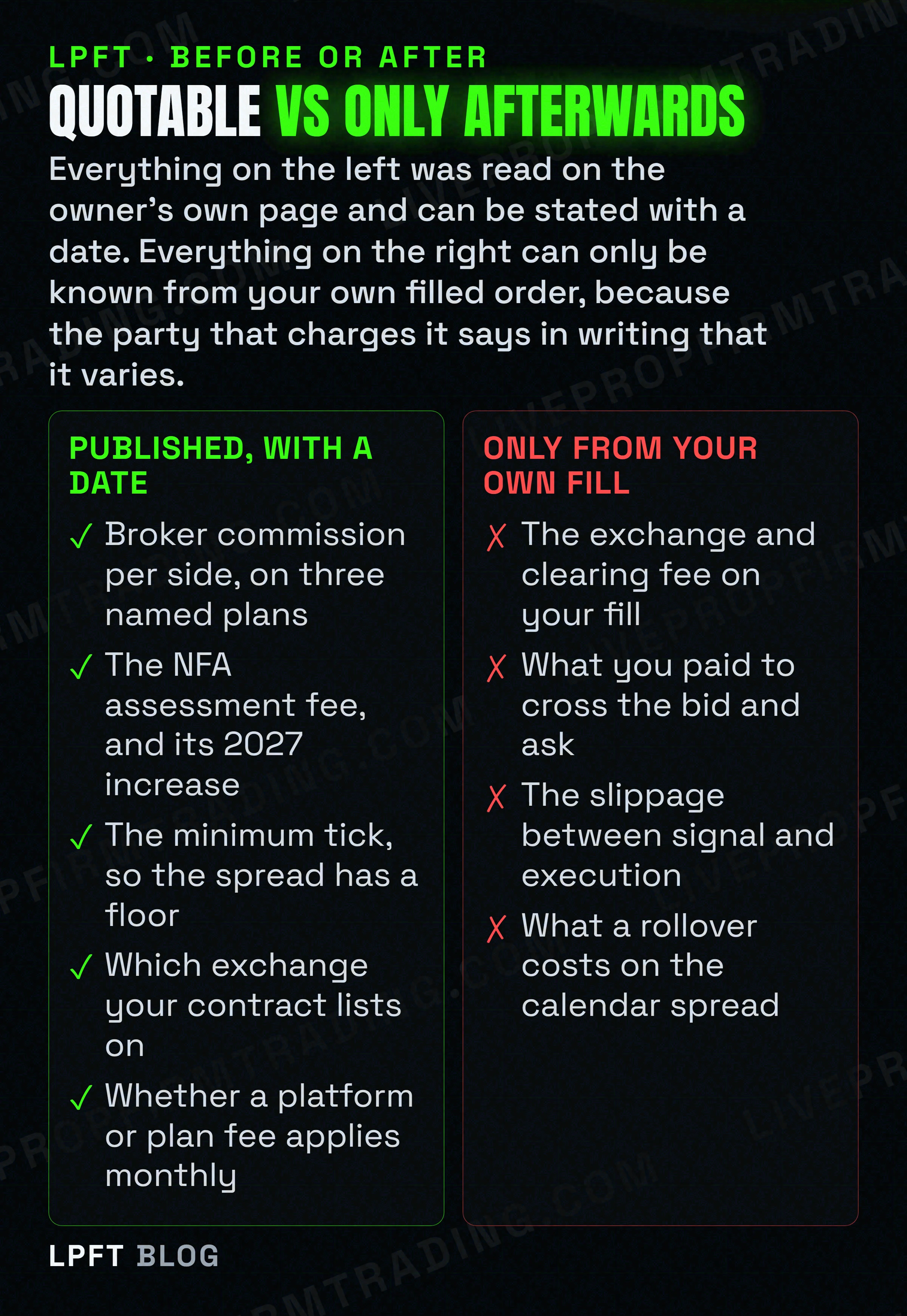
Line four: the spread, which is the biggest one and is not a fee
Nothing invoices you for this and it is almost certainly the largest of the four. Every market entry crosses from one side of the book to the other, and the minimum width of that crossing is published as the contract's tick.
CME states the increments in its own FAQ table. A Micro E-mini S&P 500 tick is "0.25 Index points= $1.25." A Micro E-mini Nasdaq-100 tick is "0.25 Index points= $0.50." A Micro E-mini Russell 2000 tick is "0.10 Index points= $0.50." Hold the first one next to the commission ladder above. One tick on MES is $1.25. The round-turn commission on the Lifetime plan is eighteen cents. The spread floor is roughly seven times the commission, and that is before anything moves against you between the signal and the fill.
We did not read any bid-ask spread study, volume report or slippage measurement, so there are no averages here. The floor is what is published, and the floor is enough to make the point: optimising the commission while ignoring how often you cross the spread is optimising the wrong line. The unit arithmetic itself is in tick size and tick value.
There is a fifth cost that only shows up four times a year, and it hides inside the same table. The calendar spread tick is a different increment from the outright tick, and it is the one you transact at when you roll a position. CME prints it as "0.05 Index points= $0.25" for MES against the "0.25 Index points= $1.25" outright. Finer, and still a cost you pay on a schedule rather than on a decision. The mechanics are in futures contract rollover explained.
Slippage lives in the gap between a decision and an order, so whatever closes that gap is part of your cost structure. TradersPost publishes which broker connections it supports and states that following your own firm's rules is your responsibility, which is the right division of labour. Free 7-day trial.
See TradersPostWhat this page deliberately does not tell you
Three figures that belong in a costs article are missing, and each one is missing for a reason worth knowing.
- A market data subscription price. Both brokers' market data pages returned 404 to us on the day this was written. The figure circulating on this search is vendor copy we could not confirm at the source, so there is no data fee on this page. Read it on your own broker's page, because it is a monthly cost and it does not care how much you trade.
- A margin number. Margin is not a cost, it is a deposit, and conflating the two is the single most common error in this category. CME answers the question with "Margins are based on current market conditions and, thus, are subject to change" rather than a figure. The difference between what you post and what you spend is the whole subject of futures margin and leverage.
- Any prop firm's fee structure. A funded or evaluation account bills on a completely different shape, and we did not read any firm's current fee page while writing this. So no firm is named and no figure is given. Read your own firm's pages on the day you sign up, and read them again at renewal.
An article that prints a number it could not read is the thing you are trying to avoid, and in a costs article it is also the easiest mistake to make, because the numbers are all plausible and none of them look like a claim.
How to work out your own number in about ten minutes
The useful output of this page is not a total. It is a short procedure you can run against your own account, once, and then re-run when something changes.
- Place one round turn in simulation or at the smallest size you are comfortable with, on the contract you actually intend to trade.
- Open the statement and itemise that single fill. You should be able to name the commission, the exchange and clearing line, and the NFA cent separately. If you cannot, ask your broker which line is which rather than guessing.
- Add your monthly obligations and divide by the round turns you realistically expect in a month. A plan fee and a data fee are costs per month, which means they are a cost per trade that gets worse the less you trade.
- Express the total in ticks on that contract, not in dollars. On MES one tick is $1.25, so a total that lands near a tick tells you how much the market has to move before you are level.
- Redo it at every rollover and whenever a schedule changes, and the schedules above changed three times in four weeks.
Then hold that figure against how often your rules trade, because cost is a function of frequency and nothing else. The account-size version of this arithmetic is in how much money you need for automated futures trading, the honest verdict on whether the whole exercise is worth it is in is automated trading worth it, and the session structure your round turns happen inside is in futures trading sessions explained.
Futures trading carries a substantial risk of loss, and lowering a cost does not change that. Nothing here is advice about what or how often to trade. It is the itemised bill, the two lines nobody can quote for you, and a way to find your own.
The LPFT Copilot runs the whole stack for you on Tradovate - start a 7-day free trial and watch it work.
Start your 7-day free trialFrequently asked questions
A round turn carries four costs. Broker commission, which two brokers publish today at $0.39 per side on a free plan, $0.29 on a $99 monthly plan and $0.09 on a $1,499 lifetime plan. The NFA assessment fee, which NFA states is "$.01 per side, invoiced to customers." An exchange and clearing fee, which CME says varies by membership status, product, volume, venue and transaction type. And the bid-ask spread, which has a published floor of one tick, worth $1.25 on the Micro E-mini S&P 500.
NFA publishes it on its own site. Today it is "$.01 per side, invoiced to customers" for futures contracts, and the same rate applies to exchange-traded options. Effective 1 July 2027 both rise to "$.02 per side." NFA states the fee is "calculated on a round-turn basis" and that its bylaws let member brokers invoice or accrue it at any point in a round turn, or split it across the transactions in one, so it can appear differently on different statements.
Because the exchange says it is not a single number. CME's own fees page states that exchange fees "vary according to whether the customer has membership or incentive program participant status" and "also vary by product as well as volume traded, venue and/or transaction type." CME publishes three separate schedules for CME, CBOT and NYMEX/COMEX, which in late 2026 carried effective dates of 19 October, 1 November and 2 November. Since the Micro E-mini Dow lists under CBOT and the other five list under CME, two contracts in one family read different schedules.
Usually not. On the lowest published plan a micro round turn is eighteen cents of commission, while one tick on the Micro E-mini S&P 500 is $1.25 according to CME's own increment table. Crossing the bid and ask once is roughly seven times the commission before any adverse movement between decision and fill. Monthly plan and data fees also become a per-trade cost that rises the less you trade.
No. CME states plainly that "Micro E-mini futures volume will not count towards the current volume-based fee discounts available to members." CME adds that it "does intend to provide a market maker program to eligible participants that may feature fee rebates, pending regulatory review," which is a stated intention rather than a published rate, so it is not something to plan a cost model around.
It costs a transaction, and the increment is a different one. CME publishes a calendar spread tick alongside the outright tick, and for the Micro E-mini S&P 500 it prints the outright as "0.25 Index points= $1.25" and the calendar spread as "0.05 Index points= $0.25." The spread increment is finer than the outright increment on five of the six Micro E-minis. It is a cost that arrives on the exchange's schedule rather than on your decision, so it belongs in a cost model even though no fee line is attached to it.
Eli Y.
Eli builds and runs rules-based automated futures systems on NinjaTrader and Tradovate, and helps traders take emotion out of the screen. He writes about futures automation, prop-firm evaluations, and the tools that connect them - plainly, and without hype.
Risk disclosure: Trading futures involves substantial risk of loss and is not suitable for everyone. This article is educational content only and is not financial advice or a recommendation to trade. Past performance is not indicative of future results. Some links are affiliate links.