
MES vs MNQ: The Same Tick Size, and Not the Same Money

Heads up: some links below are affiliate links. If you sign up through them we may earn a commission at no extra cost to you - it never changes what we recommend.
MES and MNQ both move in 0.25 index point increments, but MES is $5 times the S&P 500 while MNQ is $2 times the Nasdaq-100. So a tick is $1.25 on MES and $0.50 on MNQ, and neither is reliably the smaller trade.
Picking the instrument is the easy half. The LPFT Copilot runs a tested, rules-based method on your own prop firm or Tradovate account, with the session windows and the daily loss cap built in so the contract you chose cannot quietly become a bigger position than you planned. Start a 7-day free trial.
Start your 7-day free trialBoth contracts move in the same increment, and that is where it stops
The exchange states each one in a single sentence on its own product page. Read on 29 October 2026, the Micro E-mini S&P 500 page says, verbatim: "The Micro E-mini S&P 500 futures contract is $5 x the S&P 500 Index and has a minimum tick of 0.25 index points." The Micro E-mini Nasdaq-100 page says, verbatim: "The Micro E-mini Nasdaq-100 futures contract is $2 x the Nasdaq-100 Index and has a minimum tick of 0.25 index points."
Same increment, different multiplier. CME's own Micro E-mini FAQ prints the dollar result in a table, and the outright column reads "0.25 Index points= $1.25" for the S&P 500 contract and "0.25 Index points= $0.50" for the Nasdaq-100 one. The same page explains the family in one line: the Micros "feature multipliers 1/10 the size of their E-mini counterparts (i.e., $5 multiplier for Micro E-mini S&P 500 futures contract vs. $50 for ES futures)."
From those multipliers the arithmetic is fixed and needs no market data. MES is five dollars an index point, five hundred dollars per hundred points. MNQ is two dollars an index point, two hundred dollars per hundred points. Everything else in this comparison is downstream of those two numbers, and almost every article on this question stops here, which is the problem.
Contract specs are stable and publishable. Index levels, daily ranges and margin requirements are not, and we did not read a current figure for any of them from the exchange. So this article gives you the multipliers and the method, and leaves the measuring to your own chart on the day. Treat any article that quotes you a live range as needing a date on it.
Why "MNQ is the cheaper contract" is the wrong sentence
It is true that a point costs less on MNQ and it is nearly useless on its own, because a stop is not measured in dollars. It is measured in index points, and the two indices do not travel the same number of points in a session. The Nasdaq-100 is a hundred-stock, technology-weighted index and the S&P 500 is a five-hundred-stock broad one, and that difference shows up as range.
Which means the comparison you actually need is not dollars per point. It is dollars per the distance your rules put the stop at. A wider stop on a cheaper point can easily be the larger trade, and that is the arithmetic that decides whether a contract belongs in your account.
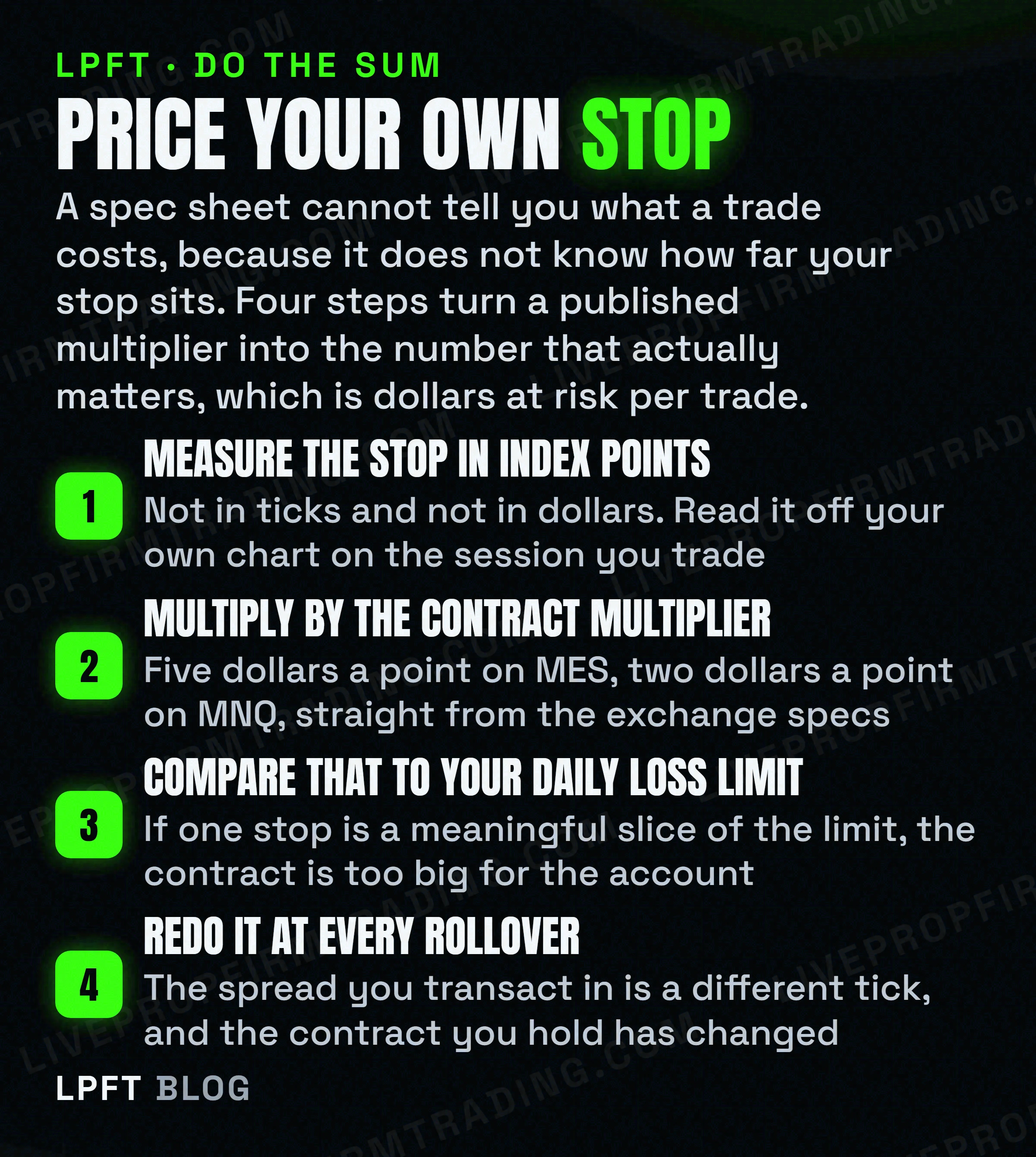
Do it in that order and the question answers itself without anybody's opinion about which index is calmer. Measure the stop your rules actually use, in index points, on the session and the hours you actually trade. Multiply by five for MES or two for MNQ. Hold the result against your daily loss limit. If a single stop eats a serious portion of the limit, the contract is too large for the account regardless of which ticker it is, and the fix is the account size or the rules rather than the contract.
This is also the step that most often exposes a strategy that was never tested properly, because a rule set tuned on one index rarely transfers to the other on its original stop. The correct way round is covered in how to backtest before automating, and the account-size version of the same sum is in how much money you need for automated futures trading.
The exchange dates its own notional column, and that tells you something
This is the detail that convinced us the usual comparison is built upside down. CME's Micro E-mini FAQ carries a table comparing the Micro and E-mini families, and one of its columns is notional value. The column heading, on the exchange's own page, reads "(as of Feb 1, 2023)."
The exchange put a date on it because a notional value is a market observation that goes stale, not a contract specification. The multiplier column beside it has no date, because five dollars a point is five dollars a point. That single editorial decision draws the line between what a spec sheet can tell you and what it cannot, and it is the reason we are not printing those notional figures here even though we read them.
Anywhere you see a confident dollar figure for what one of these contracts controls, or for what it costs to hold, check whether the page carries a date. The exchange thought that was necessary. Most of the articles ranking for this comparison did not.
Margin is in the same category. CME's FAQ answers the margin question with "Margins are based on current market conditions and, thus, are subject to change" and a set of links rather than a number, so we have no margin figure to give you and will not invent one. Your broker or funding firm publishes the requirement that actually applies to your account, and that is the only one worth reading.
The tick you pay at rollover is a different tick
Here is a mechanic that appeared on none of the comparison articles we read, and it affects anyone holding a position across a quarterly roll. The minimum increment on a calendar spread is not the outright increment, and the exchange publishes both in the same table.
| Contract | Outright tick | Calendar spread tick |
|---|---|---|
| Micro E-mini S&P 500 futures | 0.25 Index points= $1.25 | 0.05 Index points= $0.25 |
| Micro E-mini Nasdaq-100 futures | 0.25 Index points= $0.50 | 0.05 Index points= $0.10 |
| Micro E-mini Dow futures | 1.00 Index points= $0.50 | 1.00 Index points= $0.50 |
| Micro E-mini Russell 2000 futures | 0.10 Index points= $0.50 | 0.05 Index points= $0.25 |
Those are the exchange's figures, quoted as printed on its Micro E-mini FAQ on 29 October 2026, under its statement that "The tick increments will follow their E-mini counterparts." A finer increment is generally good news when you are rolling, and the point is simply that the number changes and most traders never learn there were two of them.
The roll itself is on a fixed cycle for both contracts. CME describes "five concurrent futures that expire against the opening index value on the third Friday of March, June, September, and December." If your system holds overnight or across a quarter boundary, that date is a scheduled event in its calendar rather than a surprise, and the mechanics are in futures contract rollover explained.
Three asymmetries that only start to matter once you automate
All of these are from the same CME FAQ, read 29 October 2026, and none of them change which contract to pick. They change what you should expect from the one you picked.
- A Micro settles off its big brother's trades. Verbatim: "Daily settlement for Micro E-mini futures is based on the 30-second volume-weighted average price (VWAP) of Globex trades between 3:59:30 p.m. and 4:00:00 p.m. ET of their E-mini counterpart." Your daily mark comes from the E-mini, not from the Micro you traded. Final settlement uses the same opening quotation as the E-mini as well.
- They offset against the E-mini, ten to one. Verbatim: "Yes, Micro E-mini futures are offset eligible versus their E-mini counterparts at 10:1 ratio. This can only be applied to offsetting positions." Useful if you ever size up, and a request your clearing broker makes rather than something automatic.
- Two things they are excluded from. Verbatim: "No, Micro E-mini Equity Index futures contracts will not be block or BTIC trading eligible," and "Micro E-mini futures volume will not count towards the current volume-based fee discounts available to members." Trading a lot of Micros does not walk you down a fee ladder the way the same activity in E-minis might.
And one scheduling fact that matters more to an automated system than to a person, because a person notices and a script does not. CME gives the hours for these contracts as "Sunday - Friday 6:00 p.m. - 5:00 p.m. ET with a trading halt from 4:15 p.m. - 4:30 p.m. ET." A fifteen-minute halt inside the trading day is a window where an order will not behave as your backtest assumed, which is one of several reasons session windows belong in the rules rather than in your attention. The broader version of that argument is in set and forget trading expectations.
Whichever contract you land on, something has to carry the decision to the broker. TradersPost publishes which broker connections it uses and states that following your own firm's rules is your responsibility, which is the right division of labour. Free 7-day trial.
See TradersPostSo which one, honestly
The useful answer is not a ticker. It is that the right contract is the one your rules were actually tested on, measured in dollars rather than in ticks, on the hours you intend to trade. A strategy validated on one index and deployed on the other at the same stop distance is a different strategy with an untested risk profile, and the multiplier is the reason.
If you are starting out and have no tested rules yet, the practical case for the S&P 500 contract is that a smaller point range makes a given dollar risk a wider and more forgiving stop, which gives a new system room to be slightly wrong. The practical case for the Nasdaq-100 contract is that a cheaper point lets a strategy that genuinely needs a wide stop take one without the dollar figure getting silly. Those are both statements about matching a stop to a multiplier, which is the only thing the spec sheet can actually help you with.
Whichever you choose, prove it the cheap way first. Paper trading versus live bot testing covers what simulation does and does not tell you, and automated futures trading for beginners is the ground-up version if this is early days. The wider family of contracts is in micro futures explained, and what a funded account actually lets you trade is in prop firm instruments.
Futures trading carries a substantial risk of loss, and a smaller multiplier reduces the size of a mistake without changing the chance of making one. Nothing on this page is advice about what to trade. It is the arithmetic you need before that question is even answerable, and it is arithmetic you should redo whenever your stop distance or your account size changes.
The LPFT Copilot runs the whole stack for you on Tradovate - start a 7-day free trial and watch it work.
Start your 7-day free trialFrequently asked questions
They track different indices and carry different multipliers. CME states that the Micro E-mini S&P 500 contract "is $5 x the S&P 500 Index" and the Micro E-mini Nasdaq-100 contract "is $2 x the Nasdaq-100 Index," and both have a minimum tick of 0.25 index points. So one tick is $1.25 on MES and $0.50 on MNQ, meaning an index point is $5 against $2. The Nasdaq-100 is a hundred-stock technology-weighted index and the S&P 500 is a broad five-hundred-stock one.
Per index point, yes, at $2 against $5. Per trade, not necessarily, because a stop is measured in index points and the two indices do not move the same number of points. The comparison that decides it is your own stop distance multiplied by the contract multiplier. A wider stop on the cheaper point can be the larger dollar position, which is why the tick value alone is not enough to choose on.
Neither is better in the abstract, and the honest version is that the right contract is the one your rules were tested on in dollars. If you have no tested rules yet, the S&P 500 contract's narrower point range means a given dollar risk buys a wider stop, which gives a new system more room for error. Futures trading carries a substantial risk of loss either way, so test in simulation before either contract sees real money.
Both have a minimum outright increment of 0.25 index points. CME's Micro E-mini FAQ prints the value as "0.25 Index points= $1.25" for the Micro E-mini S&P 500 and "0.25 Index points= $0.50" for the Micro E-mini Nasdaq-100. The calendar spread increment is different and finer: "0.05 Index points= $0.25" and "0.05 Index points= $0.10" respectively, which is the increment you transact in when rolling.
Both follow the standard quarterly cycle. CME describes "five concurrent futures that expire against the opening index value on the third Friday of March, June, September, and December," with final settlement using the same special opening quotation as the corresponding E-mini. The exchange gives the hours as "Sunday - Friday 6:00 p.m. - 5:00 p.m. ET with a trading halt from 4:15 p.m. - 4:30 p.m. ET," and that intraday halt is worth encoding into any automated session window.
Mostly, with three published differences worth knowing. Daily settlement for a Micro is computed from the E-mini, being "the 30-second volume-weighted average price (VWAP) of Globex trades between 3:59:30 p.m. and 4:00:00 p.m. ET of their E-mini counterpart." Micros are "offset eligible versus their E-mini counterparts at 10:1 ratio" on offsetting positions. And they "will not be block or BTIC trading eligible," nor does their volume count toward volume-based member fee discounts.
Eli Y.
Eli builds and runs rules-based automated futures systems on NinjaTrader and Tradovate, and helps traders take emotion out of the screen. He writes about futures automation, prop-firm evaluations, and the tools that connect them - plainly, and without hype.
Risk disclosure: Trading futures involves substantial risk of loss and is not suitable for everyone. This article is educational content only and is not financial advice or a recommendation to trade. Past performance is not indicative of future results. Some links are affiliate links.