
ES vs MES: Ten to One on Size, Not on Everything Else

Heads up: some links below are affiliate links. If you sign up through them we may earn a commission at no extra cost to you - it never changes what we recommend.
ES and MES track the same S&P 500 Index and move in the same 0.25 index point increment, but ES is $50 times the index and MES is $5. Four further differences are published and rarely mentioned, including that a Micro's daily settlement is computed from E-mini trades.
Choosing between ES and MES is the easy half. The LPFT Copilot runs a tested, rules-based method on your own prop firm or Tradovate account, with the session windows and the daily loss cap built in so a ten-times multiplier difference cannot turn into a ten-times surprise. Start a 7-day free trial.
Start your 7-day free trialThe two numbers everyone gives you, and where they actually come from
Start with the part the whole search agrees on, because it is correct. Read on CME's own Micro E-mini FAQ on 5 November 2026, the multiplier table puts the S&P 500 family at "$5" for the Micro and "$50" for the E-mini, and the page states the relationship in words as well: the Micro suite features "multipliers 1/10 the size of their E-mini counterparts (i.e., $5 multiplier for Micro E-mini S&P 500 futures contract vs. $50 for ES futures)."
The Micro's product page gives its own increment directly: "The Micro E-mini S&P 500 futures contract is $5 x the S&P 500 Index and has a minimum tick of 0.25 index points." The FAQ prints the dollar result as "0.25 Index points= $1.25" and introduces that whole table with the line that "The tick increments will follow their E-mini counterparts."
So from the exchange's own page we have three solid facts. ES is fifty dollars an index point. The Micro is five. And the two contracts share a minimum increment of 0.25 index points, because CME says the Micro's increments follow the E-mini's.
We could not read the ES contract specification table itself on the day this was written, so the $12.50 tick value you see quoted everywhere is not reproduced here as a quotation. It is derived in the open from the two CME statements above: 0.25 index points at fifty dollars a point is $12.50, against $1.25 on the Micro. If that derivation is wrong, one of the two sentences it rests on is wrong, and both are quoted above so you can check them yourself.
Which is where almost every comparison stops, pivots to "ES suits larger accounts" and leaves you with a size decision dressed up as a specification. The rest of this page is the material those pages skip, and all of it is on the same exchange FAQ.
Four published differences the comparisons leave out
None of these change which contract you should trade. They change what you should expect from the one you picked, and three of the four only start to matter once your position size or your order flow grows.
- The Micro is not block or BTIC eligible and the E-mini is. CME is blunt about it: "No, Micro E-mini Equity Index futures contracts will not be block or BTIC trading eligible." Those are the mechanisms for moving size off the central order book, and the Micro simply does not have access to them.
- Micro volume earns no member fee discount. Verbatim: "Micro E-mini futures volume will not count towards the current volume-based fee discounts available to members." CME adds that it "does intend to provide a market maker program to eligible participants that may feature fee rebates, pending regulatory review," which is a different thing from the volume ladder an E-mini trader walks down.
- They offset against each other, at ten to one, with conditions. Verbatim: "Yes, Micro E-mini futures are offset eligible versus their E-mini counterparts at 10:1 ratio. This can only be applied to offsetting positions." CME notes the request goes to the clearing house through your clearing broker, so it is a process rather than something that happens on its own.
- The Micro's daily mark is computed from the E-mini. The one that genuinely surprised us, and the subject of the next section.
Worth noticing what the first two have in common. Both are about scale. The E-mini is wired into the market structure that serves people trading size, and the Micro is deliberately not. That is a reasonable design and it is not a drawback, but it is the real answer to "why would anyone trade ES instead of ten MES," and it is more informative than a sentence about liquidity with no number behind it.
Your Micro's daily price is computed from the big contract's trades
Here is the mechanic that is on CME's own page and on none of the comparisons we read. Verbatim: "Daily settlement for Micro E-mini futures is based on the 30-second volume-weighted average price (VWAP) of Globex trades between 3:59:30 p.m. and 4:00:00 p.m. ET of their E-mini counterpart."
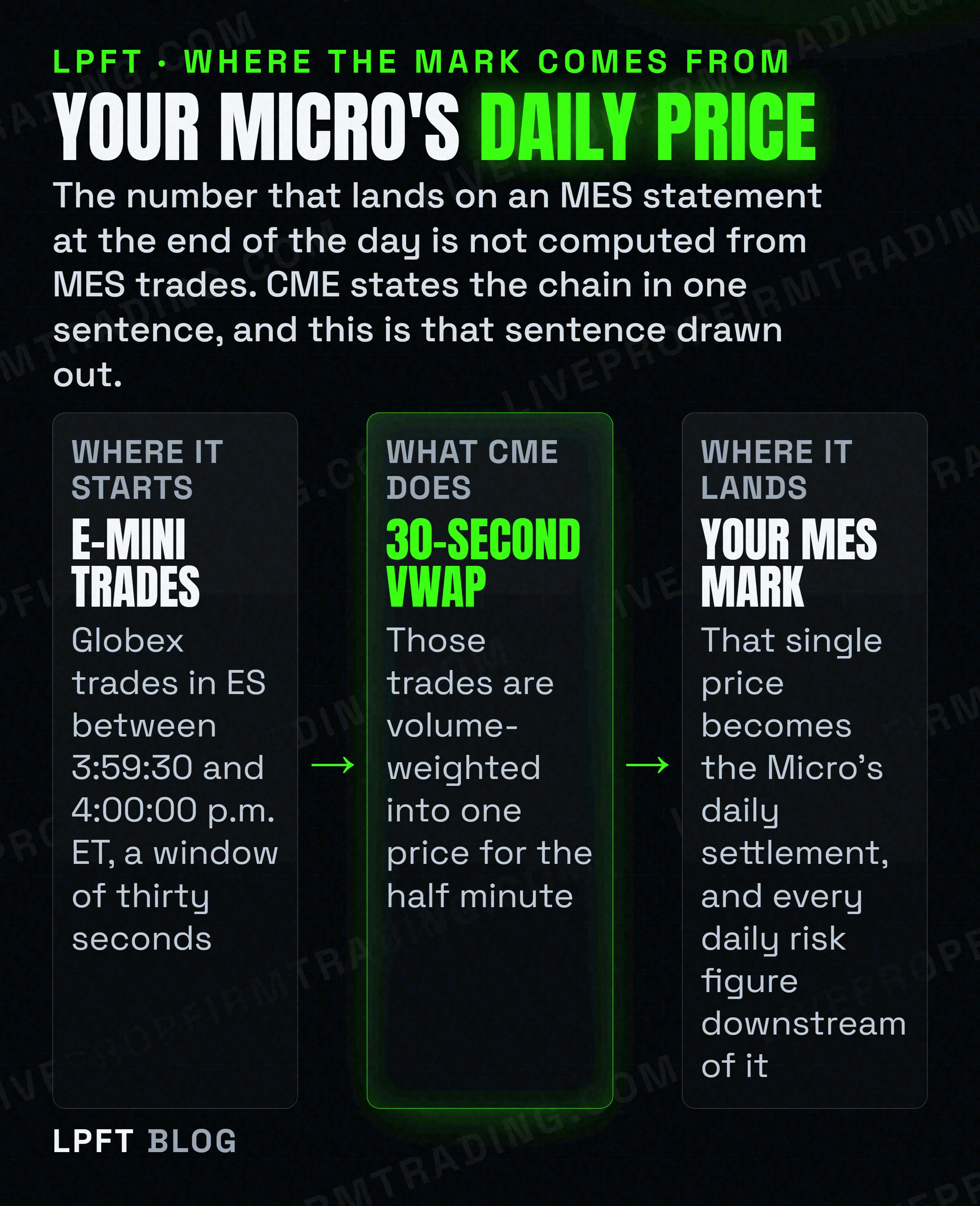
Read that chain again, because the consequence is not obvious. If you trade MES exclusively, the official daily price of your position still comes out of ES. Your own contract's prints in that half minute do not set it. For most traders this is invisible and harmless, and it is exactly the sort of thing that stops being invisible the first time a daily number does not match what you watched on your own chart.
Final settlement works the same way at expiry. CME states that the Micro "will have the same SOQ value as the corresponding E-mini contract on final settlement day," based on the Special Opening Quotation "on the third Friday of the contract month," which itself is "based on the opening price of each component stock in the relative index, regardless of when those stocks open."
For anything automated, that makes the Micro a contract whose two most important prices are determined elsewhere. Not a problem, and absolutely something to know before you build a reconciliation check that compares your fills to a settlement price and alarms when they disagree. The broader version of that lesson is in why automated traders fail.
The ten to one offset is real, and narrower than it sounds
The offset sentence gets quoted as "they are fungible," which is not what it says. Two qualifiers are doing work. "This can only be applied to offsetting positions," so it nets a long against a short rather than converting ten Micros into an E-mini you can then trade. And the request runs through your clearing broker to CME Clearing, so it is an operation somebody performs, not a property of the contracts.
Practically, that makes the ten-to-one relationship useful at the edges. Scaling a position in increments smaller than one E-mini. Flattening part of an E-mini exposure with Micros. It does not make the two contracts interchangeable mid-strategy, and it does not mean a strategy proven on one is proven on the other.
The last point is the one that costs money. A rule set validated at $5 a point and deployed at $50 a point on the same stop distance is a different system with ten times the dollar risk and an untested risk profile. The arithmetic for doing that properly is in MES vs MNQ, which sets out the stop-distance method, and the account-size version is in how much money you need for automated futures trading.
Either contract needs something to carry the decision to the broker. TradersPost publishes which broker connections it supports and states that following your own firm's rules is your responsibility, which is the right division of labour. Free 7-day trial.
See TradersPostWhy "one ES controls $X" is a sentence with a date on it
Several pages ranking for this comparison hand you a notional value for each contract as a plain fact. CME publishes those figures too, in the same table as the multipliers, and it does one thing differently: the notional column on the exchange's own page is headed "(as of Feb 1, 2023)."
The multiplier column beside it carries no date, because fifty dollars a point is fifty dollars a point. The exchange dated one and not the other because a notional value is a market observation and a multiplier is a contract specification. That single editorial choice tells you which numbers an article can safely give you, which is why there is no notional figure on this page even though we read CME's.
Margin sits in the same bucket. CME answers the margin question with "Margins are based on current market conditions and, thus, are subject to change" plus links, so there is no margin figure here either. Your broker or funding firm publishes the requirement that applies to your account, and that is the only one worth reading. The same goes for commissions and exchange fees, covered in how much it costs to trade micro futures.
So which one, honestly
The honest answer is the arithmetic rather than a ticker. Measure the stop your rules actually use, in index points, off your own chart on the hours you intend to trade. Multiply by fifty for ES or five for the Micro. Hold the result against your daily loss limit. If a single stop eats a serious slice of that limit, the contract is too large for the account, and the fix is the account size or the rules rather than the ticker.
Beyond that sum, the two real reasons to prefer ES are both about scale and both published. It is block and BTIC eligible and its volume counts toward member fee discounts. If neither of those describes your account yet, the fifty-dollar multiplier is buying you access to market structure you are not using, at ten times the dollar risk per point.
The wider family, including the two Micro E-minis that cost more per point than MES, is in micro futures explained. The session boundaries both contracts share are in best times to trade futures. And whichever you choose, prove it the cheap way first with paper trading versus live bot testing.
Futures trading carries a substantial risk of loss. A tenth of the multiplier is a tenth of the damage from a given mistake and not a tenth of the chance of making one. Nothing on this page is advice about what to trade. It is the published specification, the four differences underneath it, and the sum you need before the question is even answerable.
The LPFT Copilot runs the whole stack for you on Tradovate - start a 7-day free trial and watch it work.
Start your 7-day free trialFrequently asked questions
They track the same S&P 500 Index and share a minimum increment of 0.25 index points, but the multipliers differ by ten to one. CME states that the Micro suite carries "multipliers 1/10 the size of their E-mini counterparts (i.e., $5 multiplier for Micro E-mini S&P 500 futures contract vs. $50 for ES futures)." Beyond size, the E-mini is block and BTIC eligible and its volume counts toward member fee discounts, and the Micro is excluded from both.
On the multiplier, yes. CME puts the S&P 500 Micro at $5 and the E-mini at $50, and states the one-tenth relationship explicitly. On everything else, no. The Micro is not block or BTIC eligible, its volume earns no member fee discount, and its daily settlement is computed from E-mini trades rather than its own. They also offset against each other at a 10:1 ratio, but only on offsetting positions and only through a clearing broker request.
CME publishes the Micro E-mini S&P 500 outright increment as "0.25 Index points= $1.25," and its calendar spread increment as "0.05 Index points= $0.25." For ES, CME states the $50 multiplier and says the Micro's "tick increments will follow their E-mini counterparts," so the same 0.25 index point increment at fifty dollars a point works out to $12.50. That last figure is a derivation from two CME statements rather than a number quoted off the ES specification table.
Yes, within limits CME spells out. Verbatim: "Micro E-mini futures are offset eligible versus their E-mini counterparts at 10:1 ratio. This can only be applied to offsetting positions." The request is made by your clearing broker directly to CME Clearing, so it is an operational step rather than an automatic property. It nets a long against a short and does not convert ten Micros into a tradable E-mini.
From E-mini trades, not Micro trades. CME states that "Daily settlement for Micro E-mini futures is based on the 30-second volume-weighted average price (VWAP) of Globex trades between 3:59:30 p.m. and 4:00:00 p.m. ET of their E-mini counterpart." At expiry the Micro "will have the same SOQ value as the corresponding E-mini contract," based on the Special Opening Quotation on the third Friday of the contract month.
The test is arithmetic rather than opinion. Take the stop distance your rules actually use in index points, multiply by $50 for ES or $5 for the Micro, and compare that to your daily loss limit. If one stop is a serious slice of the limit, the contract is too large for the account. The two published advantages of ES, block and BTIC eligibility and volume-based member fee discounts, are both about scale, so an account not using them is paying ten times the dollar risk per point for access it does not need. Futures trading carries a substantial risk of loss at either size.
Eli Y.
Eli builds and runs rules-based automated futures systems on NinjaTrader and Tradovate, and helps traders take emotion out of the screen. He writes about futures automation, prop-firm evaluations, and the tools that connect them - plainly, and without hype.
Risk disclosure: Trading futures involves substantial risk of loss and is not suitable for everyone. This article is educational content only and is not financial advice or a recommendation to trade. Past performance is not indicative of future results. Some links are affiliate links.