
Best Times to Trade Futures: Read the Exchange, Not a Listicle

Heads up: some links below are affiliate links. If you sign up through them we may earn a commission at no extra cost to you - it never changes what we recommend.
There is no published best hour to trade futures, but there is a published clock. CME runs Globex from Sunday 6:00 p.m. to Friday 5:00 p.m. ET, halts equity index trading daily from 4:15 to 4:30 p.m. ET, and changes its price limits at 8:30 a.m., 3:00 p.m. and 5:00 p.m. Central.
Knowing the clock is the easy half. The LPFT Copilot runs a tested, rules-based method on your own prop firm or Tradovate account with the trading window and the daily loss cap built in, so the hours you decided on are the hours it actually trades. Start a 7-day free trial.
Start your 7-day free trialThe honest answer first, because it is not a window
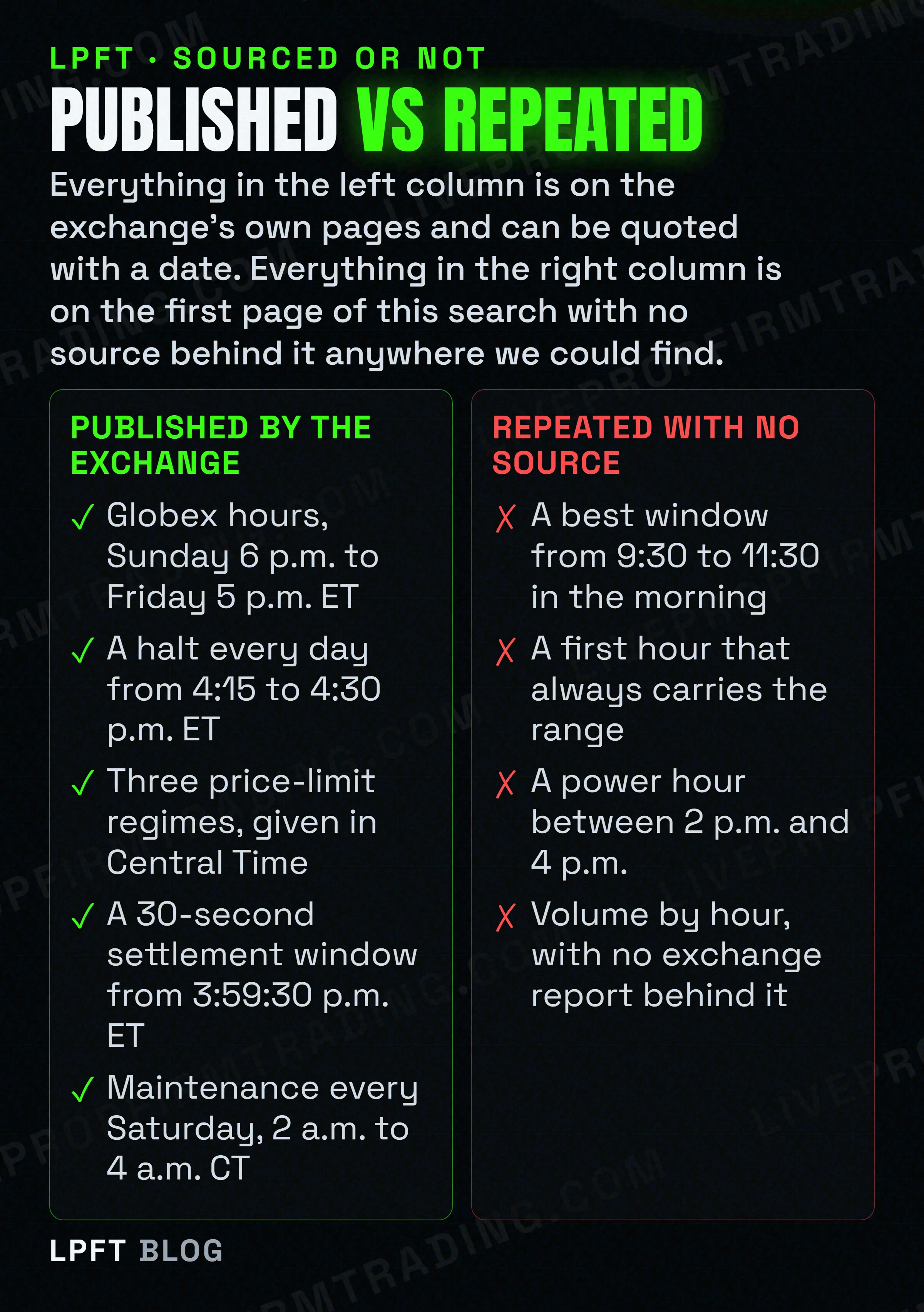
Search this question and you get the same four sentences everywhere. Trade 8:30 to 11:30 Eastern. The first hour has the most range. There is a power hour from two to four. Volume peaks when London and New York overlap. We read nine of the pages ranking for it on 5 November 2026 and not one of them cited an exchange report, a volume study, or anything else you could check. They cite each other.
None of that is necessarily wrong. It is unsourced, which is a different complaint, and it matters because it is advice about when to put money at risk. So this page does something narrower and more useful. It gives you the clock the exchange actually publishes, with the page and the date each piece came from, and then it shows you why that clock is the one a rule set should be anchored to.
The short version is that CME does not treat the trading day as uniform, and it says so in writing. It divides the day into regimes where the market is allowed to move different distances, it stops trading entirely for fifteen minutes in the middle of the afternoon, it computes the day's settlement inside a thirty-second window, and it takes the system down every Saturday morning. Those are the hours with real structural meaning, and none of them appears on the listicles.
The exchange cuts its own day into three price-limit regimes
This is the part that surprised us. CME's Micro E-mini FAQ, read on 5 November 2026, answers a question about circuit breakers by publishing a schedule. It first establishes that the limits are not a micro-only thing, verbatim: "CME Group U.S. Equity Index price limits (and corresponding CME and CBOT rules) are designed to coordinate with circuit breakers provisions as applied by the New York Stock Exchange (NYSE)," and "Micro E-mini contracts will follow the same rules as their E-mini counterparts."
Then it gives the clock, in two sentences that are worth reading slowly because they describe three different regimes.
"7%, 13%, and 20% price limits are applied to the futures fixing price and are effective from 8:30 a.m. - 3:00 p.m. CT, Mondays through Fridays. This only applies to the downside." Then, for the rest of the day, "7% up-and-down limits are effective 5:00 p.m. - 8:30 a.m. CT" on "Sundays through Fridays" and also "3:00 p.m. - 4:00 p.m. CT, Mondays through Fridays." CME closes with the cap: "Between 3:00 p.m. - 4:00 p.m. CT, the 7% price limit will not be allowed to breech the 20% daily limit."
| Clock window | Days | What the limit is |
|---|---|---|
| 5:00 p.m. to 8:30 a.m. CT | Sunday to Friday | 7 per cent, up and down |
| 8:30 a.m. to 3:00 p.m. CT | Monday to Friday | 7, 13 and 20 per cent, downside only |
| 3:00 p.m. to 4:00 p.m. CT | Monday to Friday | 7 per cent up and down, capped by the 20 per cent daily limit |
Read it as a table and the shape is obvious. The overnight session has a symmetric band. The main session has an asymmetric one, with staged downside brakes and no upside brake at all. The last hour before the close goes back to symmetric but cannot override the day's outer limit. Three regimes, four boundaries, all of it published by the venue rather than inferred from a chart.
That is not a reason to prefer one window over another. It is a reason to know which one you are in, because the distance the market is permitted to travel in a session is a property of the session, and it is the kind of thing a rule set should treat as input rather than discover.
The same exchange publishes the hours in one time zone and the limits in another
Now the practical trap, and it is on a single page. The answer two questions earlier in that same FAQ gives the trading hours for these contracts as "Sunday - Friday 6:00 p.m. - 5:00 p.m. ET with a trading halt from 4:15 p.m. - 4:30 p.m. ET." Eastern. The price-limit answer above is in Central. Same page, same contract, two clocks.
The hours page does it too. On cmegroup.com/trading-hours.html, read the same day, the Globex schedules are stated in Central Time and the ClearPort table sitting next to them says "All times are Eastern Standard Time." A few lines from each, as printed:
- Globex maintenance: under a note that "CME Globex will now have new system maintenance windows for 24/7 trading," the window is "Saturday 2:00-4:00 AM Central Time (CT)."
- Crypto futures and options: "Continuous trading Sunday to Saturday, 24 hours a day, seven days a week, Maintenance: Saturday 2:00 a.m. - 4:00 a.m. CT."
- NYMEX and COMEX: "Sunday 5:00 p.m. - Friday 4:00 p.m. CT with no reporting Monday - Thursday 4:00 p.m. - 5:00 p.m. CT."
- CME OTC FX: "Sunday 6:00 p.m. - Friday 5:45 p.m. CT with no reporting Monday - Thursday 5:45 p.m. - 6:00 p.m. CT."
This is why "the exchange opens at six" is not a fact you can copy. It is a fact about a specific venue, a specific product group and a specific zone, and the exchange itself uses both zones within arm's reach of each other. Every article on this search states everything in Eastern, which quietly re-writes four of those five lines.
The statute that moves both clocks, and it moved four days before this was written
A session window written as a number is a window that drifts, and the drift is in federal law rather than in anybody's software. Read on govinfo.gov on 5 November 2026, 15 U.S.C. 260a sets the period as beginning "at 2 o'clock antemeridian on the second Sunday of March of each year and ending at 2 o'clock antemeridian on the first Sunday of November of each year."
The first Sunday of November 2026 was the first of the month. So four days before this article was written, every Central and Eastern boundary quoted above moved an hour against UTC, and against the local clock of anyone trading these contracts from outside the United States who is not on the same switching schedule. The exchange boundaries did not move. Their relationship to your machine's clock did.
There is a second authoritative clock too, and it is the one the data arrives on. The Bureau of Labor Statistics publishes a release schedule for each series, and the column headed "Release Time" on the Employment Situation schedule reads "08:30 AM." That is a government agency's clock, not an exchange's, and it happens to land exactly on the boundary where CME switches its equity index limits from symmetric to downside-only.
We did not find a clock time for FOMC statements on the Federal Reserve's own FOMC calendar page, so this article does not give you one. We also read no exchange volume report, so there are no volume-by-hour figures here and no claim about which window is busiest. If a page gives you both of those without a source, that is the page to be careful with.
The structural minutes most session windows miss
Three specific slices of the week are worth writing into a rule set, because a person notices them and a script does not.
- The daily halt, 4:15 to 4:30 p.m. ET. CME states it inside the trading hours themselves. For fifteen minutes the market is not open, which means an order resting across it is not behaving the way a backtest assumed, and a position held through it is held through a gap rather than a quiet patch.
- The settlement window, 3:59:30 to 4:00:00 p.m. ET. The day's official number for a Micro E-mini is "the 30-second volume-weighted average price (VWAP) of Globex trades" in that half minute, taken from the E-mini counterpart. Thirty seconds decide the mark that every daily risk calculation downstream of you uses.
- Saturday 2:00 to 4:00 a.m. CT. The Globex maintenance window. Nothing trades in it, and anything that expects a heartbeat from the venue needs to expect a two-hour silence once a week rather than treat it as an outage.
Those three are the reason the useful question is not "when is the best time" but "what does my system do at each boundary." The overnight-versus-daytime version of that question is in overnight vs regular trading hours, the session structure itself is in futures trading sessions explained, and what a release does to an open position is in economic news and automated trades.
A trading window is only real if something enforces it between your decision and the broker. TradersPost publishes which broker connections it supports and states that following your own firm's rules is your responsibility, which is the right division of labour. Free 7-day trial.
See TradersPostWhat to put in the rules instead of a best time
Pick a window because your own tested rules performed inside it, not because an article named it. Then write it down in a form that cannot drift: anchor it to an exchange time zone rather than to your machine's local clock, store the boundary as a named zone instead of an offset so the statute above handles itself, and record which zone you used next to the number.
Then decide the boundary behaviour explicitly, because defaults are where the surprises live. What happens to a position still open when the window closes. What happens through the 4:15 halt. Whether anything is allowed to act in the half minute the settlement VWAP is being computed from. A system without an answer to each of those has an answer anyway, it just has not been chosen.
Proving the window is part of proving the rules, and simulation is the cheap place to do it. How to backtest before automating covers doing that honestly, paper trading versus live bot testing covers what simulation will and will not show you, and set and forget trading expectations covers what still needs a human after the window is written.
Futures trading carries a substantial risk of loss, and no hour of the day changes that. Nothing on this page is advice about when to trade. It is the published clock, the sources it came from, and the boundaries worth deciding about before a machine decides them for you.
The LPFT Copilot runs the whole stack for you on Tradovate - start a 7-day free trial and watch it work.
Start your 7-day free trialFrequently asked questions
There is no best time published by any exchange or regulator, and the windows quoted across the first page of search results cite no source. What is published is structure. CME runs Globex for these contracts from "Sunday - Friday 6:00 p.m. - 5:00 p.m. ET with a trading halt from 4:15 p.m. - 4:30 p.m. ET," and it changes its equity index price limits at 8:30 a.m., 3:00 p.m. and 5:00 p.m. Central Time. The right window is the one your own tested rules were measured inside, stated in an exchange time zone.
It depends on the product group and on which venue you mean. For equity index futures CME states "Sunday - Friday 6:00 p.m. - 5:00 p.m. ET with a trading halt from 4:15 p.m. - 4:30 p.m. ET." On the same hours page CME gives NYMEX and COMEX as "Sunday 5:00 p.m. - Friday 4:00 p.m. CT" and CME OTC FX as "Sunday 6:00 p.m. - Friday 5:45 p.m. CT." There is also a Globex maintenance window every "Saturday 2:00-4:00 AM Central Time (CT)."
Because CME Group is headquartered in Chicago and publishes its Globex schedules in Central Time. The confusion is real and it exists inside the exchange's own documents: one CME FAQ gives the trading hours for a contract in Eastern Time and gives that same contract's price limits in Central Time, and the hours page states Globex schedules in Central while the ClearPort table beside it says "All times are Eastern Standard Time." Always record which zone a time came from.
Yes, and they change by time of day. CME states that "7%, 13%, and 20% price limits are applied to the futures fixing price and are effective from 8:30 a.m. - 3:00 p.m. CT, Mondays through Fridays. This only applies to the downside," while "7% up-and-down limits are effective 5:00 p.m. - 8:30 a.m. CT" and again from "3:00 p.m. - 4:00 p.m. CT," where the 7 per cent limit cannot exceed the 20 per cent daily limit. CME adds that these are designed to coordinate with NYSE circuit breaker provisions.
The exchange boundaries stay fixed in their stated local zone, so what changes is their relationship to UTC and to any clock on a different switching schedule. Under 15 U.S.C. 260a the United States period runs from "2 o'clock antemeridian on the second Sunday of March of each year" to "2 o'clock antemeridian on the first Sunday of November of each year." A session window stored as a fixed UTC offset will be an hour wrong for part of the year, which is why a named time zone is the safer way to store it.
For Micro E-mini equity index futures CME states that "Daily settlement for Micro E-mini futures is based on the 30-second volume-weighted average price (VWAP) of Globex trades between 3:59:30 p.m. and 4:00:00 p.m. ET of their E-mini counterpart." That is a thirty-second window, and for a Micro the price is computed from trades in the larger E-mini contract rather than from the Micro you traded. Final settlement on expiry uses the Special Opening Quotation on the third Friday of the contract month.
Eli Y.
Eli builds and runs rules-based automated futures systems on NinjaTrader and Tradovate, and helps traders take emotion out of the screen. He writes about futures automation, prop-firm evaluations, and the tools that connect them - plainly, and without hype.
Risk disclosure: Trading futures involves substantial risk of loss and is not suitable for everyone. This article is educational content only and is not financial advice or a recommendation to trade. Past performance is not indicative of future results. Some links are affiliate links.