
Overnight vs Regular Trading Hours: The Exchange Does Not Split Its Day That Way

Heads up: some links below are affiliate links. If you sign up through them we may earn a commission at no extra cost to you - it never changes what we recommend.
The exchange does not divide its futures day into regular and overnight hours. CME publishes six order states instead, and what changes between them is whether orders match at all and which order types may exist. Day orders are eliminated at the close.
The order states on this page are the exchange's, and they do not care whether you are awake. The LPFT Copilot runs a tested, rules-based method on your own prop firm or Tradovate account, with the trading window and the daily loss cap built into the rules rather than left to your attention. Start a 7-day free trial.
Start your 7-day free trialThe window every page gives you is not on any exchange page we could find
Search this question and you get the same answer nine times. Regular trading hours are 9:30 a.m. to 4:00 p.m. Eastern, everything else is the overnight or extended session, and the overnight is thinner. Clean, memorable, and sourced to nobody.
We went looking for that window on the exchange's own pages across three research passes, and we have not found it stated for a futures product. What CME publishes for equity index futures is one line of hours, verbatim: "Sunday - Friday 6:00 p.m. - 5:00 p.m. ET with a trading halt from 4:15 p.m. - 4:30 p.m. ET." There is no 9:30 in it, and no second session named inside it.
This is not a word game, because the borrowed window quietly changes what you expect. Nine-thirty to four is when the American cash equity market is open. A futures contract on an equity index is open for roughly twenty-three hours, and the exchange that runs it describes the day in a completely different vocabulary, which we will get to and which is far more useful.
Several results state that regular hours carry more than seventy per cent of retail volume, and that regular-hours volume runs three to five times the overnight. Neither carries a source, and we have read no volume report in any pass. They may well be directionally right. They are not something we read, so they are not facts on this page. One result also gives the daily break as 5:00 to 6:00 p.m. Eastern, where CME's own answer for equity index is a halt from 4:15 to 4:30 p.m. Eastern.
CME does use the term, and it never attaches a clock to it
Here is where it gets genuinely interesting, and it is a correction to the easy version of this argument. CME does print the phrase Regular Trading Hours on its own domain. The trading-hours page uses it three times, verbatim, in this form: "MQ is calculated during Regular Trading Hours (RTH) only."
So the term is the exchange's, not an invention of the blogs. But look at where it lives. MQ is Mass Quoting, and that sentence sits inside the Messaging Efficiency Program, which governs how many messages a participant may send. It is a message-accounting boundary, and the page attaches no clock time to it for any product. The words Equity Index do not appear on that page at all.
The honest summary is therefore narrower and more useful than the usual one. CME names Regular Trading Hours and does not define its hours for a futures contract on that page. So you may say the exchange uses the term. You may not say the exchange defines it as 9:30 to 4:00 for index futures, because nothing we read says that.
The place the familiar three-way vocabulary IS defined turns out to be a charting platform. TradingView's own support page, re-read on 10 November 2026, defines RTH as "The standard exchange session", ETH as "Pre-market and after hours (post-market) activity" and Overnight as "Price action outside RTH and ETH, capturing the true 24 hour market". Those are good definitions. They are also, by that page's own words, for "BOATS-supported US stocks".
An equities charting feature, in other words. Which is why the session your chart shows you is a display setting rather than a fact about the contract, a point made at length in futures trading sessions explained.
What the exchange publishes instead: six states, defined by what an order may do
On the same hours page sits a legend we have not seen quoted anywhere, and it is the real answer to this question. CME describes its trading day as a set of named states, and it defines each one not by a time but by what you are permitted to do with an order. Verbatim, in the order printed:
| State | CME's own definition, quoted as printed |
|---|---|
| PREOPEN | "Order Entry, modification, and cancel are allowed. No order matching." |
| OPEN | "Start of continuous trading phase. Order matching begins." |
| Paused | "Interruption of continuous trading. Only order cancellation is allowed. No order matching." |
| pcp (POST CLOSE - PREOPEN) | "Allows GTC/GTD orders only placement, modification, and cancellation. No order matching." |
| closed | "Final Close of the date. Day and GTD (current trade date) orders are eliminated." |
| PREOPEN/HALT | "Order Entry, modification, and cancel are allowed. No order matching." |
The page closes the legend with a line that is worth its own sentence, verbatim: "Trading hours are subject to change and are in U.S. Central Time unless otherwise stated." Central, on the page that gives the equity index hours in Eastern.
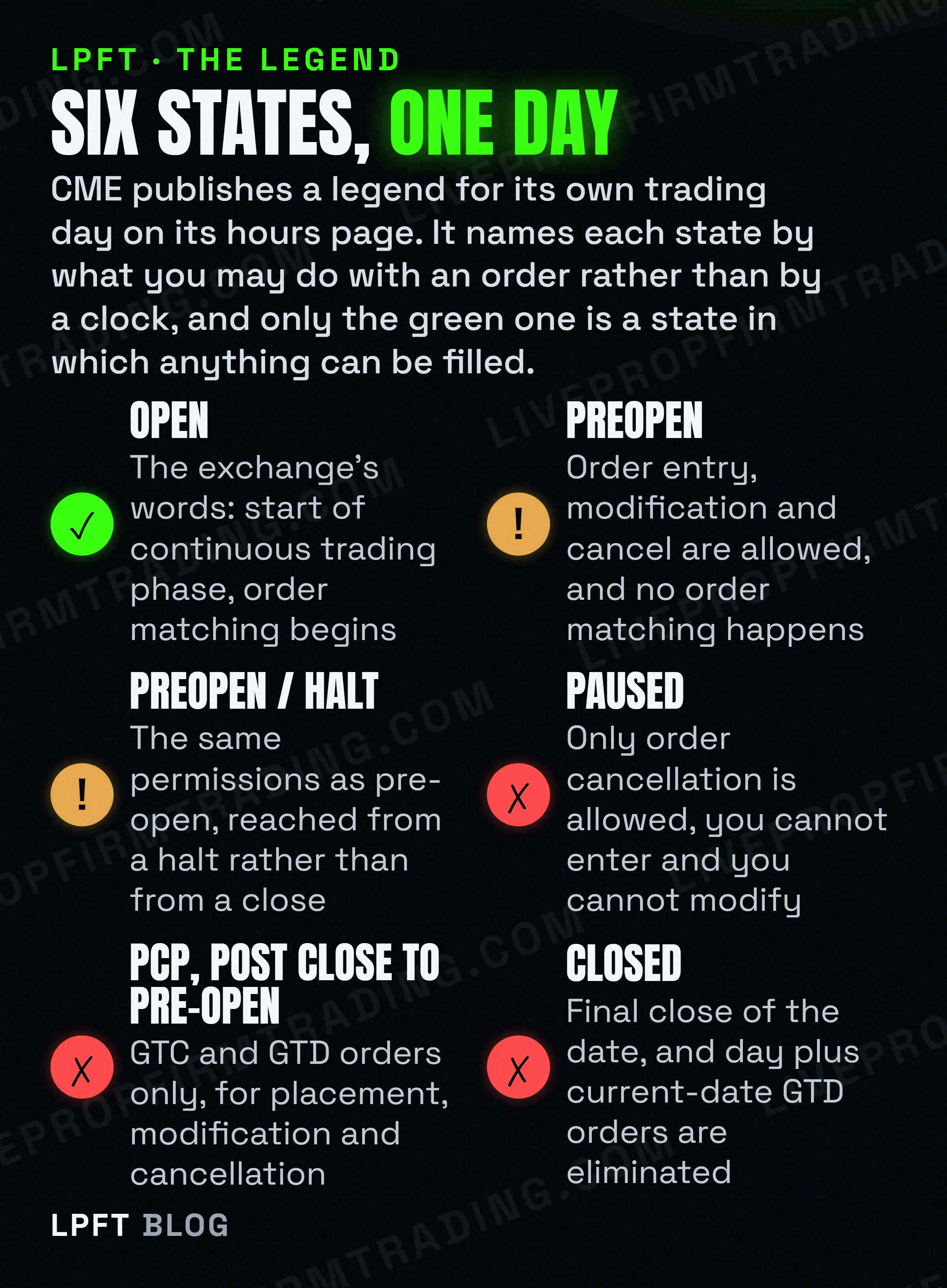
Read down that table and the overnight question reframes itself. The difference between the busy afternoon and three in the morning is not primarily a volume statistic. It is that the exchange moves through states in which matching is switched off entirely, in which the only legal action is a cancellation, and in which some order types are not permitted to exist.
Three consequences, and each one has broken somebody's automation
These follow directly from the legend above rather than from anybody's opinion about session liquidity, which is what makes them worth building rules around.
- In post close to pre-open, only GTC and GTD orders may be placed. CME's words: "Allows GTC/GTD orders only placement, modification, and cancellation." A day order cannot exist in that state. If your system submits one in that window because it has no concept of the window, it is submitting an order type the exchange has said it will not take there.
- At the close, orders are eliminated rather than rested. Verbatim: "Final Close of the date. Day and GTD (current trade date) orders are eliminated." Eliminated is the exchange's verb, not ours. Any logic that assumes a working order quietly survives a date boundary is contradicted in writing.
- In a pause, you may only cancel. "Only order cancellation is allowed. No order matching." You cannot enter and you cannot modify, which is different from pre-open, where entry and modification are both allowed. If your error handling responds to a rejection by amending the order, that path is closed in exactly the state where you most want it.
The common thread is that each of these is a rule about your ORDER rather than about the market. A thin market is a reason to be careful. A state in which your order type is not accepted is a reason your code is wrong, and the two get discussed as though they were the same risk.
The same page carries a worked example under its holiday notes, verbatim: "Day orders entered after a product's Pre-opening(s) on Wednesday, November 25th are for trade date Friday, November 27th and can continue working until their Friday, November 27th Globex close." So a day order placed on a Wednesday evening can still be working on a Friday, because the trade date it belongs to skipped the holiday. The mechanism behind that is in futures trading sessions explained.
There is one more scheduled event on the exchange's side that catches resting orders, and it is not nightly but weekly. CME publishes a Globex maintenance window of "Saturday 2:00-4:00 AM Central Time (CT)". A system that reconnects on a timer without reading its own open orders afterwards is trusting a weekend window it never looked at.
So is the overnight actually different to trade
Almost certainly yes, and we cannot tell you by how much, because the figure everyone quotes has no owner. What can be said without a source problem is structural, and it splits into two lists.
Published, and therefore something you can build on: the contract trades from Sunday evening to Friday afternoon with a fifteen-minute halt each afternoon. Matching stops entirely in several named states. Some order types are refused outside continuous trading. Day orders are eliminated at the close. Price limits change at published boundaries, which is covered in best times to trade futures.
Not published, and therefore not a number we will give you: how much volume sits in any part of the day, how wide the spread gets at three in the morning, how often an overnight gap exceeds a given size, and what any of that does to a particular strategy. Those are all measurable and we have not read a report on any of them, so the only honest instruction is to measure them yourself on your own fills.
Which is the practical close. If you want to know whether your rules work overnight, the answer is in your own fill data and nowhere else, and the way to get it without paying for it is covered in how to backtest before automating and paper trading versus live bot testing. The contract-level numbers you need first are in what is an NQ future and tick size and tick value.
An order state you cannot see is still an order state you are subject to, so whatever carries your orders is part of the problem. TradersPost publishes which broker connections it supports and states that following your own firm's rules is your responsibility, which is the right division of labour. Free 7-day trial.
See TradersPostWhat to put in the rules instead of a session name
A session label is a bad input for an automated system, because it is a human summary of several unrelated exchange behaviours. Four concrete things replace it.
- A trading window in exchange time, with the zone written down. Not "regular hours". An explicit start and end, and a note saying whether that is Central or Eastern, because the exchange publishes both on the same page.
- The afternoon halt as a hard no-trade block. 4:15 to 4:30 p.m. Eastern for equity index, from CME's own line. A script does not notice a halt.
- An order-type rule that knows about the close. If a position or a working order is meant to persist past the date boundary, it cannot be a day order, because day orders are eliminated there.
- A reconciliation step after any gap in your connection. Read your actual open orders from the broker rather than trusting your own memory of them, especially after the Saturday maintenance window.
None of that requires knowing which session is busier. It requires reading the exchange's legend once and encoding it, which is the difference between a system that behaves the same at every hour and one that works until the first night nobody was watching. The wider argument for putting the clock in the rules rather than in your attention is in set and forget trading expectations, and the machine-uptime side of it is in do you need a VPS for automated trading.
Futures trading carries a substantial risk of loss, and trading hours you have not read are one of the quieter ways that risk arrives. Nothing on this page is advice about when to trade. It is the exchange's own legend for its own day, plus a clear statement of which popular numbers about the overnight we could not source.
The LPFT Copilot runs the whole stack for you on Tradovate - start a 7-day free trial and watch it work.
Start your 7-day free trialFrequently asked questions
The exchange does not split its day that way. CME gives equity index futures hours as "Sunday - Friday 6:00 p.m. - 5:00 p.m. ET with a trading halt from 4:15 p.m. - 4:30 p.m. ET" and then describes the day as a set of named order states rather than two sessions. What actually changes is whether order matching happens at all and which order types may exist. In the state CME calls post close to pre-open, only GTC and GTD orders may be placed and nothing matches.
It uses the term but does not time it. CME's trading-hours page states "MQ is calculated during Regular Trading Hours (RTH) only," which sits inside the Messaging Efficiency Program governing how many messages a participant may send. That page attaches no clock time to RTH for any product. The familiar 9:30 a.m. to 4:00 p.m. Eastern window is the American cash equity session, and we have not found it stated for a futures product on any CME page.
It depends entirely on the order type, and the exchange is explicit. CME's own legend says that at the state it calls closed, "Day and GTD (current trade date) orders are eliminated." Eliminated, not rested. In the post close to pre-open state it "Allows GTC/GTD orders only placement, modification, and cancellation." So a GTC order can persist and a day order cannot. Any automation that assumes a working order survives a date boundary is contradicted in writing.
CME publishes them on its trading-hours page, each defined by what you may do with an order. PREOPEN and PREOPEN/HALT: "Order Entry, modification, and cancel are allowed. No order matching." OPEN: "Start of continuous trading phase. Order matching begins." Paused: "Only order cancellation is allowed. No order matching." pcp, meaning post close to pre-open: "Allows GTC/GTD orders only placement, modification, and cancellation." closed: "Final Close of the date. Day and GTD (current trade date) orders are eliminated."
Very likely, and we cannot give you a figure. The numbers in circulation, that regular hours hold more than seventy per cent of retail volume and that regular-hours volume runs three to five times the overnight, appear on this search with no source attached, and we have read no volume report in any research pass. What can be stated from published material is structural: matching stops in several named states, some order types are refused outside continuous trading, and price limits change at published boundaries. Measure the rest on your own fills.
Four things, all from published sources. A trading window written in a named time zone, since CME publishes equity index hours in Eastern and its price limits and state legend in Central. The afternoon halt from 4:15 to 4:30 p.m. Eastern as a hard no-trade block. An order-type rule that accounts for day orders being eliminated at the close. And a reconciliation step that reads your real open orders from the broker after any connection gap, including the Globex maintenance window of "Saturday 2:00-4:00 AM Central Time (CT)."
Eli Y.
Eli builds and runs rules-based automated futures systems on NinjaTrader and Tradovate, and helps traders take emotion out of the screen. He writes about futures automation, prop-firm evaluations, and the tools that connect them - plainly, and without hype.
Risk disclosure: Trading futures involves substantial risk of loss and is not suitable for everyone. This article is educational content only and is not financial advice or a recommendation to trade. Past performance is not indicative of future results. Some links are affiliate links.