
What Is an NQ Future? The Multiplier Is Published, the Tick Value Is Not

Heads up: some links below are affiliate links. If you sign up through them we may earn a commission at no extra cost to you - it never changes what we recommend.
NQ is the E-mini Nasdaq-100 futures contract on CME Globex. CME states it is $20 times the Nasdaq-100 index with a minimum tick of 0.25 index points, so a tick works out to $5.00. MNQ is the $2 micro version of the same contract.
The specs on this page are stable and free to read. What they cannot tell you is when to be in the market. The LPFT Copilot runs a tested, rules-based method on your own prop firm or Tradovate account, with a daily loss cap and a trading window built in rather than remembered. Start a 7-day free trial.
Start your 7-day free trialThe one sentence the exchange gives you, quoted as printed
Start with the source rather than a summary of a summary. CME's own E-mini Nasdaq-100 product page, read on 10 November 2026, says this, verbatim: "E-mini Nasdaq-100 futures (NQ) offer liquid benchmark contracts to manage exposure to the 100 leading non-financial U.S. large-cap companies that make up the Nasdaq-100. The E-mini Nasdaq-100 futures contract is $20 x the Nasdaq-100 index and has a minimum tick of 0.25 index points."
That is the whole specification in two clauses. A multiplier of twenty dollars a point, and a smallest legal price increment of a quarter of an index point. Everything else you have read about NQ is either downstream of those two numbers or is a market observation that goes stale.
Notice what is absent. The page does not tell you what a tick is worth in dollars. It gives you a multiplier and an increment and stops. That absence is the subject of the next section, because it is the single most-copied unsourced number on this topic.
A multiplier and a tick size are contract specifications, so they are stable and safe to print. An index level, a daily range, a margin requirement and a volume figure are none of those things. We read no current figure for any of them on the exchange's pages, so none appears here. If an article quotes you a live number without a date, treat the date as the missing part.
The $5.00 tick is real arithmetic and nobody's quotation
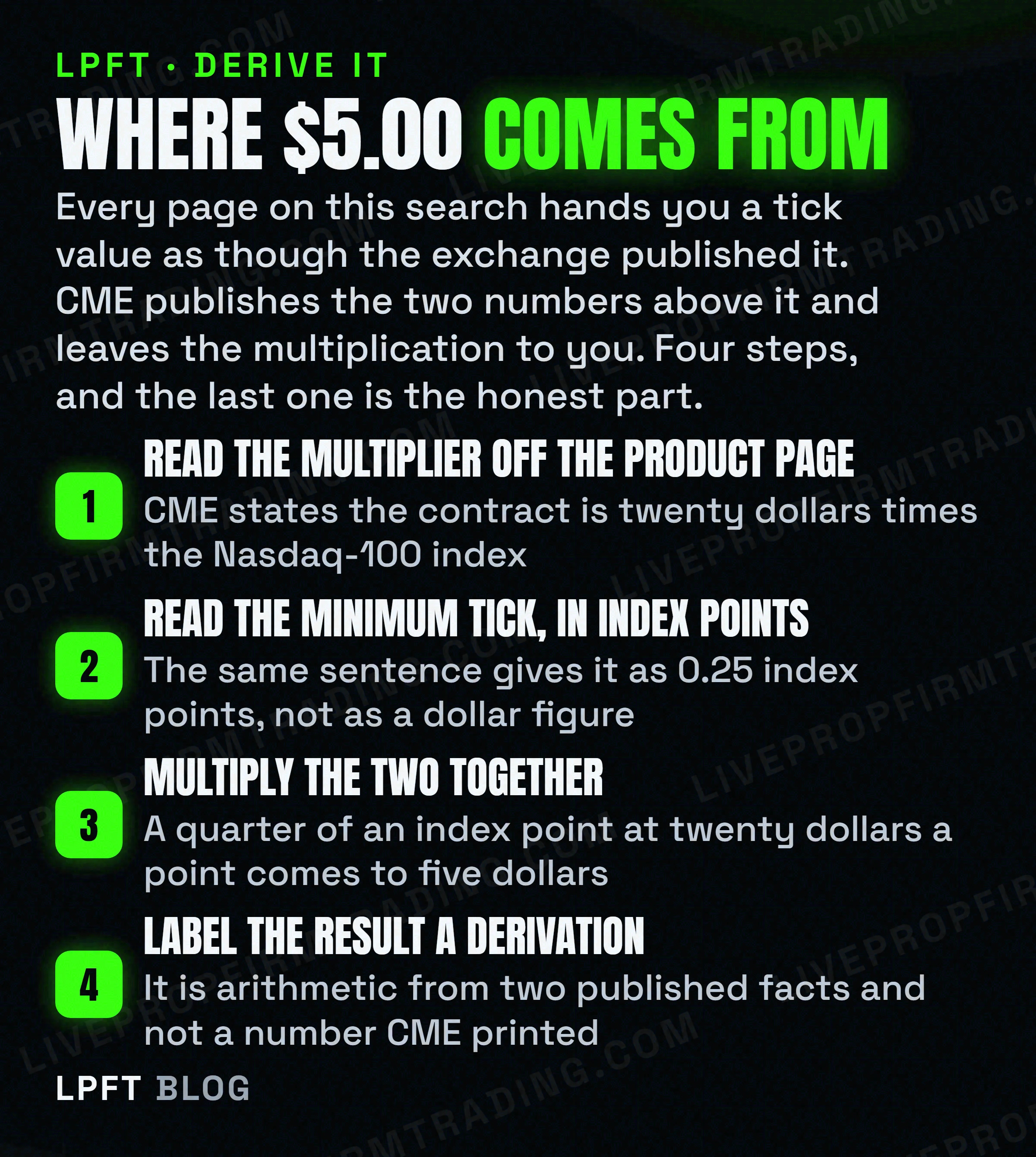
Multiply the two published numbers and the answer falls out. A quarter of an index point, at twenty dollars per index point, is five dollars. So one tick on NQ moves your position by $5.00 per contract, and a full index point moves it by $20.00.
That figure is correct. It is also a derivation, and we have not seen CME print it. Every result on this search states "$5.00 per tick" in the voice of a spec sheet, which quietly converts arithmetic into a citation. The distinction sounds pedantic until you meet a number you cannot derive, at which point knowing which kind you are holding is the difference between checking it and copying it.
There is a neat asymmetry here that makes the point better than any argument. The micro contract's tick value IS published. CME's Micro E-mini FAQ prints a tick table whose Nasdaq-100 row reads, verbatim, "0.25 Index points= $0.50" for the outright and "0.05 Index points= $0.10" for the calendar spread. So on the same exchange, for the same index, the small contract gets a dollar figure and the large one does not.
Which means if you want a tick value from the exchange's own hand, you can have the micro's. The big contract's you have to work out, and the only honest way to present it is the way it was obtained.
What NQ tracks is a listing venue, not a sector
Ask what NQ is and nearly every answer says the tech index. That is the one claim on this topic we could not support from a primary source, and we went looking.
Nasdaq owns the index and publishes its methodology. That document, copyright 2026 Nasdaq, Inc., opens with the definition, verbatim: "The Nasdaq-100 Index (the Index) is designed to measure the performance of 100 of the largest Nasdaq-listed non-financial companies. The Index employs a modified market capitalization weighting scheme."
Read the two filters in that sentence. A company has to be listed on Nasdaq, and it has to not be a financial. There is no technology test anywhere in it. The concentration in technology names that everyone describes is an outcome of which companies happen to list on Nasdaq, not a rule in the index.
The methodology goes further and makes the point for us. Verbatim: "Companies classified in the Real Estate Industry under the ICB are eligible, provided they are not organized as a REIT." An index that admits real-estate companies by rule is not a sector index. It is a listing index with one sector carved out.
| What the methodology says | Verbatim |
|---|---|
| The universe | "100 of the largest Nasdaq-listed non-financial companies" |
| The weighting | "a modified market capitalization weighting scheme" |
| Size floor | "There is no minimum or maximum market capitalization criterion" |
| Liquidity screen | "a three-month average daily value traded (ADVT) of at least $5 million (USD)" |
| Membership review | "the annual December Reconstitution" |
Two of those rows matter more than they look. Modified market-cap weighting means the index is not equally weighted, so the largest members move it more than the smallest, and a position in NQ is not a spread across a hundred equal bets. And the only size-shaped screen in the document is a liquidity test on dollars traded, not a market-capitalisation floor.
The index is reviewed at what Nasdaq calls "the annual December Reconstitution". The December contract expires on the third Friday of December. Both of those are published, and we are deliberately not telling you how they interact, because we did not read anything that says. They are two scheduled December events worth having on a calendar separately.
NQ against MNQ, and the dependency most people never learn
MNQ is the micro version of the same exposure. CME's Micro E-mini Nasdaq-100 page, read the same day, says, verbatim: "The Micro E-mini Nasdaq-100 futures contract is $2 x the Nasdaq-100 Index and has a minimum tick of 0.25 index points."
Same index, same increment, one tenth the multiplier. CME frames the whole family that way, describing micros as having "multipliers 1/10 the size of their E-mini counterparts". So the arithmetic from earlier scales straight down: two dollars an index point, fifty cents a tick, both of those published.
| NQ | MNQ | |
|---|---|---|
| Multiplier | $20 x the index | $2 x the index |
| Minimum tick | 0.25 index points | 0.25 index points |
| Tick value | $5.00, derived here | "0.25 Index points= $0.50", published |
| Calendar spread tick | Not read on the pages above | "0.05 Index points= $0.10", published |
| Contracts listed | Five in the March quarterly cycle | Five in the March quarterly cycle |
Now the part that appeared on none of the pages we read, and it is a genuine dependency rather than a curiosity. If you trade the micro, your daily mark comes from the big contract. CME states it plainly: "Daily settlement for Micro E-mini futures is based on the 30-second volume-weighted average price (VWAP) of Globex trades between 3:59:30 p.m. and 4:00:00 p.m. ET of their E-mini counterpart."
So an MNQ position is settled each day off thirty seconds of NQ trading. You are not marked against the contract you transacted in. For anything automated that reconciles its own records against a statement, that is worth knowing before the two disagree and you go looking for a bug that is actually a rule.
- They offset, ten to one, and only one way. Verbatim: "Micro E-mini futures are offset eligible versus their E-mini counterparts at 10:1 ratio. This can only be applied to offsetting positions. Requests can be made by your clearing broker directly to the CME Clearing House." It is a request through your broker, not an automatic netting.
- Final settlement is an opening print, not a close. CME describes five concurrent contracts that "expire against the opening index value on the third Friday of March, June, September, and December", with the micro taking "the same SOQ value as the corresponding E-mini contract". The Special Opening Quotation is a morning number, which surprises people who assume a settlement happens at the end of a day.
- The micro is excluded from two things. Verbatim: "Micro E-mini Equity Index futures contracts will not be block or BTIC trading eligible," and "Micro E-mini futures volume will not count towards the current volume-based fee discounts available to members." Trading size in micros does not walk you down a member fee ladder the way the same activity in NQ might.
The contract-by-contract comparison against the S&P micro is in MES vs MNQ, the same question one size up is in ES vs MES, and the whole family including the two micros that break the naming is in micro futures explained.
Whichever of the two contracts you settle on, something has to carry the decision to the broker. TradersPost publishes which broker connections it supports and states that following your own firm's rules is your responsibility, which is the right division of labour. Free 7-day trial.
See TradersPostThe clock, and the fifteen minutes inside it
CME gives the hours for these contracts in one line, verbatim: "Sunday - Friday 6:00 p.m. - 5:00 p.m. ET with a trading halt from 4:15 p.m. - 4:30 p.m. ET."
Read that twice, because there are two separate facts in it. The contract trades nearly around the clock five days a week, and there is a fifteen-minute halt sitting inside the afternoon. A person notices a halt. A script does not, and an order that assumes continuous matching across 4:15 p.m. Eastern is making an assumption the exchange has already contradicted in writing.
One more detail that trips up anyone reading the exchange closely. The same FAQ gives the hours in Eastern and gives the price-limit schedule in Central, on the same page, for the same contract. Anything that hard-codes one zone from a page that uses both is wrong twice a year.
What the exchange does to NQ at different points in that day, including the price limits and the order states, is in overnight versus regular trading hours and best times to trade futures. The session boundary itself and the trade date it carries are in futures trading sessions explained.
What to write down before you trade it
The useful output of a page like this is not a fact sheet you half-remember. It is four numbers in your own notes, three of which you can get from the exchange and one of which only you can supply.
- The multiplier, from the exchange. Twenty dollars an index point on NQ, two on MNQ. Stable, published, no date needed.
- The tick, in index points and then in dollars. A quarter point either way. Five dollars on NQ as a derivation, fifty cents on MNQ as a quotation.
- Your stop distance, in index points, measured on your own chart. This is the input nobody else has. A spec sheet cannot tell you what a trade costs, because it does not know how far your stop sits.
- The two multiplied, against your daily loss limit. If one stop is a serious slice of the limit, the contract is too large for the account, and the fix is the size or the rules rather than the ticker.
That last line is the entire reason to learn a contract specification, and it is why this page refuses to tell you whether NQ is suitable for you. The arithmetic decides it, and half the arithmetic is yours. The account-size version of the sum is in how much money you need for automated futures trading, the margin the broker will actually hold is in futures margin and leverage, and what comes off every round turn is in how much it costs to trade micro futures.
If this is early days, prove the rules the cheap way first. Paper trading versus live bot testing covers what simulation does and does not tell you, and the best futures to trade for beginners deals with the question of which contract belongs in a new account at all.
Futures trading carries a substantial risk of loss, and a twenty-dollar multiplier is the reason that sentence is not boilerplate on this particular contract. Nothing on this page is advice about what or how much to trade. It is the exchange's own specification, the index owner's own methodology, and the one multiplication you have to do yourself.
The LPFT Copilot runs the whole stack for you on Tradovate - start a 7-day free trial and watch it work.
Start your 7-day free trialFrequently asked questions
NQ is the E-mini Nasdaq-100 futures contract, traded on CME Globex. CME describes it as offering "liquid benchmark contracts to manage exposure to the 100 leading non-financial U.S. large-cap companies that make up the Nasdaq-100," and states that the contract "is $20 x the Nasdaq-100 index and has a minimum tick of 0.25 index points." So one index point is worth $20 per contract. MNQ is the micro version of the same exposure at $2 times the index.
A tick works out to $5.00 per contract, from 0.25 index points multiplied by the $20 multiplier. It is worth knowing that this is a derivation rather than a quotation. CME's E-mini Nasdaq-100 page publishes the multiplier and the 0.25 point tick size and does not print a dollar tick value. The micro contract's value is published: CME's Micro E-mini FAQ gives the Nasdaq-100 row as "0.25 Index points= $0.50" outright.
Not by rule. Nasdaq's own index methodology says the Nasdaq-100 "is designed to measure the performance of 100 of the largest Nasdaq-listed non-financial companies" using "a modified market capitalization weighting scheme." The two filters are the listing venue and the exclusion of financials, with no technology test. The methodology even states that real-estate companies are eligible provided they are not organized as a REIT. Any concentration in technology names is an outcome of who lists on Nasdaq, not an index rule.
The multiplier, and nothing else about the exposure. CME states NQ is "$20 x the Nasdaq-100 index" and MNQ is "$2 x the Nasdaq-100 Index," both with a minimum tick of 0.25 index points. There is one dependency worth knowing: a micro's daily settlement is computed from the big contract, being "the 30-second volume-weighted average price (VWAP) of Globex trades between 3:59:30 p.m. and 4:00:00 p.m. ET of their E-mini counterpart." Micros are also offset eligible against E-minis at a 10:1 ratio on offsetting positions, by request through a clearing broker.
CME gives them as "Sunday - Friday 6:00 p.m. - 5:00 p.m. ET with a trading halt from 4:15 p.m. - 4:30 p.m. ET." Two things sit in that sentence: the contract trades nearly around the clock on weekdays, and there is a fifteen-minute halt inside the afternoon when matching stops. The halt is worth encoding into any automated session window, since a script will not notice it the way a person would. Note that CME publishes these hours in Eastern while publishing the contract's price limits in Central.
On the standard quarterly cycle. CME describes five concurrent contracts that "expire against the opening index value on the third Friday of March, June, September, and December," with final settlement based on "the Special Opening Quotation (SOQ) on the third Friday of the contract month." The detail most summaries miss is that this is an opening print rather than a closing one. Separately, Nasdaq reviews index membership at what it calls "the annual December Reconstitution," which is a different December event from the contract expiry.
Eli Y.
Eli builds and runs rules-based automated futures systems on NinjaTrader and Tradovate, and helps traders take emotion out of the screen. He writes about futures automation, prop-firm evaluations, and the tools that connect them - plainly, and without hype.
Risk disclosure: Trading futures involves substantial risk of loss and is not suitable for everyone. This article is educational content only and is not financial advice or a recommendation to trade. Past performance is not indicative of future results. Some links are affiliate links.