
Prop Firm Automation Stacks: Your Firm Picks the Tools, Not You

Heads up: some links below are affiliate links. If you sign up through them we may earn a commission at no extra cost to you - it never changes what we recommend.
Which automation tools work with your prop firm is decided by the firm, not the tool. Two questions settle most of it: does the firm expose a trading API to traders at all, and where does it allow the code to run. A vendor compatibility table cannot answer either one, because both are the firm's policy rather than a technical feature.
The LPFT Copilot runs a tested, rules-based method on your own prop firm or Tradovate account with the session windows and loss limits built in. One piece instead of four. Start a 7-day free trial and watch it run.
Start your 7-day free trialHalf of this search result page is selling software to prop firms, not to you
Search for prop firm automation tools and the results split into two groups, neither of which is writing for a trader. Three of the top results sell business software to prop firms themselves. Customer relationship management, payout processing, risk dashboards, audit and reporting. Useful products, aimed at the company, ranking for your query by accident.
Most of the rest are bridge and hosting vendors publishing tables of which firms permit automation. Those tables are the thing to be careful with, and not because the vendors are dishonest. It is that the answer to "can you automate at this firm" is being supplied by the company that sells you the automation, which is the same structural problem whichever industry you find it in.
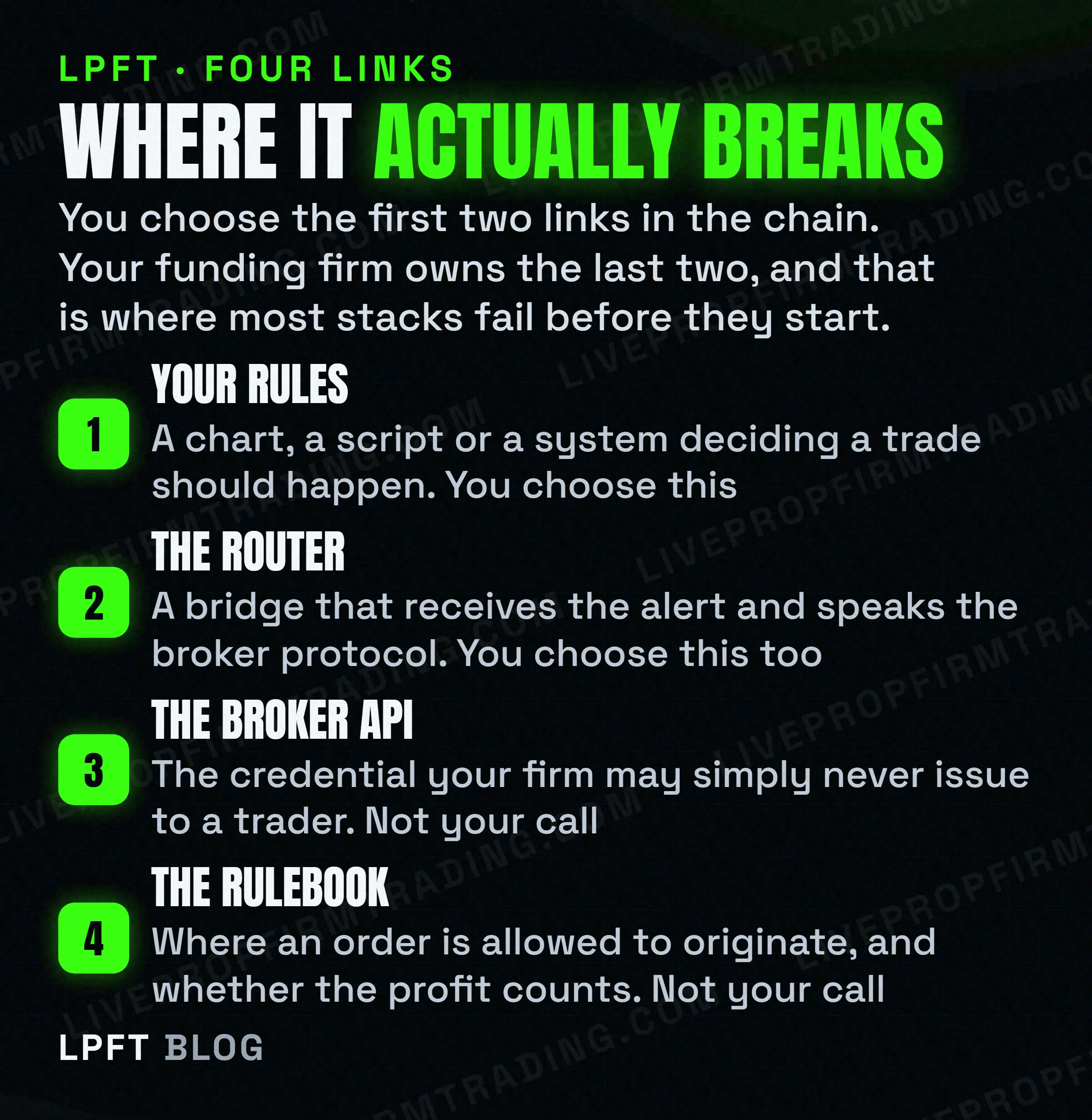
So here is the version assembled from the firms' own support pages instead. The conclusion is narrower than any compatibility table and considerably more useful: your stack has four links, you pick two of them, and your funding firm owns the other two outright.
Does your firm hand a trading API to traders at all, and where does it allow the code that places orders to run? Answer those from your own firm's page and most of the tool comparison becomes irrelevant.
The stack is four links, and you only choose the first two
Every automated futures stack, whatever it is branded as, is the same chain. Something decides a trade should happen. Something carries that decision to a broker. The broker accepts or refuses the order. And a rulebook decides afterwards whether the whole thing counted.
The vendors describe their own link honestly enough when you read their pages rather than the listicles about them. TradersPost, on its own prop firm page read on 21 October 2026, states that "TradersPost connects to prop firm accounts through Tradovate and ProjectX." It names Topstep and Apex Trader Funding among many more, carries a table of over thirty firms, and offers to "Subscribe multiple prop firm accounts to a single strategy and every signal is executed across all of them simultaneously."
That is a clear description of link two, and it tells you the thing worth knowing: a router does not have its own way into your account. It reaches your funded account through the broker layer underneath, which means the broker layer has to be open to you in the first place. The same page carries a sentence most of the SERP leaves out, and it is the most honest line we read all week: "You are responsible for understanding and following each firm's specific rules and restrictions. Prop firms differ in what they allow."
They do, enormously, and the differences are not where people look. If you want the mechanics of the signal leg rather than the permission question, sending a TradingView webhook to a broker covers it properly.
Wall one: your firm may never hand you the API at all
This is the fact that breaks every compatibility table, and it is published in plain language on a firm's own support site. Read on 21 October 2026, TradeDay states that "To use an automated trading system, you must use one of the platforms we support: NinjaTrader, Tradovate, TradingView, Jigsaw and Quantower."
So far that reads like an open door. Then, on the same page, verbatim: "We do not make platform APIs available to traders." And, to remove any doubt about which API: "TradeDay does not expose the Tradovate API to allow traders to connect automated trading systems directly."
Hold those two sentences next to the router description above. A tool that reaches funded accounts through Tradovate needs a Tradovate credential issued to you. A firm can run its accounts on Tradovate and still never issue that credential to a trader. Both firms appear as Tradovate firms on every compatibility list in this market, and the lists cannot see the difference, because the difference is a policy rather than a technical capability.
TradeDay is specific about two more things on that page. "Algos and Bots purchased from a third party and employed by the trader are forbidden," which rules out a category of product rather than a category of technology. And the consequence of sharing one, verbatim: "If multiple users are making the same trades, then all the accounts will be shut down, and the users suspended."
No firm publishes a list of which named tools it permits, so nobody honestly can tell you that a particular vendor is approved or banned at a particular firm. What we can do is quote what each firm says about APIs, purchased systems and where code may run, and hand you the questions. The answers come from your firm.
Wall two: where the code is allowed to run
The second wall catches people who cleared the first one. Having an API is not the same as being allowed to call it from anywhere, and this is where a cloud-based stack meets a rule most traders have never read.
Topstep permits automation and says so directly. Read on its own help site on 21 October 2026: "Custom automated strategies and bots are allowed via the TopstepX / ProjectX API, subject to standard platform rules and our prohibition on high-frequency trading (HFT)." That is about as clear a green light as this industry publishes.
The condition is the interesting part. On the same page: "All trading activity must originate from your personal device. The use of VPS, VPNs, and remote servers is prohibited by Topstep's Terms of Use." A private server is allowed to do historical data storage, research, backtesting, logging and analytics, and to run a read-only dashboard, but not "Placing, modifying, or cancelling orders" and not "Any automated trigger that can reach the order endpoints." They summarise it in one line: "your server can watch and record, but it cannot trade."
- What that rules out at that firm. Any arrangement where the thing that reaches the order endpoint is not the trader's own machine. That is a question to put to your firm about your specific setup, because only the firm can answer it.
- Why it matters more than latency. Most hosting content argues about milliseconds. The rule above is binary and it is about location, not speed.
- And orders are final. Also on that page: "Orders executed via the API are final - no review, adjustment, or reversal." A coding mistake is a trading result.
This is the single most common reason a stack that works perfectly in testing is a problem in a funded account, and it has nothing to do with the tools. The whole hosting question, including who actually needs a server and who has been sold one, is in do you need a VPS for automated trading. The firm-by-firm mechanics are in running a bot on a prop firm account and Topstep automation rules.
TradersPost publishes which connections it uses to reach prop accounts and states plainly that following each firm's rules is your responsibility. Read its own prop firm page alongside your firm's rules page, not instead of it. Free 7-day trial.
See TradersPostThe rungs nobody prices
Two more things sit inside link three and almost never appear in a stack comparison, both of them read on the technology providers' own documentation.
The first is that the API can itself be a paid subscription. ProjectX, the technology provider behind TopstepX, states on its own API page read on 21 October 2026: "In order to utilize the ProjectX API, you must have an active API subscription." So the cost of automating can include the firm's technology layer on top of the tool and the evaluation fee. We did not read a price, so we are not publishing one. Check it on their dashboard before you budget.
The second is why almost nobody writes directly against the broker API even when it is available. Tradovate's own partner documentation describes keys that are provided per environment rather than generated by you, a staging key for development and a production key for live use, with the expectation that a production key is beta tested for at least a week first. Access tokens expire after eighty minutes and have to be renewed before expiry. That is a perfectly reasonable design and it is also the reason the bridge layer exists at all.
| Link | Who decides it | What to check |
|---|---|---|
| Your rules | You | Can you state the entry, exit and size in writing |
| The router | You | Which broker connections it uses, and its own pricing |
| The broker API | Your firm | Whether the firm issues a trader credential at all |
| Where code runs | Your firm | Personal device only, or is a server permitted |
| Purchased systems | Your firm | Whether a third-party bot is allowed to be used |
| Multi-account copying | Your firm | Whether it is allowed, and in which direction |
| API access cost | Your firm or its provider | Whether a separate subscription applies |
Work down the right-hand column with your own firm's pages open and you will have a better answer in twenty minutes than any comparison article can give you, because four of those seven rows are specific to you. If a vendor's pricing is the part you are weighing, the models are less comparable than they look and we unpicked them in subscriptions versus one-time purchases.
What we could not read, and why we are telling you
A compatibility article is only honest if it says where it stopped. Three firms' support sites refused our requests on 21 October 2026. Apex Trader Funding and TakeProfit Trader both returned a block to every attempt, and Tradeify has blocked us on a previous pass. We therefore have nothing current to tell you about any of them, and a blocked page is not evidence that a policy is lenient or strict. It is just absence.
We will also not repeat the firm-permission claims circulating on this search result page. One summary asserts that four named firms allow a TradingView strategy to place orders unattended through a bridge. We could not read any of those four firms' own pages, and the same summary describes a firm as permitting automation at every stage in terms that do not match that firm's own personal-device requirement quoted above. Vendor compatibility lists are not firm policy, and we are not going to launder them into one.
What we can say with confidence is the shape of the thing. Across every firm page we have been able to read, the pattern is not hostility to automation. It is four narrower bars: the system has to be yours rather than resold, the order has to originate where the firm says, the account cannot be a copy of somebody else's, and there is usually a ceiling on speed or trade count. A strategy that clears those is permitted at more firms than the forums suggest, which is also what we found in HFT prop firms.
Futures trading carries a substantial risk of loss, and a correctly assembled stack does nothing whatsoever about that. It only removes the failure modes that are about plumbing and permission rather than about the market. Test in simulation first, read your own firm's current rules before you connect anything, and assume both will change again. If you would rather not assemble four links at all, that is a reasonable conclusion and it is the one we built our product around, which you can weigh in is automated trading worth it.
The LPFT Copilot runs the whole stack for you on Tradovate - start a 7-day free trial and watch it work.
Start your 7-day free trialFrequently asked questions
The question is better asked the other way round, because the firm decides. A router reaches a funded account through the broker layer underneath it, so what matters is whether your firm issues a trading API credential to traders and where it allows order-placing code to run. TradersPost, for example, states that it connects to prop firm accounts through Tradovate and ProjectX, which means the firm has to open that path first.
Some firms deliberately do not. TradeDay states on its own support site, read on 21 October 2026, that "We do not make platform APIs available to traders" and that it does not expose the Tradovate API to allow traders to connect automated trading systems directly. A firm can run its accounts on a platform and still not issue that credential, which is why vendor compatibility tables can be misleading.
At some firms, no. Topstep states on its own help site, read on 21 October 2026, that "All trading activity must originate from your personal device" and that the use of VPS, VPNs and remote servers is prohibited by its Terms of Use. It allows a private server for data storage, backtesting, logging and a read-only dashboard, summarising the boundary as your server can watch and record, but it cannot trade. Check your own firm.
It varies and some firms prohibit them specifically. TradeDay states that "Algos and Bots purchased from a third party and employed by the trader are forbidden," and warns that if multiple users are making the same trades then all the accounts will be shut down and the users suspended. This is a rule about the product rather than the technology, so a bot you built yourself may be treated differently from one you bought.
It can. ProjectX, the technology provider behind TopstepX, states on its own API page that "In order to utilize the ProjectX API, you must have an active API subscription." That sits on top of whatever you pay for the evaluation and for any tool, and it is a cost that almost no stack comparison includes. We did not read a published price, so check it on their dashboard before budgeting.
Because the raw API is built for developers rather than traders. Tradovate's own partner documentation describes keys that are provided per environment rather than self-generated, a staging key for development and a production key for live use, an expectation that a production key is beta tested for about a week, and access tokens that expire after eighty minutes and must be renewed before expiry. A bridge exists to absorb that work.
Eli Y.
Eli builds and runs rules-based automated futures systems on NinjaTrader and Tradovate, and helps traders take emotion out of the screen. He writes about futures automation, prop-firm evaluations, and the tools that connect them - plainly, and without hype.
Risk disclosure: Trading futures involves substantial risk of loss and is not suitable for everyone. This article is educational content only and is not financial advice or a recommendation to trade. Past performance is not indicative of future results. Some links are affiliate links.