
How to Vet an Automated Futures Trading Service in Twenty Minutes

Heads up: some links below are affiliate links. If you sign up through them we may earn a commission at no extra cost to you - it never changes what we recommend.
Judge an automated futures trading service on four documents rather than its feature list: the hypothetical-performance statement and where it sits, the disclosures on its testimonials, a registration record you can look up, and a written limit on what it will not do. All four are public before you pay.
Everything below is a question you are entitled to ask any seller, and that includes this one. The LPFT Copilot runs a rules-based method on your own prop firm or Tradovate account, with session windows and loss limits built in. Start a 7-day free trial and judge it from the inside.
Start your 7-day free trialThe search results rank features, and the features are not where the risk is
Search for an automated futures trading service and you get two kinds of page. The first is a vendor describing itself. The second is a listicle ranking vendors by feature, and on the results we read this week three of those listicles were published by a company that sells virtual private servers, which is a product you may or may not need and which has nothing to do with whether a strategy works.
Neither kind of page is lying to you. They are answering a different question. A feature matrix tells you what a tool can do. It cannot tell you whether the person selling it has shown you real results, whether anyone has checked them, or what happens to your account when the thing is wrong. That is the part that costs money, and it is almost absent from the first page of results.
So here is the version built from documents instead. Four of them, all public, all readable before you pay, and three of them required by a rule that we read in full on the regulator's own site. Working through them takes about twenty minutes and it will eliminate most of what is for sale in this category.
They test disclosure discipline and identity, not profitability. A seller who passes all four can still lose your money, because futures trading carries a substantial risk of loss no matter who wrote the rules. What the checks remove is the subset of sellers who were never going to be straight with you about the numbers.
Check one: the sentence that is supposed to sit beside the equity curve
If a service shows you a performance chart, the first question is whether those trades happened. Backtested and forward-simulated results are legitimate and useful. Presenting them as though they were a live account is the thing that gets people charged, and the rule covering it is specific.
Read on 29 October 2026 on the electronic Code of Federal Regulations, with the page stating it was current as of 27 October 2026, 17 CFR 4.41(b)(1) requires that simulated or hypothetical performance be accompanied by a prescribed statement. The text of it, verbatim, begins: "These results are based on simulated or hypothetical performance results that have certain inherent limitations. Unlike the results shown in an actual performance record, these results do not represent actual trading."
It continues: "Also, because these trades have not actually been executed, these results may have under-or over-compensated for the impact, if any, of certain market factors, such as lack of liquidity. Simulated or hypothetical trading programs in general are also subject to the fact that they are designed with the benefit of hindsight. No representation is being made that any account will or is likely to achieve profits or losses similar to these being shown."
Two details in that rule do the real work, and neither is about the wording. The first is placement. Paragraph (b)(2), verbatim: "If the presentation of such simulated or hypothetical performance is other than oral, the prescribed statement must be prominently disclosed and in immediate proximity to the simulated or hypothetical performance being presented." A disclaimer buried in a footer three screens below the chart is a different object from one sitting next to it, and you can see which you are looking at in about four seconds.
The second is scope. Paragraph (c)(2), verbatim, applies the section "Regardless of whether the commodity pool operator or commodity trading advisor is exempt from registration under the Act," and paragraph (c)(1) reaches "any publication, distribution or broadcast" including "information provided via internet or e-mail." So "we are exempt, that rule is not ours" is not an answer available to anybody, and a web page is covered.
The rule permits an alternative: paragraph (b)(1)(ii) allows "A statement prescribed pursuant to rules promulgated by a registered futures association." We have not read that alternative, so we cannot tell you which form any particular seller owes, and neither can anyone else without reading it. Judge presence and placement. Never conclude from wording that a named company is non-compliant.
Check two: a testimonial carries three things attached to it, or it carries nothing
Screenshots of happy customers are the cheapest asset in this industry to manufacture and the easiest to check against a rule. The same regulation, at 4.41(a)(3), says an advertisement referring to a testimonial must "prominently disclose" three things.
- That it may not be typical. Verbatim: "That the testimonial may not be representative of the experience of other clients."
- That it predicts nothing. Verbatim: "That the testimonial is no guarantee of future performance or success."
- That it was paid for, if it was. Verbatim: "If, more than a nominal sum is paid, the fact that it is a paid testimonial."
This one is fast. Scroll to the testimonials, look for those three notes, and move on. Their absence is not proof of anything dishonest on its own, and plenty of small operators are simply careless. What it does tell you is that nobody involved has read the rulebook they are selling inside, which is a reasonable thing to weigh when you are about to hand them a card number and an account.
Check three: look the entity up, then read the regulator's own caveat about it
The regulator publishes a free lookup and tells you to use it. On its check page, read 29 October 2026, the instruction is verbatim: "Before working with any person or firm to trade in commodity futures, commodity pools, options, forex, or other derivatives, verify that the entity is properly registered with the CFTC." It points at the National Futures Association BASIC database and at what it calls the CFTC Registration Deficiency list, which exists for "unregistered entities making false registration claims."
BASIC itself, read the same day, describes itself as "a free tool that NFA Members and investors can use to research the background of derivatives industry professionals," searchable by firm name, NFA or pool identifier, last name and pool name. Its own note is worth reading too: an entity you look up "may currently hold, or may have previously held, licenses to offer additional financial services beyond those regulated by NFA," and the securities side lives in a different database.
Then read the sentence that keeps this check honest, which is the regulator's own and not ours. Verbatim: "While registration and a clean disciplinary record won't protect you from fraud, most scams involve unregistered entities, people, and products." That is a filter, not a verdict. A clean record is not a recommendation, and a seller who is not registered is not automatically a criminal, because whether registration is even required depends on what they are actually doing. What you are looking for is a mismatch between what the page claims about its standing and what the database says.
That mismatch is a real pattern rather than a hypothetical one, and we wrote it up with the cases attached in the red flags of trading-bot scams. If what you are weighing is whether this whole category is regulated in the first place, are prop firms legal walks through what actually is and is not covered.
Check four: nobody downstream of the seller is vetting the strategy for you
This is the assumption that does the most quiet damage. If a regulated broker will auto-execute a third-party system on its own platform, it feels as though somebody regulated must have looked at the system. A broker page says otherwise in one sentence.
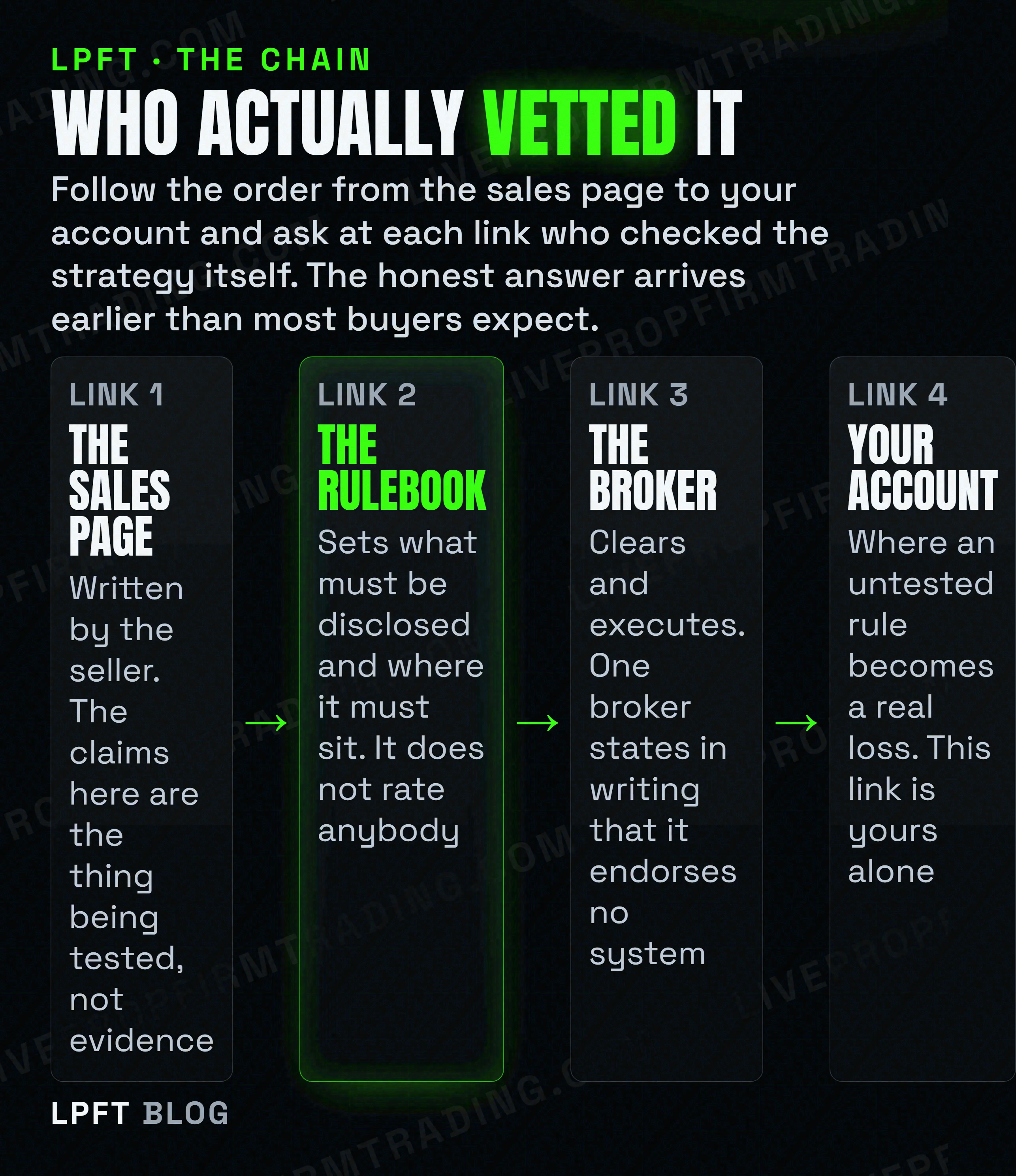
Optimus Futures publishes a page about third-party automated trading systems, read on 29 October 2026, which describes them as "computer programs designed by expert developers to follow a given market algorithm, every minute of the day" and the service as the broker auto-executing "your selected system" while the customer "simply monitor[s] the results." On the same page, verbatim: "Optimus Futures, LLC is not affiliated with nor does it endorse any trading system, methodologies, newsletter or other similar service."
Read that next to the word "selected." The broker will carry out what you chose. The choosing is the entire risk and it stays with you. That is not a criticism of the broker, it is a clear statement of a boundary that most listicles leave implicit, and it is the reason the other three checks matter at all.
There is a second boundary in the same position. If the account is funded by a prop firm, that firm's rulebook decides whether an automated order is allowed at all and where the code placing it may run, and no vendor can answer that for you. Those rules differ sharply between firms and they change, so read your own firm's current pages rather than a compatibility table. We keep the firm-by-firm reading in running a bot on a prop firm account, and the hosting question specifically in do you need a VPS for automated trading.
A bridge is a different purchase from a system. TradersPost publishes which broker connections it uses to reach an account and states plainly that following each firm's rules is your responsibility, which is the kind of scoping sentence check four is looking for. Free 7-day trial.
See TradersPostThe twenty-minute pass, in order
Run it top to bottom with the seller's site open in one tab and the lookup in another. Most of what fails, fails in the first two rows.
| Minute | What you open | What a pass looks like |
|---|---|---|
| 0 to 4 | Every performance chart on the site | A hypothetical-results statement sits beside the numbers, not in the footer |
| 4 to 7 | The testimonials block | All three disclosures present, and paid ones marked as paid |
| 7 to 12 | NFA BASIC and the regulator's check page | What the site claims about its standing matches the record |
| 12 to 15 | The pricing and cancellation page | The billing basis is stated and the exit is described, not implied |
| 15 to 18 | Your own firm or broker rulebook | Automation permitted, and the place the code runs is permitted too |
| 18 to 20 | Anything describing limits | A written statement of what the system will not do and when it stands down |
The last row is the one almost nothing passes, and it is the one we would weigh most heavily. A seller who has written down the conditions under which their own system should be switched off has thought about failure. A seller whose material contains no such sentence has told you something about how it was built. If you want the pricing side of this done properly, the two billing models are less comparable than they look and we unpicked them in subscriptions versus one-time purchases, with the free end covered in free versus paid trading bots.
Where we sit, since the checks apply to us too
It would be cheap to publish a vetting guide and exempt ourselves from it, so here is our own card, weaknesses first. We are a subscription, which means the billing does not stop being a cost if you stop using it. We sell a system you run on your own account, which means the work of setting it up is real and some people will not want it. And we cannot tell you what it will return, because nobody honestly can.
What we can point at is the same four documents. Our performance material is labelled for what produced it. Our product rule is that a trade counts only when the broker executed it, which is a deliberately awkward standard to hold yourself to. We never take custody of your money and never pool it, because you trade your own account. And the limits are written down, including the session windows and the daily loss cap at which the thing stands down on purpose.
Weigh that the way you would weigh anyone else here. If the conclusion you reach is that no service of this kind is worth it for you, that is a legitimate answer and we laid out the honest version of it in is automated trading worth it. If you would rather see what the category looks like from the inside first, paper trading versus live bot testing is the cheapest way to find out.
Futures trading carries a substantial risk of loss and none of these checks reduces that by a single dollar. They reduce a different risk, which is paying someone whose numbers were never real in the first place. Run them in simulation, read your own firm's current rules before you connect anything, and assume both the rules and the sales pages will have changed by the time you come back.
The LPFT Copilot runs the whole stack for you on Tradovate - start a 7-day free trial and watch it work.
Start your 7-day free trialFrequently asked questions
Check four public documents before you pay. First, whether a hypothetical-performance statement sits immediately beside any performance chart, which 17 CFR 4.41(b)(2) requires for non-oral presentations. Second, whether testimonials carry the three disclosures 4.41(a)(3) demands. Third, whether the entity appears in NFA BASIC as the site claims. Fourth, whether anything states what the system will not do. None of that proves profitability, and futures trading carries a substantial risk of loss regardless.
Under 17 CFR 4.41(b)(1)(i), read on the eCFR on 29 October 2026, the prescribed statement begins "These results are based on simulated or hypothetical performance results that have certain inherent limitations. Unlike the results shown in an actual performance record, these results do not represent actual trading." The rule also permits an alternative statement prescribed by a registered futures association, so the exact wording can differ. What matters is that such a statement exists and sits in immediate proximity to the numbers.
Not necessarily, and at least one states so in writing. Optimus Futures publishes a page on third-party automated trading systems, read 29 October 2026, carrying the sentence "Optimus Futures, LLC is not affiliated with nor does it endorse any trading system, methodologies, newsletter or other similar service." A broker executing a system you selected is not a broker vetting it. Ask your own broker directly rather than assuming either way.
The National Futures Association runs a free lookup called BASIC at nfa.futures.org, searchable by firm name, NFA or pool identifier, last name and pool name. The CFTC's own check page tells the public to verify registration before working with any person or firm, and also names a Registration Deficiency list for unregistered entities making false registration claims. Note the CFTC's own caveat that registration and a clean record will not protect you from fraud.
No, and treating it that way will mislead you. Whether registration is required depends on what the seller actually does, and some activities are exempt. The CFTC's own framing is that most scams involve unregistered entities rather than that every unregistered entity is a scam. The signal to act on is a mismatch: a page that claims a registration the database does not show. In one CFTC case the defendant falsely stated he was registered as a commodity trading advisor when he was not.
Four questions covering the things nobody volunteers. Which account produced the numbers on your site, and is the statement from the broker. What are the conditions under which your system should be switched off. What exactly is billed, on what basis, and how does cancelling work. And does anything about your setup require the code to run somewhere other than my own machine, because that is a question my funding firm's rulebook may answer differently than you do.
Eli Y.
Eli builds and runs rules-based automated futures systems on NinjaTrader and Tradovate, and helps traders take emotion out of the screen. He writes about futures automation, prop-firm evaluations, and the tools that connect them - plainly, and without hype.
Risk disclosure: Trading futures involves substantial risk of loss and is not suitable for everyone. This article is educational content only and is not financial advice or a recommendation to trade. Past performance is not indicative of future results. Some links are affiliate links.