
Free vs Paid Trading Bots: The Free Ones Stop at the Live Order

Heads up: some links below are affiliate links. If you sign up through them we may earn a commission at no extra cost to you - it never changes what we recommend.
Free trading bots give you signals, backtesting and paper trading. What they withhold is the live order: free tiers typically automate a paper account while making you submit live trades by hand. Paid products buy execution on a real account, risk controls and somebody to call. Neither buys a strategy that works.
The LPFT Copilot runs a tested, rules-based method on your own prop firm or Tradovate account with the session windows and loss limits already built in. Start a 7-day free trial and watch it run before you decide anything.
Start your 7-day free trialThe word "free" is doing four different jobs here
Search for a free trading bot and the results treat the word as though it means one thing. It does not. There are four separate arrangements wearing the same label, they cost wildly different amounts over a year, and the difference between them is the whole answer to this question.
Worth saying up front, because this is a page about a product category we sell into: we charge money for a trading system, so read this knowing that. The specific claim we are making is narrow and checkable, and it is not that paid is better. It is that free and paid draw the line in a consistent place, and the line is the live order.
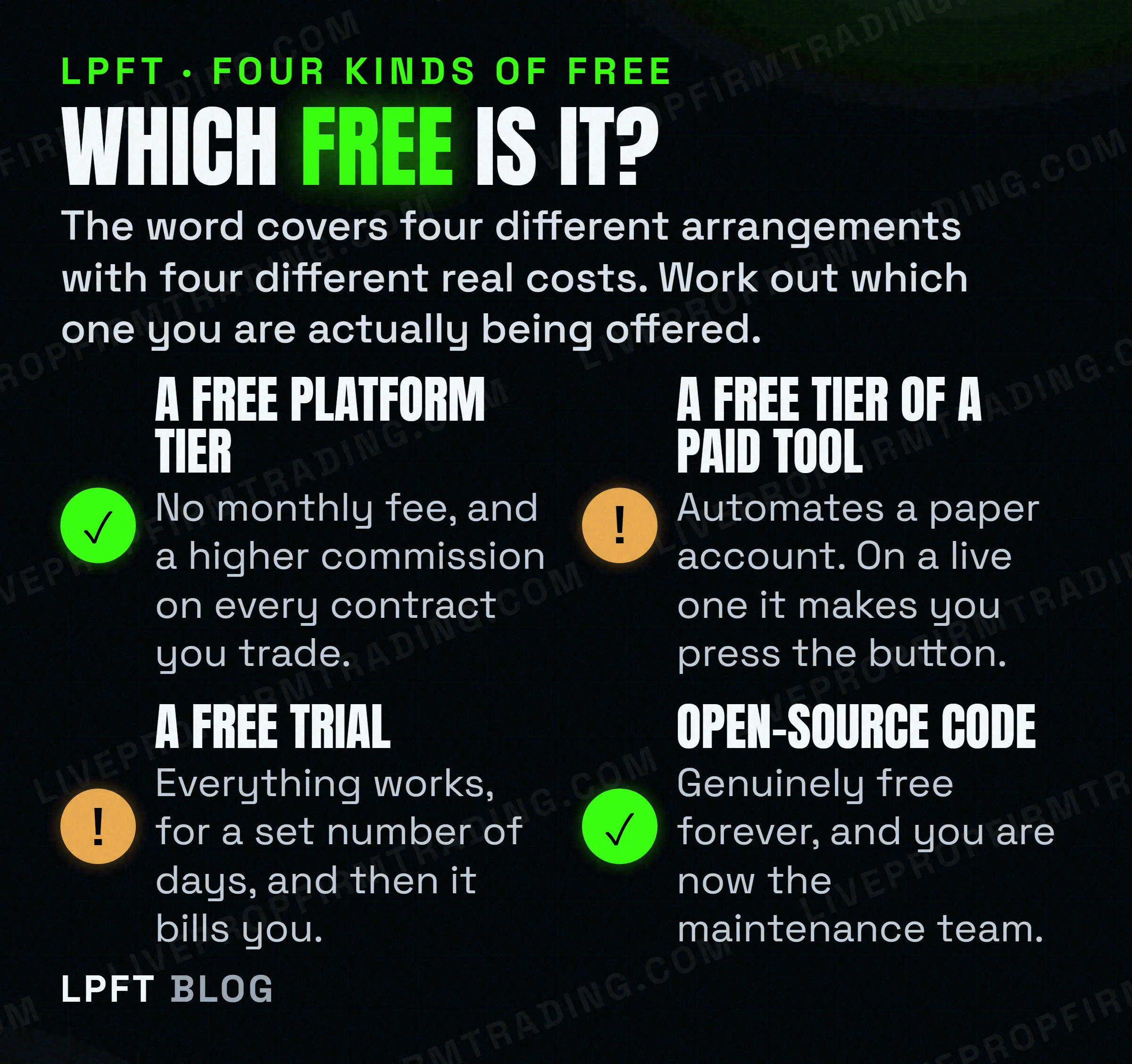
Free never removes the cost. It moves it onto your time, your maintenance, your commission rate, or a clock. That is not a criticism, it is just what you are agreeing to, and it is easier to agree to on purpose.
The free tier that automates everything except the thing you want
Here is the cleanest example in the category, quoted from the vendor's own pricing page, read on 25 October 2026. TradersPost describes its free tier as: "Test signals with manual submission on live accounts and automated submission on paper accounts free for 7 days."
Read that twice. The automation works. It works on a paper account. On a live account the free tier hands the order back to you to submit by hand, which is the precise thing most people wanted automated in the first place. And the whole arrangement has a seven-day clock on it.
That is not a trick, and we say so as their affiliate. It is a rational product decision, and it is also the clearest statement anywhere of where the paid boundary sits in this industry. Free gets you everything up to and including proof that the plumbing works. Live execution is the paid feature.
Why that boundary sits exactly there
- Live execution is where the vendor carries real risk. A paper fill that goes wrong costs nobody anything. A live one generates a support ticket, and sometimes an argument about money.
- It is also the only part you cannot evaluate for yourself. You can judge a backtest in an afternoon. You cannot judge whether a router will behave at 9:31am until it has done so with your money on the line.
- And it is the part that costs the vendor every month. Charts and backtests are compute. Live order handling is compute plus uptime plus the obligation to answer the phone.
If what you actually want is proof the chain works before anything is at stake, that is a sensible goal and a free tier is the right tool for it. The order to test things in is in paper trading versus live bot testing.
TradersPost publishes its free tier terms plainly, including that live submission stays manual on it. That makes it a genuinely useful way to see an alert turn into an order without committing. Read the pricing page yourself rather than our summary of it. Futures trading carries a substantial risk of loss.
See TradersPostA free platform is real, and you pay for it per contract
The second kind of free is a platform tier, and this one is genuinely free in the sense that there is no monthly bill. NinjaTrader prints a free plan on its own pricing page with "No monthly fee". The cost has not vanished, it has moved into the commission.
On that page, read on 21 October 2026, the free plan trades at "$0.39 / Micro & e-Nano" per contract. The same page prices a "$1,499 one-time payment" lifetime licence at "$0.09" on the same contract. And underneath all of it, in their words: "Exchange, clearing, and NFA fees apply."
So the free platform is not cheaper in any absolute sense. It is cheaper for a trader who takes few trades and more expensive for one who takes many, and the crossover is arithmetic you can do yourself in two minutes with your own trade count. That is a much more useful way to think about free than arguing about whether free software is any good.
Exchange, clearing and regulatory fees apply no matter which tier you are on, free or paid. Market data is usually separate again. Any comparison that only counts subscription fees is counting the smallest line on the invoice.
What the full set of running costs looks like, with the ones people forget, is in how much money you need to start automated futures trading.
The genuinely free bots exist, and they do not trade futures
The third kind of free is open source, and this is where the honest answer is likely to disappoint anyone who came here for a futures bot. The best-known free trading bot in the world describes itself on its own documentation, verbatim, as "Freqtrade is a free and open source crypto trading bot written in Python." Crypto exchanges only. Their docs state it does not support stocks.
That is the shape of the whole free bot ecosystem. It grew up around crypto, where the exchanges hand out API keys to anybody with an email address. Futures brokerage does not work that way, which is why the free, mature, community-maintained futures bot you are looking for mostly does not exist as a product.
The same documentation is refreshingly blunt about what you are taking on. Verbatim: "This software is for educational purposes only. Do not risk money which you are afraid to lose. USE THE SOFTWARE AT YOUR OWN RISK. THE AUTHORS AND ALL AFFILIATES ASSUME NO RESPONSIBILITY FOR YOUR TRADING RESULTS." It advises running in dry-run mode first and expects basic Python skills.
Which is the real price of open source. It is free of charge and it is not free of cost. You are the developer, the tester, the person who notices at 2am that the process died, and the only support channel you have. Plenty of people happily make that trade. It is just not the same transaction as buying something.
There is a fourth category worth naming because it gets sold as a bot and is not one. Indicator and signal packs produce alerts and stop there. LuxAlgo states its own scope on its own site: "LuxAlgo does not execute trades and does not provide personalized investment advice." Free or paid, that is a different product, and the distinction is covered in do automated trading bots actually work.
The LPFT Copilot runs the whole stack for you on Tradovate - start a 7-day free trial and watch it work.
Start your 7-day free trialSo what is the paid version actually buying
This is where most articles on this subject quietly lie by implication, so here is the list with the big one removed first. A paid bot is not buying you a strategy that works. No price tag establishes that, ours included, and anyone implying otherwise is telling you something they cannot know.
What money does reliably buy is narrower and still worth having.
- Live execution, which is the line we established above. On most of these products this is literally the paid feature and the free tier says so.
- Maintenance you do not do. Brokers change APIs, contracts roll, tokens expire. On a free self-hosted setup every one of those is your evening.
- Risk controls that are enforced rather than intended. Session windows, loss limits and position caps that the software applies whether or not you are in the mood to apply them.
- Somebody to ask. Unglamorous until the day an order does something you did not expect, at which point it is the only feature that matters.
- A refund window, usually. Most monthly products let you leave. That is a real feature of the pricing model and it tends to be strongest on the cheapest tier.
And what it does not buy, stated as plainly as we can: it does not buy an edge, it does not make a bad set of rules good, and it does not remove the risk of loss. The reasons automated traders lose money are mostly not tooling problems, which is covered honestly in why most automated traders fail and seven trading bot myths.
How to decide, in about twenty minutes
The question is not really free versus paid. It is which of the four kinds of free you are being offered, and whether the thing it withholds is the thing you need.
- Write down what you want automated. If the answer includes "the live order", most free tiers are already out and you have saved yourself a week.
- Count your trades per month and do the commission arithmetic. A free platform tier at a higher rate per contract can cost more than a paid one at a lower rate. This takes two minutes and almost nobody does it.
- Ask whether you want to be the maintenance team. Open source is a real and respectable answer, as long as you are answering it honestly.
- Use the free tier or trial to test the chain, not the strategy. Seven days tells you whether alerts arrive and orders appear. It tells you nothing about whether the rules make money.
- Check the rules before any of it, if the account is funded. Some firms do not permit a bot to originate an order at all, free or paid, which makes the entire comparison moot.
- Price the whole stack, not the bot. Charting plan, router, data, commissions and fees. The subscription is rarely the largest number.
If your charting plan is the piece you are unsure about, that has its own answer in TradingView free vs paid. And if you are weighing the whole idea rather than a specific tool, is automated trading worth it takes the question seriously, including the case against.
Futures trading carries a substantial risk of loss, and nothing on this page changes that in either direction. A free bot and a paid one can both lose money, and the paid one will do it with better logging. Test everything in simulation first, read your own broker and firm terms before connecting anything live, and treat any product that promises a result rather than a function as the warning it is.
The LPFT Copilot runs the whole stack for you on Tradovate - start a 7-day free trial and watch it work.
Start your 7-day free trialFrequently asked questions
For testing, yes. For live trading, usually not in the way people expect, because the live order is the part most free tiers hold back. TradersPost, for example, describes its free tier as automating submission on paper accounts while keeping submission manual on live accounts. Free tiers are genuinely useful for proving the chain works end to end before any money is involved.
The consistent dividing line is live execution. Free tiers give you signals, backtesting and paper trading. Paid versions add automated submission on a live account, maintenance as brokers and contracts change, enforced risk controls such as session windows and loss limits, and support. Neither free nor paid buys a strategy that works, and any pricing page implying otherwise is overclaiming.
Not a mature, widely used one. The free and open-source bot ecosystem grew up around crypto because those exchanges issue API keys freely. Freqtrade, the best-known example, describes itself as a free and open source crypto trading bot written in Python and does not support stocks. For futures the realistic free options are a free platform tier where you write the strategy yourself, or a trial.
No, the cost moves into the commission. NinjaTrader prints a free plan with no monthly fee on its own pricing page, trading at $0.39 per micro contract, against $0.09 on its $1,499 lifetime licence. The same page notes that exchange, clearing and NFA fees apply regardless. Whether free is cheaper depends entirely on how many contracts you trade in a month.
No, and they are easy to confuse. A free trial usually unlocks the full paid product for a set number of days and then bills you. A free tier is permanently available with specific features removed, and in this category the removed feature is normally live order submission. Check which one you are being offered before planning around it.
Only if you can name what the money buys. Reasonable answers are live execution, maintenance you would otherwise do yourself, enforced risk controls, and someone to contact when an order behaves unexpectedly. An unreasonable answer is that paying will make the strategy work. Futures trading carries a substantial risk of loss at any price point, so test in simulation before committing either money or capital.
Eli Y.
Eli builds and runs rules-based automated futures systems on NinjaTrader and Tradovate, and helps traders take emotion out of the screen. He writes about futures automation, prop-firm evaluations, and the tools that connect them - plainly, and without hype.
Risk disclosure: Trading futures involves substantial risk of loss and is not suitable for everyone. This article is educational content only and is not financial advice or a recommendation to trade. Past performance is not indicative of future results. Some links are affiliate links.