
Trading Bot Scams: The Two Lies a Regulator Actually Charges

Heads up: some links below are affiliate links. If you sign up through them we may earn a commission at no extra cost to you - it never changes what we recommend.
The two things a regulator actually charges in trading bot cases are hypothetical results presented as real trading, and a registration claim that is false or missing. Both are checkable in minutes, unlike the spelling and pressure warnings that dominate this topic.
Every test below is one you can run on us, and the last section does exactly that. The LPFT Copilot runs a rules-based method on your own prop firm or Tradovate account with the session windows and loss limits written down. Start a 7-day free trial and check it yourself.
Start your 7-day free trialThe first page of this search is mostly crypto, and none of it cites a regulator
Search for trading bot scams and you get ten articles that broadly agree with each other. Watch for pressure. Watch for bad grammar. Reverse image search the founder. The highest-ranking result on the page we read was published by a company that sells virtual private networks, and most of the rest are about crypto, forex or something labelled an AI bot.
None of that advice is wrong. It is just unsourced, and it is aimed at a different market than the one you are in if you are looking at futures. Not one result on that first page cited a rule, a regulator or a single enforcement action. Which is odd, because the regulator for US futures has published cases that are precisely about people selling automated futures trading systems, and they are more specific and more useful than any of the lists.
Here is what those cases actually turned on. In both of them the software was beside the point. Nobody was charged for writing a bad bot. What was charged was the way the results were described and the way the seller described himself. Two lies, both of which you can test for before you pay anyone.
Everything below comes from the regulator's own published pages about named parties who were charged. We are describing a pattern and citing the cases that establish it. We are not suggesting that any seller operating today is comparable to them, and you should treat anyone who makes that leap about a named company with suspicion.
Lie one: results that were hypothetical, presented as money somebody made
This is the one that does the damage, because it survives every other check on every other list. The spelling is fine. The founder is real. The website is years old. And the equity curve on the homepage was never a trade.
In the matter of TradeMasters USA and Mirko Schacke, on the CFTC press page read 29 October 2026, the product was automated futures trading software licensed to customers for between $1,500 and $20,000. The court found they "fraudulently solicited and accepted $168,626 from 39 customers" and had failed to obtain required registrations. The finding that matters most here is one sentence, verbatim: "trading results presented as actual trading profits, in fact, were only hypothetical."
The same case is where the testimonial advice on all those listicles gets its teeth. The court also found that video testimonials presented as coming from real customers had in fact featured paid actors. The order totalled $674,504, being $168,626 in disgorgement and a $505,878 civil monetary penalty.
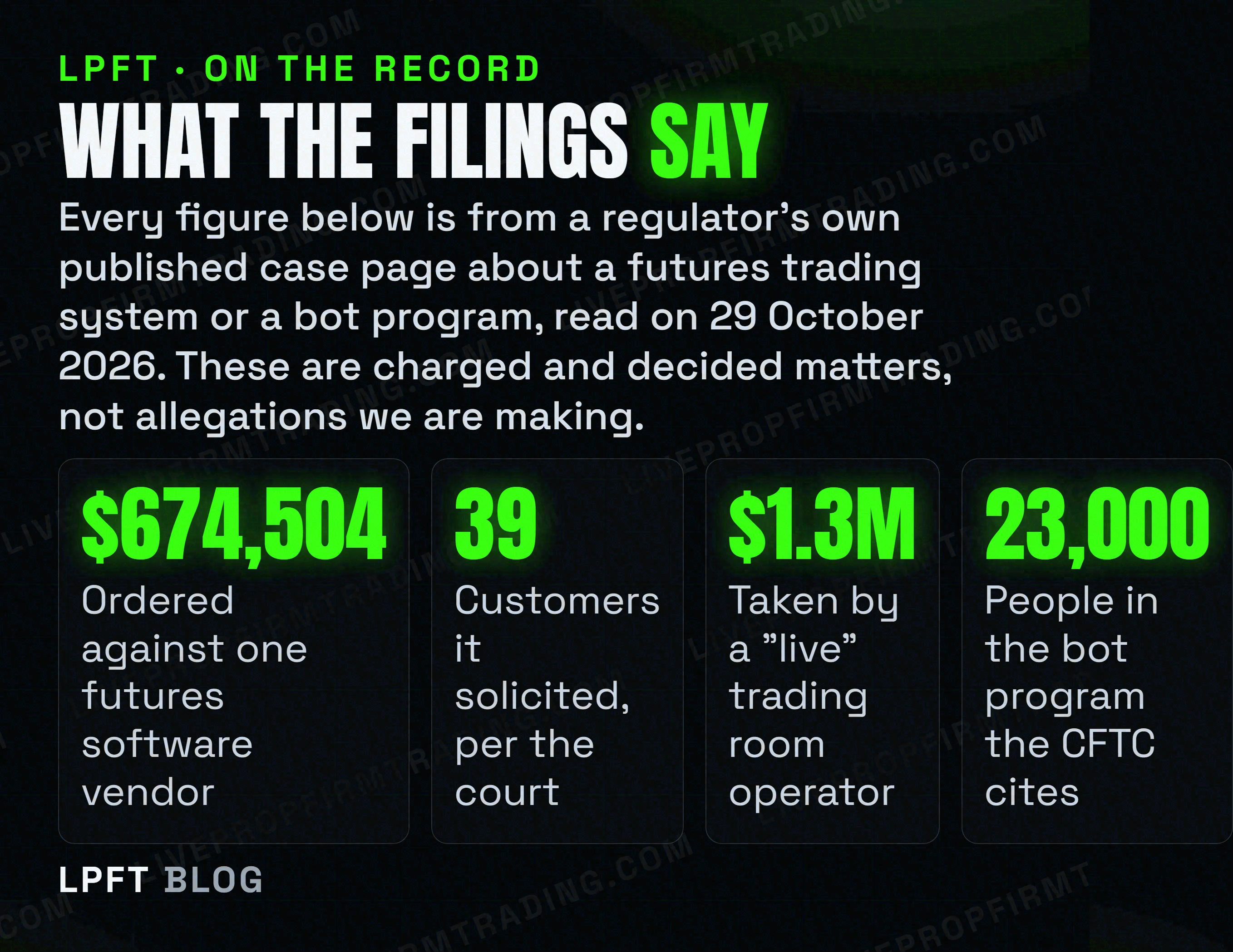
The second case is the same lie wearing a different costume. FuturesFX and Simon Jousef sold access to what was marketed as a live foreign exchange and commodity futures trading room, with videos and support, between 1 July 2014 and 31 January 2016, taking roughly $1.3 million from over 300 members at subscriptions of up to $9,000. The CFTC alleged that he claimed to be trading in a "live trading room," when he "only made hypothetical or simulated trades," and that he failed to disclose that results were "hypothetical or simulated."
So the test is not whether a seller shows you simulated results. Simulated results are normal, legitimate and often the only thing a new system has. The test is whether they are labelled as what they are.
How to test lie one in about thirty seconds
There is a rule that makes this fast, and we read it in full on the electronic Code of Federal Regulations on 29 October 2026, with the page stating it was current as of 27 October 2026. Under 17 CFR 4.41(b)(1), simulated or hypothetical performance has to be accompanied by a prescribed statement that begins, verbatim: "These results are based on simulated or hypothetical performance results that have certain inherent limitations. Unlike the results shown in an actual performance record, these results do not represent actual trading."
The part to actually use is paragraph (b)(2), verbatim: "If the presentation of such simulated or hypothetical performance is other than oral, the prescribed statement must be prominently disclosed and in immediate proximity to the simulated or hypothetical performance being presented." Immediate proximity. Beside the chart, not at the bottom of the page under the cookie notice.
And paragraph (c)(2) removes the standard excuse, verbatim, by applying the section "Regardless of whether the commodity pool operator or commodity trading advisor is exempt from registration under the Act." The rule also reaches internet material explicitly. So a seller cannot wave it away on the grounds that they are a small operation or an exempt one.
Paragraph (b)(1)(ii) permits an alternative statement prescribed by a registered futures association, and we have not read that alternative. So the all-caps version you will see on many sites may be perfectly correct. Check whether a statement is there and whether it sits next to the numbers. Do not conclude from wording that a named company has broken a rule, because you cannot know that from the outside and neither can we.
Lie two: a claim about who the seller is
In the FuturesFX matter the CFTC also alleged that Jousef falsely stated he was "registered with the CFTC as a commodity trading advisor (CTA)" when he was not. In the TradeMasters matter the finding was the reverse shape: they "executed trades for three customers despite TradeMasters and Schacke not obtaining the required registrations." One lied about having standing, the other acted as though standing was not required.
Both are checkable against a free database. The National Futures Association runs BASIC, which it describes as "a free tool that NFA Members and investors can use to research the background of derivatives industry professionals," searchable by firm name, identifier, last name and pool name. The CFTC's own check page, read the same day, instructs the public verbatim: "Before working with any person or firm to trade in commodity futures, commodity pools, options, forex, or other derivatives, verify that the entity is properly registered with the CFTC." It also names a Registration Deficiency list aimed at "unregistered entities making false registration claims."
Now the caveat, which is the regulator's own and is the reason this is a filter rather than a verdict. Verbatim: "While registration and a clean disciplinary record won't protect you from fraud, most scams involve unregistered entities, people, and products." An absent registration is not proof of anything, because whether one is required depends on what the seller is doing. What you are hunting is the mismatch between the claim on the page and the record in the database.
If the question underneath yours is whether this corner of the market is regulated at all, we went through what actually is and is not covered in are prop firms legal, and the related question of who counts as an advisor in is copy trading legal.
The AI version is the same pitch with a new noun
The regulator has published an advisory specifically about this, titled so plainly that it barely needs summarising: AI Won't Turn Trading Bots into Money Machines. Read on 29 October 2026, it opens by describing how "Fraudsters are exploiting public interest in artificial intelligence (AI) to tout automated trading algorithms, trade signal strategies, and crypto-asset trading schemes" whose promised returns it calls, verbatim, "unreasonably high or guaranteed." And then, flatly: "AI technology can't predict the future or sudden market changes."
Its worked example is the largest of its kind. The advisory describes Cornelius Johannes Steynberg and Mirror Trading International taking more than $1.7 billion in bitcoin from at least 23,000 people, on a bot program guaranteeing "at least a 10 percent monthly return (or more than 200 percent per year)" with "no trading experience required," for as little as $100. It was a Ponzi scheme, where some money from new investors paid older ones.
Two things in that sentence are worth separating. A fixed monthly figure is the tell, not the size of it. And "no trading experience required" is doing as much work as the number, because the promise being made is that you will not need to understand what you own. The advisory's own suggestions include a reverse image search on the people, checking the age of the website's domain registration at lookup.icann.org, getting a second opinion, understanding the fees, and reporting what you find.
It is also worth saying plainly that a bot being automated has nothing to do with any of this. The mechanics of ordinary automation are dull and public, which is rather the point, and we walked through them in how trading bots work and do automated trading bots work.
The red flags worth your attention, and the ones that are just texture
Sorted by whether you can actually verify them. The top four map onto a charged case or a published rule. The bottom four are the ones that fill most articles on this topic, and they are not useless, they are just weak evidence that a careful fraudster will pass easily.
| Signal | How strong | What to do about it |
|---|---|---|
| Performance shown with no hypothetical statement beside it | Strong, rule-based | Look for the statement in immediate proximity to the chart |
| A claimed registration the database does not show | Strong, charged in a case | Search NFA BASIC by firm and by the person's surname |
| A fixed monthly figure, or any promise of a set outcome | Strong, named in the advisory | Treat the number as the warning regardless of its size |
| Testimonials with none of the three required disclosures | Moderate to strong | Check for all three, and remember one case involved paid actors |
| No written statement of what the system will not do | Moderate, and rarely discussed | Ask for it in writing before paying |
| Pressure, countdowns and limited slots | Weak on its own | Note it, but never let its absence reassure you |
| Spelling and grammar, or a suspicious photo | Weak and easily fixed | Useful only alongside one of the strong signals |
The reason the ordering matters is that the weak signals are the ones a competent operation will never trip. A polished site with a real founder, clean copy and no countdown can still be showing you a backtest it has labelled as a track record, which is exactly the arrangement the first case above describes.
Now point every one of these at us
A post like this is worthless if the author quietly exempts themselves, so here is our own card, and the weaknesses go first. We are a monthly subscription, which means the billing continues whether or not you are getting value from it that month. We sell a system you install and run on your own account, so the setup is real work and some people will decide it is not worth theirs. We have a strong commercial interest in you subscribing, which is a reason to check us rather than trust us. And we cannot tell you what it will return, because that is not a thing anyone can honestly say.
Against the four strong signals. Any performance material we publish is labelled with what produced it, and our own product rule is that a trade only counts when the broker executed it, which is a deliberately uncomfortable standard. Eli is a named person with a face and a public channel rather than a stock photo. We never take custody of your money and never pool it, because you trade your own account through your own broker or funding firm. And the limits are written down, including the session windows and the daily loss cap at which it stops on purpose.
None of that is a reason to believe us about returns. It is a reason to believe that the numbers we show are the numbers we got, which is a much smaller claim and the only one worth making. If you want the structured version of the same interrogation applied to anybody, it is in how to vet an automated futures trading service, and the honest case against buying anything in this category at all is in is automated trading worth it.
Futures trading carries a substantial risk of loss, and a seller passing every test on this page changes nothing about that. Avoiding fraud and making money are two separate problems, and this article only helps with the first one. Test anything you buy in simulation first, as covered in paper trading versus live bot testing, and if you believe you have encountered one of the patterns above, the CFTC and the FBI both take reports.
The LPFT Copilot runs the whole stack for you on Tradovate - start a 7-day free trial and watch it work.
Start your 7-day free trialFrequently asked questions
Performance figures presented as real trading when the trades never happened. In a CFTC case against TradeMasters USA and Mirko Schacke, the court found that "trading results presented as actual trading profits, in fact, were only hypothetical." In a second case the CFTC alleged a seller claimed to trade in a live trading room when he "only made hypothetical or simulated trades." This single signal survives every other check, because a site can be polished, old and well written and still do it.
Search the National Futures Association's BASIC database at nfa.futures.org, which NFA describes as a free tool for researching the background of derivatives industry professionals, by firm name, identifier, last name or pool name. The CFTC's check page instructs the public to verify registration before working with any person or firm trading futures, options or forex, and names a Registration Deficiency list for unregistered entities making false registration claims.
No, and the regulator says so in its own words. The CFTC states that "While registration and a clean disciplinary record won't protect you from fraud, most scams involve unregistered entities, people, and products." Treat it as a filter rather than a verdict. The signal with real weight is a mismatch, meaning a seller claiming a registration that the database does not show, which is what was alleged in one of the CFTC cases.
Automation itself is ordinary, but the CFTC has published an advisory titled AI Won't Turn Trading Bots into Money Machines, which warns that "Fraudsters are exploiting public interest in artificial intelligence (AI) to tout automated trading algorithms, trade signal strategies, and crypto-asset trading schemes" whose promised returns it describes as "unreasonably high or guaranteed," and states flatly that "AI technology can't predict the future or sudden market changes." Judge the promise being made, not the technology label attached to it.
In two published matters the charges centred on description rather than code. TradeMasters USA and Mirko Schacke sold automated futures software for between $1,500 and $20,000, and the court found they fraudulently solicited $168,626 from 39 customers, used paid actors in testimonials presented as real customers, and presented hypothetical results as actual profits. The total ordered was $674,504. FuturesFX and Simon Jousef took around $1.3 million from over 300 members of a supposedly live trading room.
Not by itself, because a new system may have nothing else, and simulated results are legitimate when labelled. The red flag is the labelling. 17 CFR 4.41(b)(2) requires that for non-oral presentations the prescribed hypothetical-performance statement "must be prominently disclosed and in immediate proximity to the simulated or hypothetical performance being presented," and the rule applies regardless of whether the seller is exempt from registration. A footer disclaimer far from the chart is a different thing from one beside it.
Eli Y.
Eli builds and runs rules-based automated futures systems on NinjaTrader and Tradovate, and helps traders take emotion out of the screen. He writes about futures automation, prop-firm evaluations, and the tools that connect them - plainly, and without hype.
Risk disclosure: Trading futures involves substantial risk of loss and is not suitable for everyone. This article is educational content only and is not financial advice or a recommendation to trade. Past performance is not indicative of future results. Some links are affiliate links.