
Best Futures to Trade for Beginners: Micro Is a Ratio, Not a Size

Heads up: some links below are affiliate links. If you sign up through them we may earn a commission at no extra cost to you - it never changes what we recommend.
There is no single best futures contract for a beginner, and the word micro does not identify the small ones. CME prices two of its six Micro E-minis at $10 an index point against the S&P micro's $5. Judge a contract by tick value times your stop distance.
Picking a small contract limits the size of a mistake and does nothing about how often you make one. The LPFT Copilot runs a tested, rules-based method on your own prop firm or Tradovate account, with a daily loss cap and a trading window built in rather than remembered. Start a 7-day free trial.
Start your 7-day free trialThe advice everyone gives, and the word it rests on
Every result on this search arrives at the same recommendation. Start with micro futures, trade one contract, pick one market. It is sensible advice and we are not going to argue with the shape of it.
The problem is the word doing the work. Micro gets used as though it were a size category, and on the exchange that lists these contracts it is not. It is a ratio to a bigger sibling, and once you read the exchange's own table you can see the two things come apart.
CME says the ratio part itself. Its Micro E-mini FAQ describes the suite as having "multipliers 1/10 the size of their E-mini counterparts (i.e., $5 multiplier for Micro E-mini S&P 500 futures contract vs. $50 for ES futures)." One tenth of its own sibling. That is a relationship between two contracts, not a statement about dollars.
Which matters because the siblings are not the same size to begin with. One tenth of a large thing can be bigger than one tenth of a small thing, and in this family it is.
Six micros, and two of them cost double the one everybody recommends
First, there are six, not the four that most articles list. CME's own answer to what is listed names "Micro E-mini S&P 500 futures, Micro E-mini Nasdaq-100 futures, Micro E-mini Dow futures, Micro E-mini Russell 2000 futures, Micro E-mini S&P MidCap 400 futures" and "Micro E-mini S&P SmallCap 600 futures". Not one result we read on this search names the last two.
Now the multipliers, straight from the exchange's table, read on 10 November 2026:
| Index family | Micro multiplier | E-mini multiplier |
|---|---|---|
| S&P 500 | $5 | $50 |
| Nasdaq-100 | $2 | $20 |
| Dow Jones | $0.50 | $5 |
| Russell 2000 | $5 | $50 |
| S&P MidCap 400 | $10 | $100 |
| S&P SmallCap 600 | $10 | $100 |
There it is. The MidCap 400 and SmallCap 600 micros are ten dollars an index point. That is double the five dollars on the Micro E-mini S&P 500, the contract that gets recommended as the gentle starting point, and twenty times the fifty cents on the Dow micro. All six are called micro. They are not one size.
Each is faithfully one tenth of its own big brother, so CME's description is exactly right. It just does not mean what a beginner reasonably takes it to mean.
A multiplier does not tell you what a tick costs. The S&P micro and the Russell micro share the same $5 multiplier and have different tick values, because their tick SIZES differ. CME prints the S&P row as "0.25 Index points= $1.25" and the Russell row as "0.10 Index points= $0.50". Same dollars per point, and the smallest possible loss on one is more than double the other. Neither number predicts the other, so you have to read both.
The exchange publishes a notional column, and it dates it
This is the part that settles the argument, and we had been quoting CME's table without its middle column until this pass. The full table carries a notional value for each micro, and the column heading on the exchange's own page reads "Micro E-mini Notional Value (as of Feb 1, 2023)."
CME dated it because a notional value is a market observation that goes stale, unlike a multiplier. So the figures below are the exchange's, carrying the exchange's own label, and they are emphatically not current numbers. What survives the staleness is the ORDER, and the order is the point.
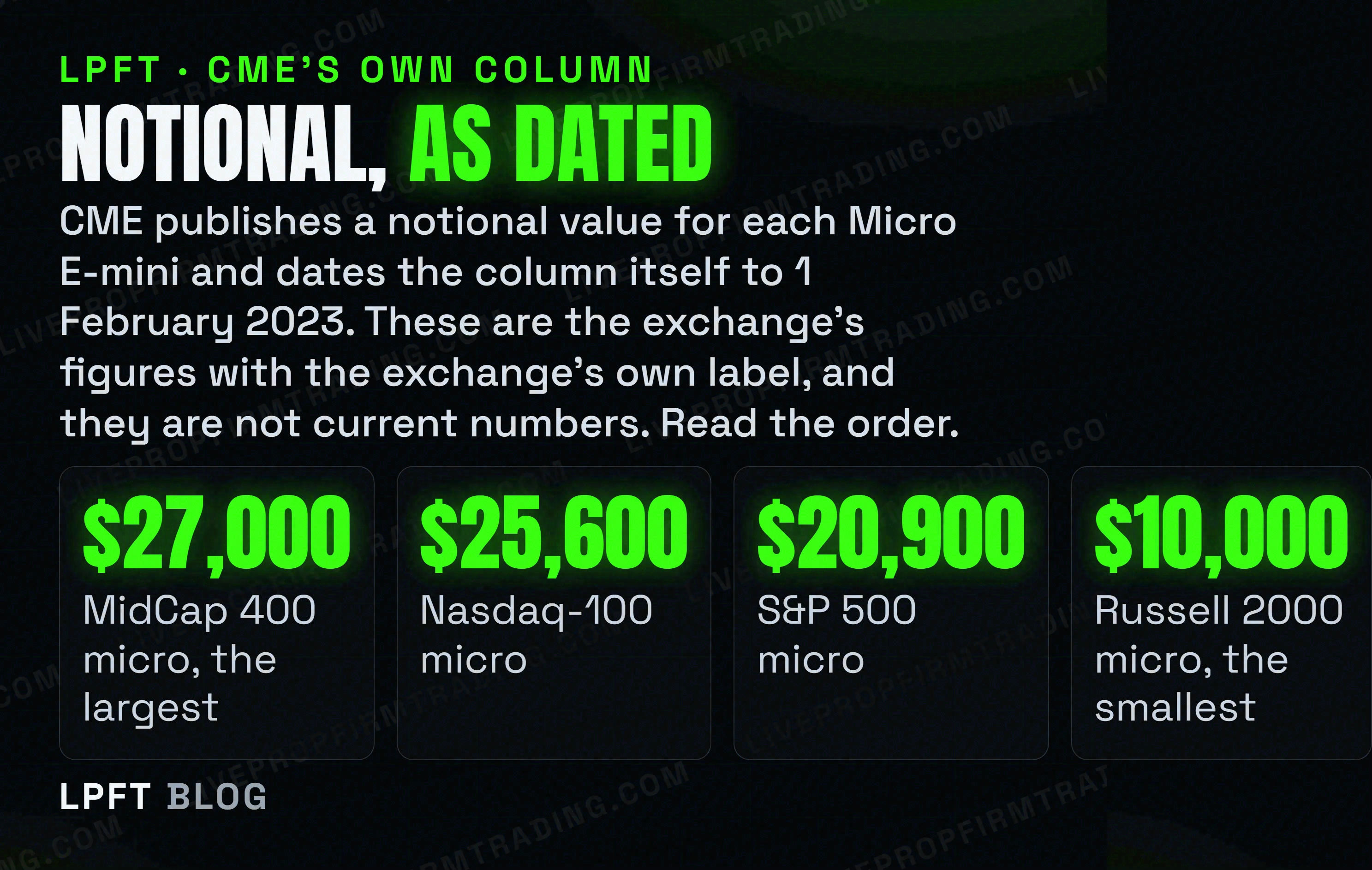
On the exchange's own dated column, the Nasdaq-100 micro at $25,600 controlled more notional than the S&P 500 micro at $20,900, and the MidCap 400 micro at $27,000 controlled more than either. The smallest of the six was the Russell 2000 micro at $10,000, and the Dow micro at $17,000 sat between them.
Hold that against the standard advice. MNQ gets recommended to beginners constantly, frequently on the grounds that its fifty-cent tick makes mistakes cheap. The tick IS cheaper. The contract was also carrying more notional exposure than the MES everybody calls the conservative choice. Both of those are true at once, and only one of them usually gets mentioned.
The deeper version of this comparison, contract by contract, is in MES vs MNQ, the whole family is in micro futures explained, and the unit arithmetic everything here depends on is in tick size and tick value.
Two more things the spec sheet will not tell a beginner
Both of these came out of reading the exchange's pages rather than the advice pages, and both affect a first contract choice.
- Outside the equity indices, the per-point cost may not be published at all. Micro Gold and Micro WTI Crude Oil both describe themselves by RATIO on their own CME pages, at "1/10 the size of benchmark" contracts, and neither states a dollar multiplier or a tick value there. Those two get recommended for beginners regularly. You cannot do the arithmetic in this article on them from those pages, which is worth knowing before you pick one.
- One of the six lists on a different exchange. Five Micro E-minis list under CME and the Micro E-mini Dow lists under CBOT. That matters because CME's clearing fees page offers separate schedules with separate effective dates for CME and CBOT, so two contracts in the same family read from different fee schedules. The Dow micro also lists four contract months where the others list five.
And a cost line that applies to every one of them and appears on none of the beginner guides we read. The NFA assessment fee, from NFA's own page re-read on 10 November 2026, is "$.01 per side, invoiced to customers" for futures, and that same page states it "will be $.02 per side" effective 1 July 2027. A published, dated doubling of a cost line.
It is a cent. The reason to know it is that both broker pricing pages we read carry the same sentence under their headline commission, that "Exchange, clearing, and NFA fees apply", and both then link separately to all-in rates. The vendor is telling you the headline is not the total. A beginner comparing contracts on commission alone is comparing the part that was advertised. The full stack is in how much it costs to trade micro futures.
Whichever contract you start on, something has to carry the order to the broker. TradersPost publishes which broker connections it supports and states that following your own firm's rules is your responsibility, which is the right division of labour. Free 7-day trial.
See TradersPostThe question that actually picks your first contract
Not which contract is best. Which contract makes your smallest unit of loss small relative to the account, on the rules you actually intend to trade. That is one multiplication and it beats every ranked list, including a ranked list we could write.
- Measure your stop in index points. Off your own chart, on the hours you intend to trade. Not in ticks and not in dollars.
- Convert it with the published tick value. The exchange gives you the tick size and the tick value for every Micro E-mini. Stop distance divided by tick size, times tick value, is dollars at risk per contract.
- Hold that against your daily loss limit. If one stop eats a serious slice of the limit, the contract is too large for the account, whatever the word in front of its name.
- Redo it when anything moves. A new stop distance, a different account size or a rollover into a different contract all change the answer, and a number calculated once and left in a config file was right on a day that has passed.
Run that on the six micros and the ranking falls out of your own numbers rather than somebody's opinion. It will usually point at a cheap tick, which is why the common advice is directionally fine. It will occasionally point somewhere surprising, and the surprise is the whole value of doing it.
You will read that one contract has the deepest liquidity, the tightest spreads and the cleanest order flow. We read no liquidity, spread or volume report on any exchange or broker page in any research pass, so no claim of that kind appears here. The same goes for the margin figures and starting balances on this search: CME answers the margin question with "Margins are based on current market conditions and, thus, are subject to change" and gives links rather than a number.
If you have no tested rules yet, the contract is the wrong thing to be agonising over, because it is the cheapest decision to change later. Start with automated futures trading for beginners, prove the rules without money using paper trading versus live bot testing, and work out what the account needs to carry in how much money you need for automated futures trading.
Two more things worth reading before a first trade rather than after. The contract specifications for the most-recommended index are in what is an NQ future, and the hours question, which catches beginners harder than the contract question does, is in overnight versus regular trading hours. If a funded account is the plan, what you are allowed to trade on one is in prop firm instruments.
Futures trading carries a substantial risk of loss, and a smaller contract reduces the size of a mistake without changing how often you make one. Nothing on this page is advice about what to trade or how much. It is the exchange's own specifications and the one multiplication that turns them into a number about your account.
The LPFT Copilot runs the whole stack for you on Tradovate - start a 7-day free trial and watch it work.
Start your 7-day free trialFrequently asked questions
There is no single answer, and the usual one rests on a misreading. The common advice is to start with Micro E-minis, which is directionally reasonable, but the word micro describes a ratio rather than a size. CME states the suite has "multipliers 1/10 the size of their E-mini counterparts," and because the siblings differ, the micros differ: $0.50 an index point on the Dow micro, $5 on the S&P 500 micro, and $10 on both the MidCap 400 and SmallCap 600 micros. The right contract is the one whose tick value times your stop distance is small against your account.
It means one tenth of that contract's own E-mini sibling, which is not the same thing. CME lists six Micro E-minis, and two of them, the S&P MidCap 400 and S&P SmallCap 600 micros, carry a $10 multiplier against the Micro E-mini S&P 500's $5. On CME's own notional column, which the exchange dates to 1 February 2023, the MidCap micro showed $27,000 and the Nasdaq micro $25,600 against the S&P micro's $20,900. So the word identifies a relationship, not a size.
Of the six Micro E-minis, CME publishes the Nasdaq-100, Dow and Russell 2000 rows all at $0.50 per outright tick, with the S&P 500 micro at $1.25 and the MidCap 400 and SmallCap 600 micros at $1.00. The important subtlety is that tick value does not follow the multiplier. The S&P micro and the Russell micro share a $5 multiplier and differ on tick value, because their tick sizes are 0.25 and 0.10 index points respectively. You have to read both numbers for any contract you are considering.
Measure your stop distance in index points off your own chart, divide by the contract's tick size, multiply by its tick value, and compare the result to your daily loss limit. If a single stop takes a serious portion of the limit, the contract is too large for the account regardless of its name. Both inputs from the exchange are stable specifications, and the stop distance is the one nobody else can supply, which is why no article can honestly rank contracts for you.
We cannot answer that from their own pages, which is itself worth knowing. Both CME product pages describe the contracts by ratio, at "1/10 the size of benchmark" Gold and WTI Crude Oil contracts respectively, and neither states a dollar multiplier or a tick value. So the arithmetic that lets you compare a Micro E-mini against your account cannot be done on those two from what the exchange publishes there. They are recommended often on this search. The per-point cost is not in the recommendation.
At minimum the fee lines the broker tells you about separately. Both broker pricing pages we read state under their headline commission that "Exchange, clearing, and NFA fees apply," and both link onward to all-in rates, so the advertised figure is not the total by the vendor's own admission. The NFA assessment fee is "$.01 per side, invoiced to customers" and NFA's page states it "will be $.02 per side" effective 1 July 2027. Exchange fees have no single number: CME says they vary by membership status, product, volume, venue and transaction type.
Eli Y.
Eli builds and runs rules-based automated futures systems on NinjaTrader and Tradovate, and helps traders take emotion out of the screen. He writes about futures automation, prop-firm evaluations, and the tools that connect them - plainly, and without hype.
Risk disclosure: Trading futures involves substantial risk of loss and is not suitable for everyone. This article is educational content only and is not financial advice or a recommendation to trade. Past performance is not indicative of future results. Some links are affiliate links.